Lecture 23: The Birth of Particle Cosmology
TL;DR
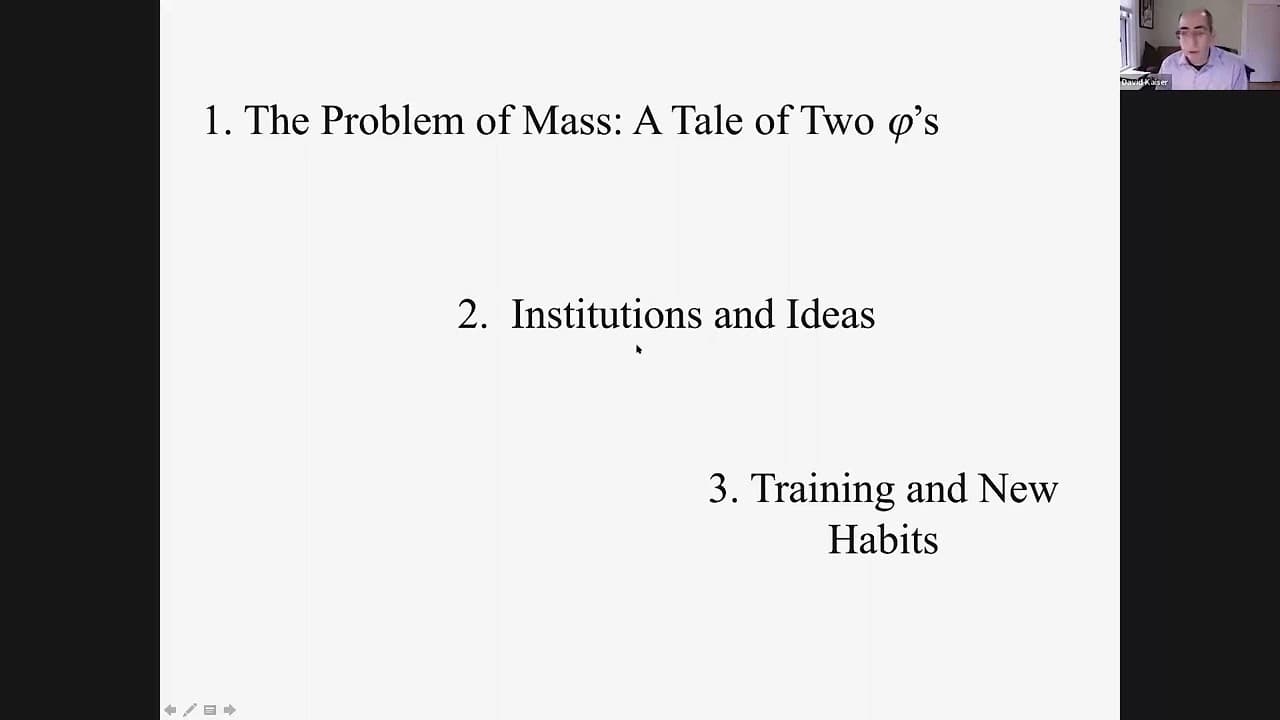
Particle cosmology, the study of the smallest units of matter and their role in shaping the universe, emerged as a new field as a result of changes in ideas and the crumbling job prospects in particle physics.
Transcript
[SQUEAKING] [RUSTLING] [CLICKING] DAVID KAISER: So today we're going to be talking about the kind of invention or the hybridization of a whole new subfield within physics that now is often called particle cosmology. It happens to be the field where I spend a lot of my time. I think it's just fantastic. But it's actually a fairly new invention. This... Read More
Key Insights
- 🏑 Particle cosmology is a flourishing field of study that explores the intersection of particle physics and cosmology, examining the role of elementary particles in shaping the universe.
- 🧑🏭 The emergence of particle cosmology can be attributed to various factors, including changes in ideas, institutions, and job prospects in particle physics.
- 💖 The introduction of concepts like asymptotic freedom and grand unified theories sparked interest in exploring the high-energy physics of the early universe.
- 🥺 Changes in the field of physics, including a decrease in funding and job opportunities, led to the broadening of training for young physicists and the incorporation of gravitation and cosmology into their coursework.
Install to Summarize YouTube Videos and Get Transcripts
Explore YouTube Video Summarizer or Get YouTube Transcript Extractor
Questions & Answers
Q: What is particle cosmology?
Particle cosmology is a branch of physics that studies the smallest particles of matter and their impact on the universe, particularly how they shape the evolution of the cosmos from the Big Bang to the present.
Q: What factors contributed to the emergence of particle cosmology?
The emergence of particle cosmology can be attributed to changes in ideas, institutions, and training, as well as the decline in job prospects in particle physics. These factors created an opportunity for physicists to explore the interface between particle theory and cosmology.
Q: How did changes in the field of physics affect job prospects in particle physics?
The field of particle physics experienced a sharp decrease in funding and job opportunities in the 1970s, leading to a crisis in the discipline. Many physicists specialized in particle theory were forced to broaden their training and explore other subfields, such as gravitation and cosmology, due to limited job prospects in their area of expertise.
Q: What is asymptotic freedom and how does it relate to particle cosmology?
Asymptotic freedom refers to the property of the strong nuclear force, also known as quantum chromodynamics (QCD), where the strength of the force decreases as the energy scale increases. This concept, proposed by Frank Wilczek, David Gross, and David Politzer in 1973, suggested that at very high energies, the quarks and gluons that make up matter would behave as if they were free from strong interactions. This idea played a role in motivating the study of high-energy cosmological processes.
Summary & Key Takeaways
-
Particle cosmology, the study of the smallest constituents of matter and their impact on the fate of the universe, is a recent invention in the field of physics.
-
The emergence of particle cosmology can be attributed to changes in ideas, institutions, and training, as well as the decline of job prospects in particle physics.
-
The fields of gravitation and particle theory were once separate, but they began to overlap in the mid-1970s due to the introduction of new theoretical ideas, such as asymptotic freedom and grand unified theories.
-
Changes in the field of physics, including the decrease in funding and job opportunities in particle physics, led to the broadening of training for young physicists and the incorporation of gravitation and cosmology into their coursework.
Read in Other Languages (beta)
Share This Summary 📚
Summarize YouTube Videos and Get Video Transcripts with 1-Click
Try YouTube Summary with ChatGPT & Claude or YouTube Transcript Generator
Explore More Summaries from MIT OpenCourseWare 📚


Summarize YouTube Videos and Get Video Transcripts with 1-Click
Try YouTube Summary with ChatGPT & Claude or YouTube Transcript Generator