How to Use Multiplication by t Property in Laplace Transforms
TL;DR
To find the Laplace transform of a function using the multiplication by t property, first expand the function into a manageable form. Apply relevant properties, such as linearity, first shifting, and the multiplication by t property, to simplify the calculation of the Laplace transform for individual terms.
Transcript
hi friends so after finishing two numericals on multiplication by t property let's move to the next numerical on multiplication by t property so your the difficulty level will be higher than the previous numerical so let's start let's see how to apply the property in the numerical and get the answer so let's start so here we have to find out the la... Read More
Key Insights
- ❓ Expanding a function using algebraic formulas can simplify the process of finding the Laplace transform.
- ❓ Various properties, such as the Laplace transform of t^n and the first shifting property, are crucial in simplifying the Laplace transform of complex functions.
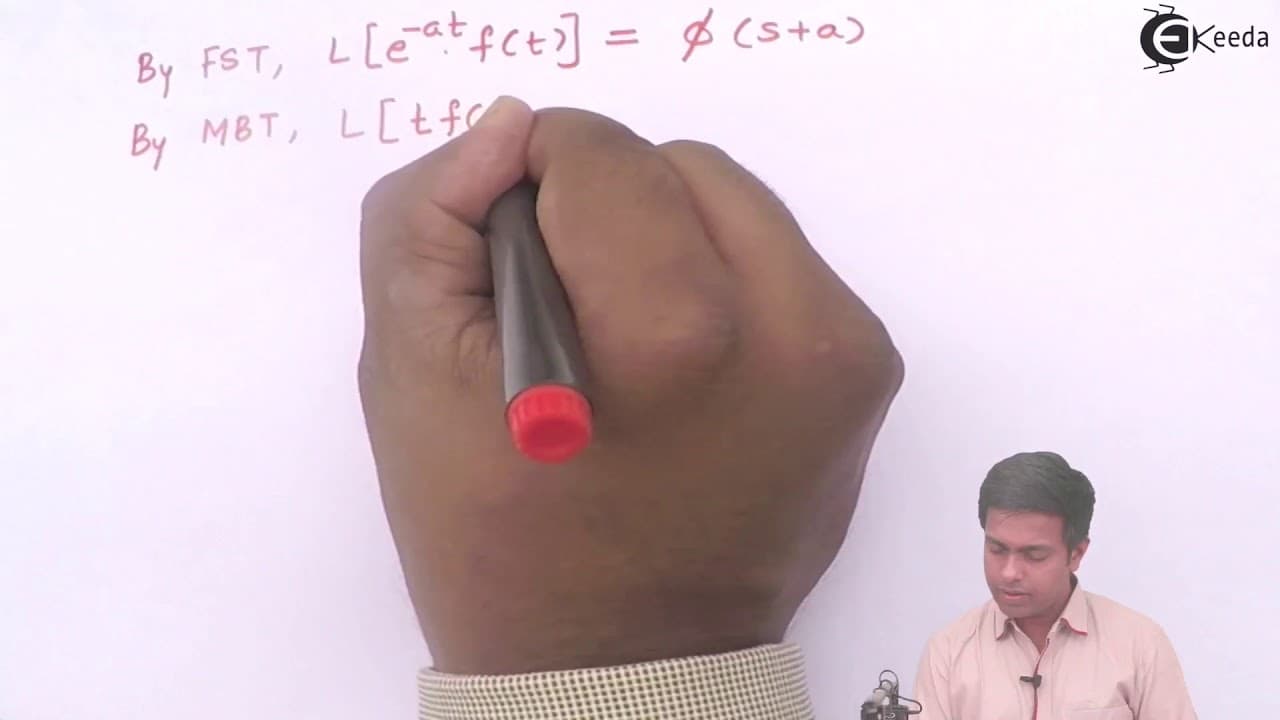
- 💁 The multiplication by t property allows for the transformation of a function in the form t*f(t) into a more manageable form for finding the Laplace transform.
- ❓ Substituting values obtained through the first shifting property enables further simplifications in the Laplace transform.
Install to Summarize YouTube Videos and Get Transcripts
Explore YouTube Video Summarizer or Get YouTube Transcript Extractor
Questions & Answers
Q: What is the purpose of expanding the given function before finding the Laplace transform?
Expanding the function allows us to apply the multiplication by t property, which requires the function to be in the form t*f(t). By expanding, we can identify the necessary terms to use this property effectively.
Q: How is the Laplace transform of t^2 calculated?
The Laplace transform of t^2 follows the property laplace(t^n) = n!/s^(n+1), where n is the power of t. In this case, t^2 gives us (2!)/(s^3).
Q: What are the properties used to simplify the Laplace transform in this numerical analysis?
The properties used include the Laplace transform of e^(-at), the first shifting property (phi(s-a) = phi(s) + e^(-as)f(t)), and the multiplication by t property (laplace(t*f(t)) = -d/ds(phi(s))).
Q: Why are phi1(s+1) and phi2(s+1) necessary in finding the final Laplace transform?
Phi1(s+1) and phi2(s+1) are obtained by applying the first shifting property, allowing us to simplify the Laplace transform further. These substituted values provide the necessary substitutions to find the final Laplace transform.
Summary & Key Takeaways
-
The video tutorial demonstrates the process of finding the Laplace transform of a function using the multiplication by t property.
-
The function in question is t + e^-t + sin^2(t), which can be expanded using the algebraic formula (a+b+c)^2 to simplify the Laplace transform.
-
The Laplace transform is found by applying various properties, including the Laplace transform of t^2 and e^(-at), as well as the first shifting property and the multiplication by t property.
Read in Other Languages (beta)
Share This Summary 📚
Summarize YouTube Videos and Get Video Transcripts with 1-Click
Try YouTube Summary with ChatGPT & Claude or YouTube Transcript Generator
Explore More Summaries from Ekeeda 📚



Summarize YouTube Videos and Get Video Transcripts with 1-Click
Try YouTube Summary with ChatGPT & Claude or YouTube Transcript Generator