10 Best YouTube Videos on How to Learn Faster

Sep 15, 2026
16 min read
62 views
Last updated: September 2026
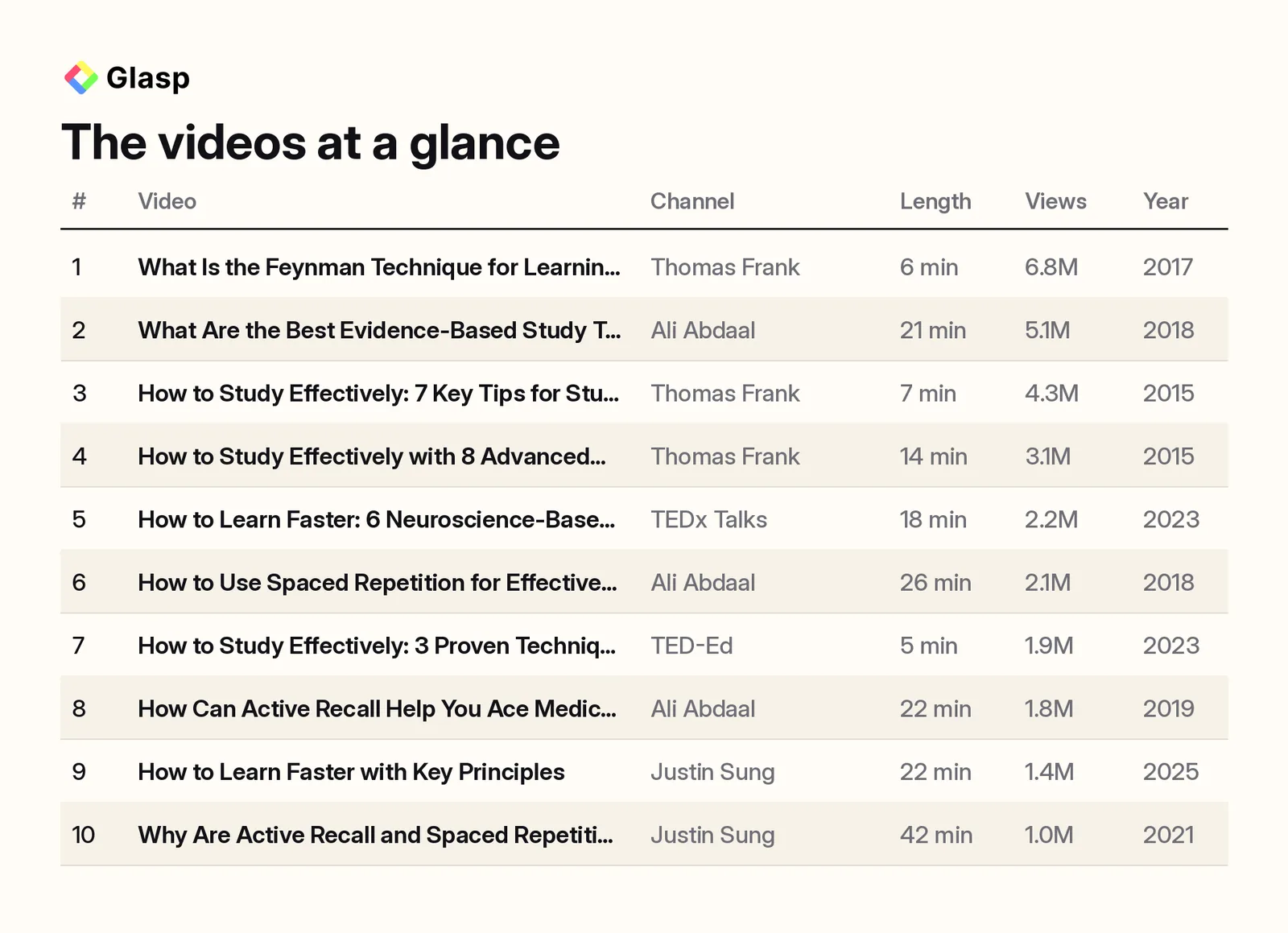
This is a ten-video sequence about learning faster, ordered as a path rather than a ranking. It is for students and other learners who want to replace passive review with methods that improve understanding and retention.
The full set runs just over three hours. Its enduring entries include Thomas Frank on the Feynman Technique and effective study routines, and Ali Abdaal on evidence-based active recall.
The videos on this list, in the order to watch them, are:
What Is the Feynman Technique for Learning Faster? (Thomas Frank)
What Are the Best Evidence-Based Study Techniques? (Ali Abdaal)
How to Study Effectively: 7 Key Tips for Students (Thomas Frank)
How to Study Effectively with 8 Advanced Techniques (Thomas Frank)
How to Learn Faster: 6 Neuroscience-Based Tips (TEDx Talks)
How to Use Spaced Repetition for Effective Studying (Ali Abdaal)
How Can Active Recall Help You Ace Medical School Exams? (Ali Abdaal)
How to Learn Faster with Key Principles (Justin Sung)
Why Are Active Recall and Spaced Repetition Less Effective Than Thought? (Justin Sung)
Total: 10 videos, 183 minutes of watch time (3 hours 3 minutes), and 29.7M combined views.
1. What Is the Feynman Technique for Learning Faster?
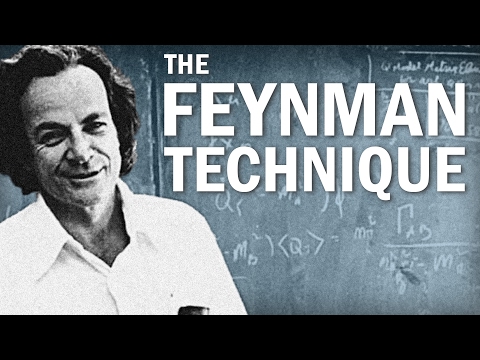
"How to Learn Faster with the Feynman Technique (Example Included)" · Thomas Frank · 6 min · 6.8M views · 2017
In short: Explaining a concept in simple language as if teaching it to someone else exposes gaps and deepens your understanding.
Start here because the Feynman Technique gives the sequence a simple test for whether learning has actually happened. Thomas Frank presents it as a step-by-step process: explain a concept to someone else in plain language, notice where the explanation breaks down, and return to those weak areas. The method challenges assumptions that can remain hidden when you only reread material, and it applies beyond math and science.
The technique is named after Richard Feynman, a physicist known both for his scientific work and for explaining complex ideas clearly. Its practical force comes from removing technical language and asking how you would teach the idea to a child. The source also applies the method to subjects such as history, language, and web development, showing that the act of explanation is a general test of knowledge rather than a subject-specific trick.
Key takeaways
The Feynman Technique asks you to explain a concept in simple language as if you were teaching someone else.
Gaps and untested assumptions become easier to find when your explanation breaks down.
Replacing technical terms with simpler language can deepen your understanding of a concept.
The method can be applied to any subject, including history, language, and web development.
Watch on YouTube · Read the summary and Q&A
2. What Are the Best Evidence-Based Study Techniques?

"How to study for exams - Evidence-based revision tips" · Ali Abdaal · 21 min · 5.1M views · 2018
In short: Active recall improves long-term retention by making you retrieve information instead of passively rereading, highlighting, or summarizing it.
After testing understanding through explanation, move to the broader evidence for retrieval practice. Ali Abdaal contrasts active recall with rereading, highlighting, and summarizing, three familiar methods that research rates as less effective or more demanding to use well. Active recall requires you to retrieve information from memory, strengthening the connections behind retention and understanding rather than relying on the feeling that familiar material has been learned.
The video turns that principle into three usable approaches: make flashcards in Anki, write notes with the book closed, or create questions that force you to supply the answers. Anki adds spaced repetition by changing when a card returns according to its difficulty. The evidence discussed in the video consistently rates practice testing as high utility, while rereading is low utility, highlighting is often unhelpful for higher-level tasks, and effective summarizing requires extensive training.
Key takeaways
Rereading, highlighting, and summarizing have limited effectiveness compared with active recall.
Active recall strengthens memory by requiring you to retrieve information rather than look at it again.
Flashcards, closed-book notes, and self-generated questions are practical forms of active recall.
Practice testing has high utility and should be part of a study routine.
Watch on YouTube · Read the summary and Q&A
3. How to Study Effectively: 7 Key Tips for Students

"Study Less Study Smart: A 6-Minute Summary of Marty Lobdell's Lecture - College Info Geek" · Thomas Frank · 7 min · 4.3M views · 2015
In short: Short focused sessions, active engagement, effective notes, teaching, strategic textbook use, and mnemonics make study time more productive.
This comes third because it turns the first two principles into a complete study routine. Thomas Frank condenses Marty Lobdell's longer lecture into seven practical ideas, beginning with shorter sessions and a dedicated study area. The video then connects active learning to note-taking, teaching, textbook use, and memorization, giving students a structure for deciding not only how to retrieve information but also where and when to work with it.
The clearest recommendation is to study in focused chunks of 20 to 30 minutes, separated by 5-minute breaks that help maintain attention and prevent fatigue. A designated study area gives the brain a consistent context for focused work. After class, effective notes and clarification can solidify understanding, while surveying a textbook chapter before reading and reviewing its end-of-chapter questions helps direct attention toward the important material. Acronyms, coined sayings, and image associations can support fact memorization.
Key takeaways
Study in focused sessions of 20 to 30 minutes with 5-minute breaks.
A dedicated study area can reduce distractions and create a context associated with focused work.
Summarizing or teaching material reinforces knowledge and reveals gaps in understanding.
Surveying chapters and using mnemonics can make reading and memorization more deliberate.
Watch on YouTube · Read the summary and Q&A
4. How to Study Effectively with 8 Advanced Techniques

"How to Study Effectively: 8 Advanced Tips - College Info Geek" · Thomas Frank · 14 min · 3.1M views · 2015
In short: Advanced study improves when you diagnose confusion, space review, use memory structures, manage procrastination, and alternate focused with diffused thinking.
Once the basic routine is in place, this video adds techniques for the problems that remain. Thomas Frank covers how to ask for help, remember difficult material, manage procrastination, adjust focus intervals, and connect new ideas. The unifying move is diagnosis: identify exactly what is confusing, notice what interrupts a work session, and begin problem sets alone so that collaboration does not conceal gaps in your own understanding.
The Corson Technique asks you to pinpoint a specific area of confusion before approaching a professor, demonstrating preparation while building the skill of recognizing where your reasoning failed. For memory, spaced repetition revisits weaker facts at increasing intervals, while the Method of Loci associates information with rooms or locations. For action, commitment devices and shorter-term rewards counter akrasia, and a modified Pomodoro session can include writing down distractions and experimenting with different time intervals.
Key takeaways
The Corson Technique makes requests for help more precise by identifying the exact point of confusion first.
Spaced repetition concentrates review on facts that need more work and returns to them at increasing intervals.
The Method of Loci uses remembered rooms or locations to organize material for recall.
Commitment devices and shorter-term rewards can reduce procrastination caused by akrasia.
Watch on YouTube · Read the summary and Q&A
5. How to Learn Faster: 6 Neuroscience-Based Tips

"Brain Hack: 6 secrets to learning faster, backed by neuroscience | Lila Landowski | TEDxHobart" · TEDx Talks · 18 min · 2.2M views · 2023
In short: Attention, alertness, sleep, repetition, breaks, and mistakes help the brain form and stabilize the connections involved in learning.
The sequence now moves from study tactics to the brain processes those tactics depend on. Lila Landowski organizes faster learning around six conditions: sustained attention, enough alertness, sleep, repetition, breaks, and a useful response to mistakes. Neuroplasticity, the brain's ability to change physically through experience, connects them. The argument explains why an efficient routine must manage both the information being studied and the learner's physical and attentional state.
The most concrete mechanism is memory consolidation. Sleep helps move short-term memories stored in the hippocampus into the cortex for long-term storage, while insufficient sleep interferes with that process. Repetition signals that a connection is worth reinforcing, and breaks give the brain time to replay and stabilize newly encoded information. Attention improves when distractions such as social media are removed, while exercise, breathing techniques, stressors, or caffeine can increase alertness. Mistakes create windows for neuroplasticity and further learning.
Key takeaways
Neuroplasticity allows experience to form and strengthen connections between neurons.
Removing distractions and focusing on one task supports the attention that learning requires.
Sleep helps transfer short-term memories from the hippocampus to the cortex for long-term storage.
Repetition, breaks, and mistakes each create conditions that can strengthen learning.
Watch on YouTube · Read the summary and Q&A
6. How to Use Spaced Repetition for Effective Studying

"How to Study for Exams - Spaced Repetition | Evidence-based revision tips" · Ali Abdaal · 26 min · 2.1M views · 2018
In short: Spacing active review over time interrupts the forgetting curve and improves long-term retention more effectively than cramming.
With the role of repetition and sleep established, this video shows how to schedule retrieval across time. Ali Abdaal presents spaced repetition as repeated contact with topics at widening intervals, paired with active recall so each review requires genuine retrieval. It belongs here because spacing is not a separate substitute for effortful study. It is a system for deciding when to revisit material so that memory and understanding become more durable.
The forgetting curve describes forgetting as an exponential process, and spaced repetition interrupts that curve by restoring information before it disappears. The video suggests practical systems including flashcards, a scattergun approach, beginning with challenging topics, and a color-coded spreadsheet that makes learning progress visible. It also notes that spacing repeated recall within the same study day can improve exam performance. Consistent practice directs more attention toward material that remains weak and supports longer-term skill and knowledge retention.
Key takeaways
Spaced repetition separates review sessions over time instead of concentrating them in one period of cramming.
Active recall is essential within spaced repetition because retrieval strengthens memory and understanding.
A color-coded spreadsheet can show progress and identify topics that need more attention.
Spacing repeated recall within one study day can also improve exam performance.
Watch on YouTube · Read the summary and Q&A
7. How to Study Effectively: 3 Proven Techniques

"3 tips on how to study effectively" · TED-Ed · 5 min · 1.9M views · 2023
In short: Self-testing, learning through retrieval mistakes, and spacing or interleaving review help stabilize knowledge in long-term memory.
This short TED-Ed lesson follows the detailed scheduling advice with a compact demonstration of why retrieval and spacing matter. It links flashcards, quizzes, mistakes, interleaving, rest, and sleep to the way the brain organizes information. Watch it here as a check on the routine built so far: the goal is not simply to repeat material but to repeatedly retrieve it, update it, and connect it across topics.
The video begins with a 2006 study of surgical residents learning to suture arteries. Both groups received the same materials, but one changed how it studied; when tested one month later, that group performed significantly better in surgery. The explanation traces memory from temporary encoding in the hippocampus toward more stable storage as repeated neural firing strengthens connections. Struggling to retrieve an answer, including making a mistake, helps integrate new information, while interleaving subjects requires repeated forgetting and retrieval across different topics.
Key takeaways
Medical residents who used testing in their study performed better when assessed one month later.
Flashcards and quizzes strengthen memory by requiring active retrieval.
Mistakes made during retrieval can improve long-term memory and help integrate new information.
Interleaving and spacing create repeated opportunities to retrieve, connect, and stabilize knowledge.
Watch on YouTube · Read the summary and Q&A
8. How Can Active Recall Help You Ace Medical School Exams?

"How my friend ranked 1st at Medical School - The Active Recall Framework" · Ali Abdaal · 22 min · 1.8M views · 2019
In short: Turning study material into questions and answering them over time can replace passive notes with a more efficient retrieval system.
After the principles and evidence, this video gives active recall a full workflow. Ali Abdaal describes a framework used by a friend who consistently ranked in the top three at medical school and sometimes ranked first in particular subjects. The method replaces traditional note-taking with questions created from lectures or textbooks. Those questions become prompts for repeated retrieval, keeping comprehension central while reducing the need to write every answer into a permanent set of notes.
The framework combines active recall with spaced repetition: create questions, attempt to answer them, then return to them at intervals that counter the forgetting curve. It also asks the learner to trust that answers can be found again when needed instead of copying everything during the first pass. Notes still have a role, but they should balance compression with enough context to remain useful. The effort involved resembles physical exercise, with harder retrieval producing better retention and understanding.
Key takeaways
Active recall can begin by converting lecture notes or textbook material into questions.
Answering those questions engages retrieval more directly than passive reading or summarizing.
Spaced repetition returns questions at intervals to support long-term retention.
Effective notes compress material without removing the context needed for understanding.
Watch on YouTube · Read the summary and Q&A
9. How to Learn Faster with Key Principles

"How to Learn ANYTHING Faster Than Everyone" · Justin Sung · 22 min · 1.4M views · 2025
In short: Invest effort early, adapt across learning methods, and test ideas frequently so understanding improves through generation and iteration.
This video broadens the sequence beyond individual techniques into three learning principles. Justin Sung calls them effort-time exchange, omni-learning, and the iteration effect. The first trades more demanding thinking now for stronger memory later. The second rejects fixed learning styles in favor of adaptability. The third treats testing as a frequent check on a developing understanding, so weak hypotheses can be corrected before they harden into superficial knowledge.
Sung connects effort-time exchange to the generation effect, where actively producing an idea improves retention and understanding. Omni-learning includes visual methods because the brain processes visual information rapidly, but it does not confine a learner to one preferred style. The iteration effect appears through micro retrieval and immediate application, including problem-solving soon after learning. In the transcript, Sung says these principles helped him finish his master's program at the top of his class while studying less than 10% as much as his peers.
Key takeaways
Effort-time exchange means investing more thought initially to save time through stronger memory and understanding later.
An omni-learner adapts to different methods instead of relying on a fixed learning style.
Organizing both information and the relationships among its parts prevents superficial knowledge.
Micro retrieval and immediate application reveal gaps early and reinforce new understanding.
Watch on YouTube · Read the summary and Q&A
10. Why Are Active Recall and Spaced Repetition Less Effective Than Thought?

"The PROBLEM with Active Recall and Spaced Repetition (Truth Behind Studying Smarter)" · Justin Sung · 42 min · 1.0M views · 2021
In short: Active recall and spaced repetition help retention, but their returns can diminish unless effective encoding and deeper processing come first.
Close with this critique because it tests the strongest recommendations in the preceding videos. Justin Sung accepts that active recall and spaced repetition slow forgetting, then argues that they can become tedious and time-consuming for learners already skilled at studying and encoding information. His distinction is between studying, the physical act of reviewing, and learning, the cognitive process of retaining and applying knowledge. Retrieval schedules cannot replace that deeper process.
The video locates the limit in the forgetting curve. Active recall and spaced repetition adjust the curve so information remains available longer, but repeated retrieval produces diminishing returns at higher levels of proficiency. Sung points instead toward encoding, the process on which later retrieval depends. Active learning raises cognitive load by requiring deeper processing, which can improve long-term retention. He also warns that success bias can make one method look universal when learners differ in how well they already encode material.
Key takeaways
Active recall and spaced repetition can slow forgetting and improve retention.
Their returns may diminish for learners who are already proficient at studying and encoding information.
Learning means retaining and applying knowledge, while studying is the physical process of reviewing it.
Effective encoding and deeper processing form the foundation on which retrieval methods depend.
Watch on YouTube · Read the summary and Q&A
Frequently asked questions
What are the best YouTube videos on how to learn faster?
Start with Thomas Frank's video on the Feynman Technique, Ali Abdaal's evidence-based guide to active recall, and Lila Landowski's TEDx talk on six neuroscience-based learning conditions. Together they cover explanation as a test of understanding, retrieval as a study method, and the roles of attention, sleep, repetition, breaks, and mistakes.
How long does it take to watch all ten videos?
The full sequence takes 183 minutes, or 3 hours 3 minutes. The shortest video is TED-Ed's five-minute explanation of self-testing, mistakes, and spaced review. The longest is Justin Sung's 42-minute critique of active recall and spaced repetition, while the other eight videos range from 6 to 26 minutes.
What is the Feynman Technique?
The Feynman Technique asks you to explain a concept in simple language as if teaching it to another person. When the explanation becomes unclear, you have found a gap or assumption that needs more work. It is named after physicist Richard Feynman and can be used for subjects including history, language, and web development, not only math or science.
Why is active recall more effective than rereading?
Active recall makes you retrieve information from memory, strengthening the connections involved in retention and understanding. Rereading only exposes you to the material again and is rated as low utility in the evidence Ali Abdaal discusses. Flashcards, closed-book notes, and self-generated questions turn review into practice retrieving what you need to know.
How do active recall and spaced repetition work together?
Active recall determines what you do during review: try to produce the answer from memory. Spaced repetition determines when you do it: revisit material at intervals that interrupt the forgetting curve. Used together, they make each review effortful while distributing that effort over time, with more attention available for information that remains difficult to retrieve.
Why do sleep and breaks matter for learning?
Sleep supports memory consolidation by helping transfer short-term memories from the hippocampus to the cortex for longer-term storage. Breaks give the brain time to replay and stabilize newly encoded information. TED-Ed's explanation adds that rest and sleep help integrate knowledge in the neocortex, which is one reason spaced review supports retention better than cramming.
Do mistakes help you learn?
Yes, when they happen during an effort to retrieve and are used to update understanding. TED-Ed explains that struggling to remember, including making a mistake, can strengthen long-term memory and help integrate new information. Landowski also describes mistakes as windows for neuroplasticity, turning an incorrect response into an opportunity for the brain to change and learn.
Which video should I watch first?
Start with Thomas Frank's six-minute explanation of the Feynman Technique. It gives you an immediate test for every idea that follows: can you explain the concept clearly in simple language? That test reveals weak spots and assumptions before you add active recall, study schedules, spaced repetition, interleaving, and more advanced approaches to encoding.
Are the older learning videos still worth watching?
Yes. The three videos from 2015 cover focused sessions, dedicated study space, teaching, spaced repetition, the Method of Loci, and ways to diagnose confusion. The 2017 and 2018 videos add the Feynman Technique and evidence-based retrieval methods. The newer videos extend or challenge these ideas, but the older ones establish the practical methods the sequence builds on.
How to use this list
Watch the videos in order. The sequence starts by testing understanding through explanation, moves into active recall and a practical study routine, adds neuroscience and spaced review, then closes with broader principles and a critique of retrieval methods. If you only have twenty minutes, start with Thomas Frank's six-minute Feynman Technique video because it gives you a test you can apply immediately. If you want the single video that covers the physical conditions behind learning, choose Lila Landowski's six neuroscience-based tips.
Related lists
💡 Want summaries and transcripts for any YouTube video? Try YouTube Summary with ChatGPT & Claude.