10 Best AI Automation Videos for Business

Jul 31, 2026
11 min read
10 views
Last updated: July 2026
This is a curated set of ten videos on using AI automation to run and grow a business, made for founders and solo operators who want to move from understanding AI to shipping real workflows. It covers the tools, the business models, and the mindset in one deliberate sequence.
Together the picks run about 14 hours, ordered as a learning journey from AI fundamentals through no-code automation platforms, business models, client acquisition, and strategy. Each video comes from a creator with a track record, and the set avoids get-rich hype in favor of concrete methods you can apply.
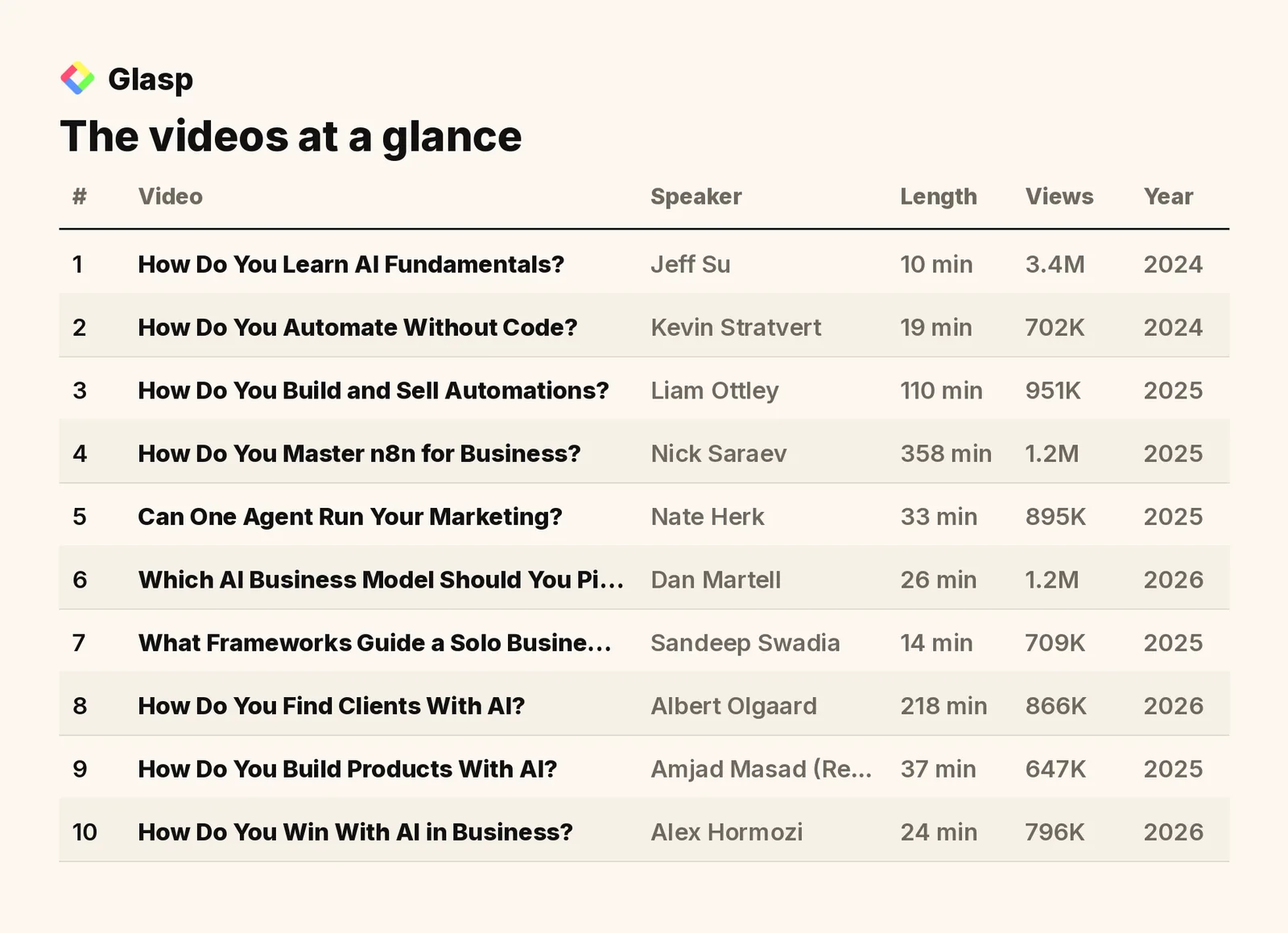
The videos on this list, in the order to watch them, are:
How Do You Learn AI Fundamentals? (Jeff Su)
How Do You Automate Without Code? (Kevin Stratvert)
How Do You Build and Sell Automations? (Liam Ottley)
How Do You Master n8n for Business? (Nick Saraev)
Can One Agent Run Your Marketing? (Nate Herk)
Which AI Business Model Should You Pick? (Dan Martell)
What Frameworks Guide a Solo Business? (Sandeep Swadia)
How Do You Find Clients With AI? (Albert Olgaard)
How Do You Build Products With AI? (Amjad Masad (Replit))
How Do You Win With AI in Business? (Alex Hormozi)
Total: 10 videos, 849 minutes of watch time (about 14 hours), and 11.3M combined views.
1. How Do You Learn AI Fundamentals?
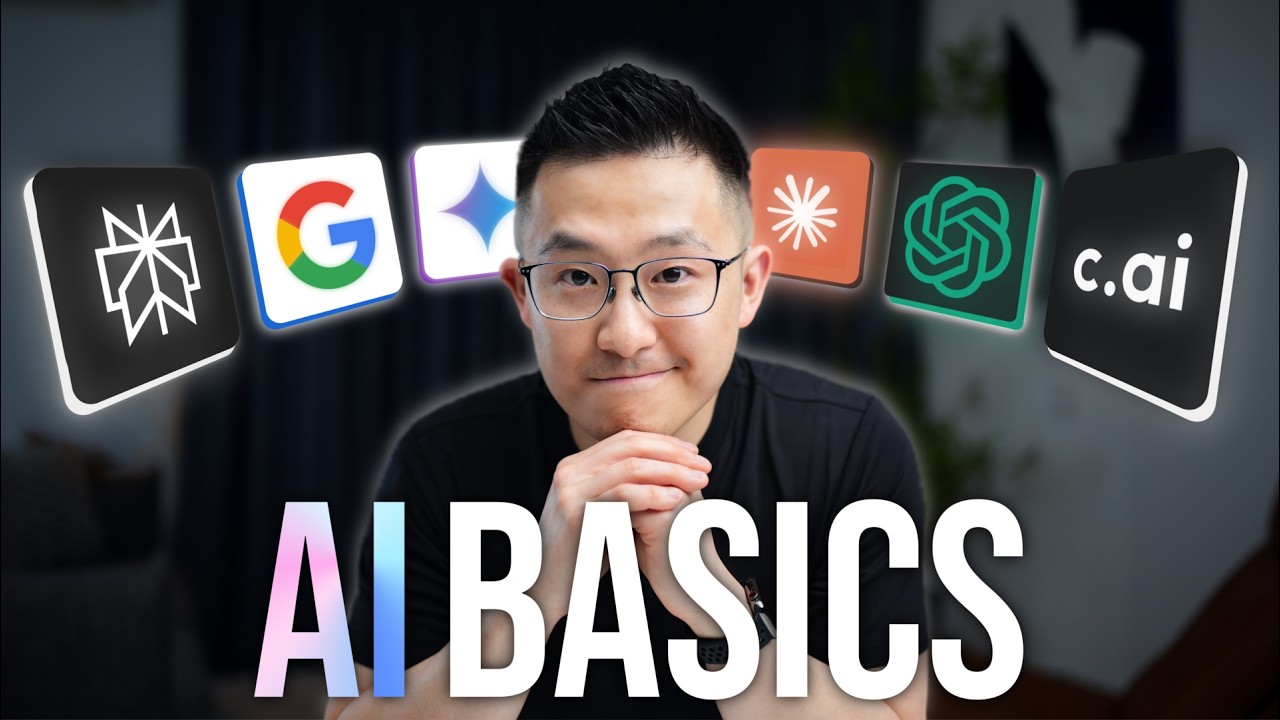
Jeff Su · 10 min · 3.4M views · 2024
In short: Start with how AI tools are categorized, then practice prompt engineering techniques like zero-shot, few-shot, and chain of thought prompting.
Before automating anything, you need shared vocabulary and working prompt habits. Jeff Su distills Google's AI Essentials course into a beginner foundation, answering what the core categories and prompting techniques actually are. It earns the first slot as the on-ramp for everything that follows.
Key takeaways
The course sorts AI tools into three groups: standalone tools, tools with integrated AI features, and custom AI solutions, each serving different purposes.
Zero-shot, one-shot, and few-shot prompting refine AI outputs by providing different levels of example context inside the prompt.
Chain of thought prompting improves accuracy by breaking a complex task into smaller, manageable steps for the model to follow.
AI tools carry limitations such as data bias, missing information, and hallucinations, so users must stay aware and fact-check outputs.
Watch on YouTube · Read the summary and Q&A
2. How Do You Automate Without Code?

Kevin Stratvert · 19 min · 702K views · 2024
In short: Zapier connects over 7,000 apps into automated Zaps that handle repetitive tasks, and its AI can suggest workflows from a prompt.
The fastest way to feel automation working is to build one small Zap. Kevin Stratvert walks through connecting apps and personalizing responses with no code, answering how a beginner ships a first automation. It is the practical step right after the fundamentals.
Key takeaways
Zapier connects more than 7,000 apps, letting beginners automate repetitive tasks such as email responses without writing any code.
Dynamic values personalize automated messages, for example addressing each customer by name inside an automated email response.
Zapier's AI can suggest workflow automations based on a user prompt, lowering the barrier to designing a first Zap.
Advanced features including paths, webhooks, and loops extend what a single Zap can handle beyond simple two-step automations.
Watch on YouTube · Read the summary and Q&A
3. How Do You Build and Sell Automations?

Liam Ottley · 110 min · 951K views · 2025
In short: Use no-code platforms like Make.com and Vapy to automate tasks such as lead qualification and proposal generation, then package them for clients.
This is where automation becomes a business, not just a personal convenience. Liam Ottley shows how to build sellable systems with no code, answering what a client-ready automation looks like end to end. It bridges tinkering and revenue.
Key takeaways
AI automation builds systems that perform complex tasks traditionally done by humans, such as lead qualification and proposal generation.
No-code platforms like Make.com let people build AI automations without prior technical expertise or engineering background.
Vapy provides AI voice agents that can make or receive calls, improving customer interaction and lead qualification.
Workflow automations can chain multiple AI tools into end-to-end processes, and models from OpenAI handle research and personalization.
Watch on YouTube · Read the summary and Q&A
4. How Do You Master n8n for Business?

Nick Saraev · 358 min · 1.2M views · 2025
In short: n8n is a no-code platform for building procedural workflows and real AI agents that drive revenue and improve business efficiency.
Once you know the concepts, it helps to go deep on one serious platform. Nick Saraev's full course covers n8n from setup to real agents, answering how to build automations robust enough to sell. It is the deep-dive anchor of the list.
Key takeaways
n8n is a versatile no-code platform for building both procedural automations and real AI agents for business use.
n8n supports cloud-hosted and self-hosted options and integrates with tools like Google Sheets and ClickUp for flexibility.
Workflows in n8n are built from triggers, actions, and nodes that connect data between different applications.
AI can be integrated into n8n workflows using OpenAI's API to add advanced automation to standard processes.
Watch on YouTube · Read the summary and Q&A
5. Can One Agent Run Your Marketing?

Nate Herk · 33 min · 895K views · 2025
In short: A single no-code n8n agent can create images, write LinkedIn posts and blog articles, and generate videos automatically.
After the deep dive, seeing one focused build makes the value concrete. Nate Herk assembles a marketing team from a single agent, answering what a real applied automation stack looks like. It shows the payoff of the earlier n8n groundwork.
Key takeaways
A single AI agent can automate marketing tasks including creating and editing images and writing LinkedIn posts and blog articles.
The system uses OpenAI for image generation, 11 Labs for sound effects, and Telegram for text and voice communication.
Runway and Cre8mate handle video generation and rendering inside the automated marketing workflow built entirely on n8n.
Setup involves downloading the free template, configuring API keys, and budgeting for n8n, OpenAI, Runway, Cre8mate, and 11 Labs costs.
Watch on YouTube · Read the summary and Q&A
6. Which AI Business Model Should You Pick?

Dan Martell · 26 min · 1.2M views · 2026
In short: Rank opportunities by profitability, competition, and longevity: AI agent development, consulting, and lead generation rank top, while trading bots rank lowest.
With building skills in hand, the next question is where to point them. Dan Martell ranks fourteen AI business models by profit, competition, and longevity, answering which opportunities are worth pursuing. It reframes the list from how to build toward what to build.
Key takeaways
AI lead generation and AI consulting rank as top-tier opportunities due to high profitability and strong longevity.
AI agent development ranks as the top opportunity because of high profitability, low competition, and strong future relevance.
AI trading bots and faceless AI YouTube channels rank lowest, often unprofitable and hurt by competition or demonetization.
The speaker recommends validating ideas, pre-selling, and building an audience before turning an AI service into a product.
Watch on YouTube · Read the summary and Q&A
7. What Frameworks Guide a Solo Business?

Sandeep Swadia · 14 min · 709K views · 2025
In short: The Founder's Triangle combines domain expertise, craft depth, and unique distribution, while the DREAM framework covers demand, revenue, engine, admin, and marketing.
Choosing a model is easier with a structure to hold it. Sandeep Swadia offers frameworks for solo AI businesses and durable moats, answering how a one-person operation defends its position. It adds strategic scaffolding to the practical builds.
Key takeaways
The Founder's Triangle framework leverages domain expertise, depth in your craft, and a unique distribution advantage.
The DREAM framework outlines five core business functions, namely demand, revenue, engine, admin, and marketing, for a solo operator.
Counterpositioning works as a moat by attacking a competitor's core business model in a way they cannot easily answer.
Proprietary data and learning loops help refine products over time and maintain a competitive edge against imitators.
Watch on YouTube · Read the summary and Q&A
8. How Do You Find Clients With AI?

Albert Olgaard · 218 min · 866K views · 2026
In short: Acquire clients through Upwork and cold email, run structured calls that solve client pain points, and build trust with testimonials.
A working system needs paying clients to matter. Albert Olgaard's course focuses on client acquisition and delivery for a solo operator, answering how to actually land the first customers. It closes the gap between capability and income.
Key takeaways
Cold email and platforms like Upwork are effective channels for acquiring clients in the AI service industry.
A structured approach to client calls focuses on identifying and solving the client's pain points to close work.
Building trust and collecting testimonials are essential steps for establishing credibility in the AI service market.
The speaker claims 84% of the global population has not yet used AI, pointing to a large market opportunity.
Watch on YouTube · Read the summary and Q&A
9. How Do You Build Products With AI?

Amjad Masad (Replit) · 37 min · 647K views · 2025
In short: AI coding platforms like Replit lower the barriers to app development, so founders can focus on domain knowledge and iteration.
Beyond services, some founders will want to ship software products. Amjad Masad explains how Replit compresses development, answering what changes when building an app gets cheap. It widens the list from automations to full products.
Key takeaways
Replit is an AI-powered coding platform that simplifies app development and makes launching a software business more accessible.
Prompt engineering is central to working with AI systems, described here as programming without traditional syntax or code.
Marketing remains a major bottleneck for entrepreneurs even as AI makes building products faster and easier.
Grit and resourcefulness stay essential traits, letting founders persist through challenges as AI lowers technical barriers.
Watch on YouTube · Read the summary and Q&A
10. How Do You Win With AI in Business?

Alex Hormozi · 24 min · 796K views · 2026
In short: Automate tasks rather than roles, train AI like a new employee with feedback loops, and adopt it now to gain operational leverage.
The list ends on strategy that ties the tactics together. Alex Hormozi argues for adopting AI now and automating tasks over roles, answering how to think about AI at the level of the whole business. It leaves founders with a durable operating principle.
Key takeaways
Automating tasks rather than whole roles is the key to maximizing efficiency and productivity inside an organization.
Training AI should mirror training a new employee, using clear instructions and feedback loops to improve results.
AI adoption stays slow due to complacency and short-term thinking, which leaves room for early adopters to gain advantage.
The future may involve Bring Your Own Software or Bring Your Own Agent models as businesses shift to workflow thinking.
Watch on YouTube · Read the summary and Q&A
Frequently asked questions
What is the best no-code tool for AI automation?
Zapier and n8n are the most cited no-code platforms; Zapier connects over 7,000 apps, while n8n supports procedural workflows and AI agents with cloud or self-hosted options.
Do you need to code to build AI automations?
No. Platforms like Zapier, Make.com, and n8n let you build automations and AI agents through a visual interface without writing code.
Which AI business models are most profitable?
Dan Martell ranks AI agent development, AI consulting, and AI lead generation as top opportunities, and warns that AI trading bots and faceless YouTube channels rank lowest.
What is an AI agent?
An AI agent is a tool that makes decisions and acts autonomously based on inputs, often using system prompts, memory, and a vector database for retrieval.
How do you get clients for an AI automation business?
Founders use cold email and platforms like Upwork, then run structured calls that identify and solve a client's pain points and collect testimonials for credibility.
Where should a complete beginner start with AI automation for business?
The most reliable starting point is AI fundamentals, then no-code automation, and only after that building and selling automations to clients. Skipping the fundamentals is what makes later steps feel confusing, since every no-code workflow and agent build assumes you understand what the AI is actually doing.
Is n8n worth learning for a business, or is a simpler no-code tool enough?
Simpler no-code tools are enough for straightforward automations, while n8n is worth the extra learning curve when a business needs workflows that connect many tools and handle real operational logic. The practical path is to start with no-code automation to learn the concepts, then move to n8n once the workflows outgrow what a basic tool can express.
Can an AI agent really run your marketing by itself?
A single AI agent can handle a meaningful share of marketing work, but it runs on the strategy, offers, and judgment a human sets up first. Treat it as a system that executes and scales what already works, not as a replacement for deciding what to say and who to say it to.
Do you need a team to build an AI business, or can one person do it?
One person can run an AI business, which is exactly why frameworks matter more for solo operators than for teams: with no one to delegate to, the constraint becomes choosing which model to pursue and which work to ignore. The usual sequence is to pick a business model, adopt a framework for prioritizing, then use AI to find clients and build products.
How to use this list
Watch these in order to move from understanding AI to building, selling, and running automations, or jump straight to the video that matches your current step. If you are short on time, start with Jeff Su's foundations video to build the vocabulary, then Kevin Stratvert's Zapier tutorial so you can ship your first automation the same day.
Related lists
💡 Want summaries and transcripts for any YouTube video? Try YouTube Summary with ChatGPT & Claude.