10 Best a16z Videos for Founders

Jul 20, 2026
10 min read
3 views
Last updated: July 2026
This is a curated set of ten a16z videos for founders who want to move from first principles to execution. It covers disruption theory, company building, fundraising, venture capital, and how AI is reshaping startups.
Together the ten run about ten hours and feature Marc Andreessen, Ben Horowitz, Clayton Christensen, and Adam Neumann. The set is canonical because each video pairs a durable founder lesson with a concrete view of where technology is heading.
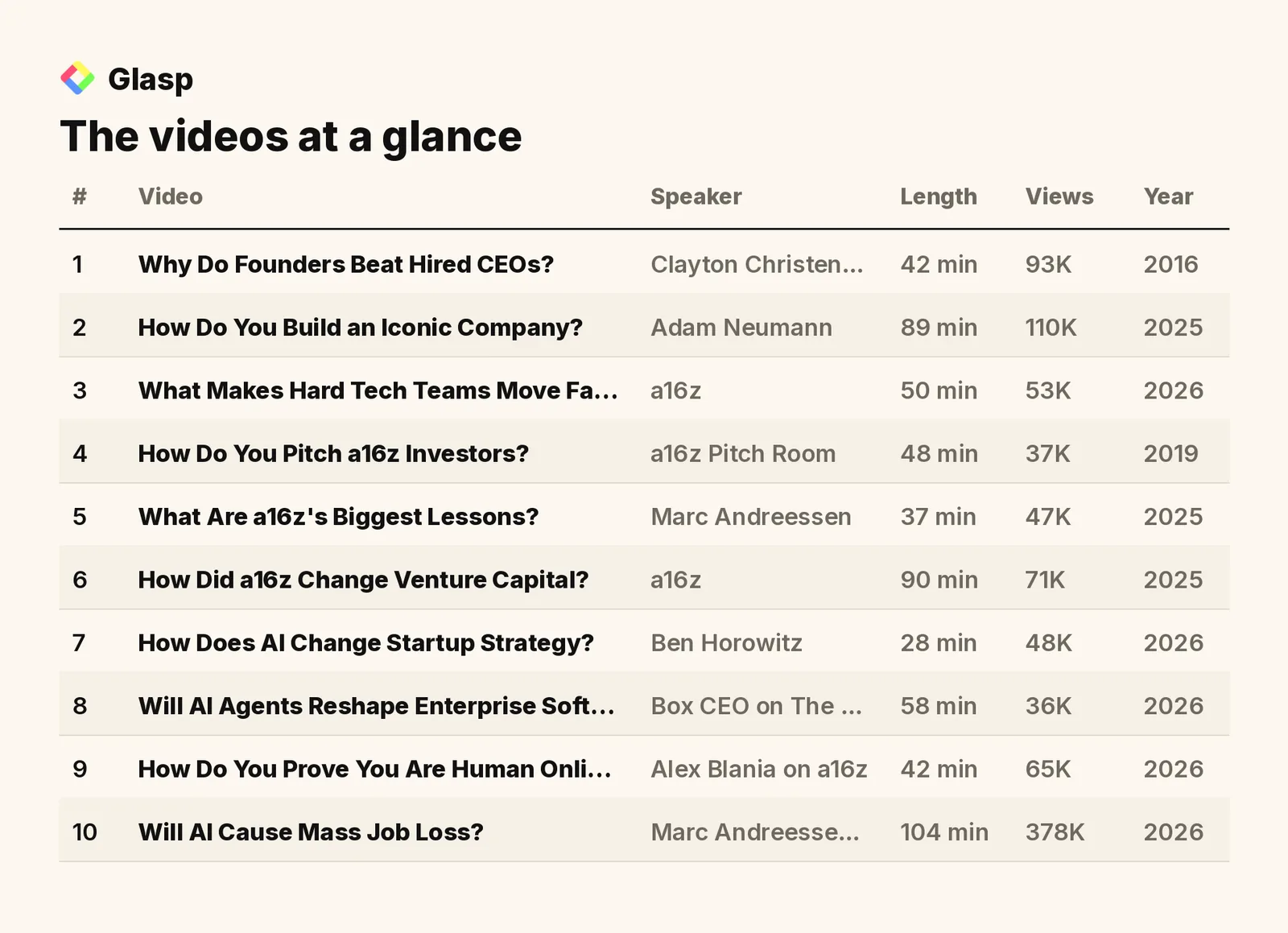
The videos on this list, in the order to watch them, are:
Why Do Founders Beat Hired CEOs? (Clayton Christensen and Marc Andreessen)
How Do You Build an Iconic Company? (Adam Neumann)
How Do You Pitch a16z Investors? (a16z Pitch Room)
What Are a16z's Biggest Lessons? (Marc Andreessen)
How Does AI Change Startup Strategy? (Ben Horowitz)
Will AI Agents Reshape Enterprise Software? (Box CEO on The a16z Show)
How Do You Prove You Are Human Online? (Alex Blania on a16z)
Will AI Cause Mass Job Loss? (Marc Andreessen on Lenny's Podcast)
Total: 10 videos, 588 minutes of watch time (about 10 hours), and 942K combined views.
1. Why Do Founders Beat Hired CEOs?

Clayton Christensen and Marc Andreessen · 42 min · 93K views · 2016
In short: Founders bring unique perspective and moral weight that lets them guide companies through disruption more effectively than hired CEOs.
This talk pairs the author of the innovator's dilemma with a16z's cofounder to frame how disruption works. It earns the first slot because it explains why founder-led companies hold an edge and sets up every lesson that follows.
Key takeaways
Disruption theory has evolved and now reshapes industries far beyond technology, including education and hospitality, changing how new entrants challenge incumbents.
Founders carry a moral weight and long-term perspective that helps guide companies through disruption in ways hired executives often cannot match.
Building new business models is essential for established companies to keep innovating and growing rather than defending only their existing products.
Christensen argues that career decisions should align with personal values, applying the same rigor founders use for strategy to their own lives.
Watch on YouTube · Read the summary and Q&A
2. How Do You Build an Iconic Company?

Adam Neumann · 89 min · 110K views · 2025
In short: Building iconic companies means integrating community, technology, and design so people feel belonging and connection, as Neumann pursues with Flow.
Neumann walks from WeWork to Flow and centers the conversation on community, reinvention, and second chances. It answers how a founder builds a vision durable enough to survive failure and start again.
Key takeaways
Neumann traces his focus on community and belonging to a childhood of frequent moves, shaping a vision where connection sits at the center of business.
Flow aims to rework real estate by combining technology, design, and community into flexible living that addresses loneliness and disconnection.
The partnership between Neumann and a16z rested on shared vision and a stated willingness to learn from past mistakes before scaling again.
Flow's move into Saudi Arabia shows its global ambition, using local partnerships to pursue rapid growth and market entry.
Watch on YouTube · Read the summary and Q&A
3. What Makes Hard Tech Teams Move Fast?

a16z · 50 min · 53K views · 2026
In short: High decision velocity and flat organizations speed hard tech by giving engineers direct access to decision-makers and clear information flow.
Drawing on Tesla and SpaceX, this session explains how to run a hard tech company fast without losing rigor. It answers how founders can structure teams and decisions so execution keeps pace with ambition.
Key takeaways
Flat organizations improve information flow by letting junior engineers reach senior decision-makers directly instead of routing everything through layers of management.
High decision velocity lets leaders make quick, informed calls, which empowers teams to move faster on hard technology problems.
Vertical integration works best when applied strategically to components that bottleneck production, not as a blanket rule across the whole company.
Mission alignment reduces burnout by keeping team members motivated around a shared and compelling goal even during demanding build cycles.
Watch on YouTube · Read the summary and Q&A
4. How Do You Pitch a16z Investors?

a16z Pitch Room · 48 min · 37K views · 2019
In short: You pitch by naming the market challenge directly, then showing a scalable, differentiated product with strong economics and a path to growth.
Sandbox VR's founders present a live pitch that names market challenges and shows immersive experiences with strong economics. It earns a slot as a concrete model of how to structure a fundraising conversation.
Key takeaways
Sandbox VR opens its pitch by naming the real challenges of VR adoption and engagement, then positions itself as the solution.
The company differentiates in location-based VR through immersive, social experiences built on a standard format that supports scaling across sites.
Aggressive growth in the pitch rests on expanding locations, securing exclusive content, and demonstrating strong unit economics.
The pitch pairs a clear market problem with scalability and economics, the combination a16z looks for when evaluating founders.
Watch on YouTube · Read the summary and Q&A
5. What Are a16z's Biggest Lessons?

Marc Andreessen · 37 min · 47K views · 2025
In short: Resilience, adaptability, and deep domain expertise drive good venture decisions, since strong companies often emerge despite skepticism and adverse markets.
Andreessen reviews his biggest wins and mistakes, from early skepticism about Facebook to the idea of little tech. It answers how founders and investors should read uncertainty and stay resilient.
Key takeaways
Successful investing often happens despite adverse market conditions, so resilience matters more than waiting for perfect timing.
Initial public skepticism can precede transformation, as Facebook moved from doubt about its model to strong valuation.
Deep domain expertise sharpens investment decisions, since understanding specific challenges improves judgment about which companies can win.
The idea of little tech serves as a counter-narrative to negative views of big tech and supports startup innovation.
Watch on YouTube · Read the summary and Q&A
6. How Did a16z Change Venture Capital?

a16z · 90 min · 71K views · 2025
In short: a16z broke from traditional VC by adding a platform of operational support, resources, and networks so founders get value beyond funding.
This discussion traces why a16z was founded and how its platform model departs from traditional venture capital. It helps founders understand what a modern investor can offer beyond a check.
Key takeaways
Andreessen Horowitz was founded out of discontent with the traditional venture model and a desire to create more value for entrepreneurs.
The firm's platform approach provides operational support, resources, and networking that distinguish it from traditional venture capital firms.
Personal relationships and mentorship with founders drive results, since the firm believes real value comes from support beyond funding.
Rising competition in venture capital pushes firms to stay adaptable and open to new practices as market conditions change.
Watch on YouTube · Read the summary and Q&A
7. How Does AI Change Startup Strategy?

Ben Horowitz · 28 min · 48K views · 2026
In short: AI lets companies solve problems by adding resources while weakening old software lock-ins, so startups must innovate faster to stay relevant.
Horowitz explains how AI shifts the fundamental dynamics for startups and incumbents alike. It answers what founders should rethink as traditional moats weaken and product cycles shorten.
Key takeaways
AI lets companies solve problems by investing resources, unlike older constraints where adding engineers could not close a competitive gap.
Traditional software lock-ins tied to data and user interfaces are becoming obsolete as AI adds flexibility to switching.
Shortening product lifecycles pressure startups to innovate rapidly to avoid becoming obsolete in fast-moving markets.
Concerns about authenticity in AI-driven communication push toward cryptographic verification to confirm genuine human interaction.
Watch on YouTube · Read the summary and Q&A
8. Will AI Agents Reshape Enterprise Software?
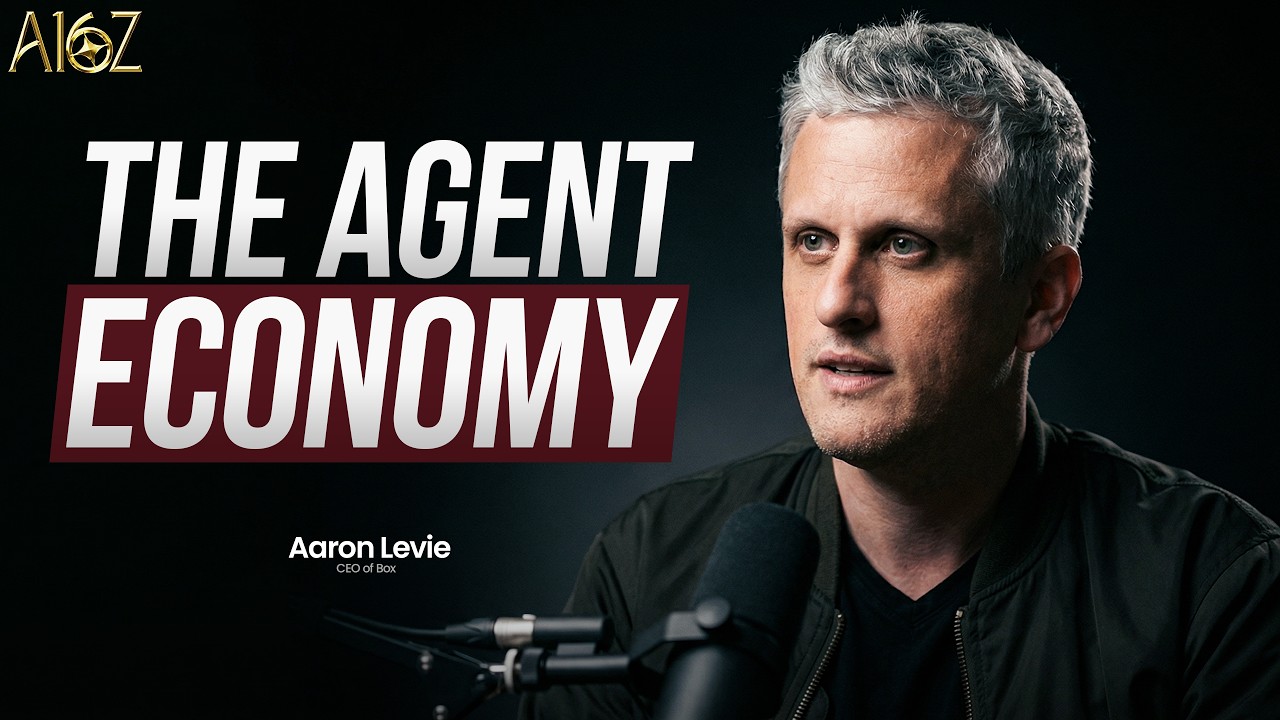
Box CEO on The a16z Show · 58 min · 36K views · 2026
In short: AI agents will reshape enterprise software gradually, pushing companies to build API-first systems, with startups adopting faster than legacy-bound enterprises.
Box's CEO discusses the gap between AI's promise and enterprise adoption, and how software must adapt to agents. It answers where the practical opportunities and constraints sit for founders building for business.
Key takeaways
AI agents will require software built specifically for them, with a focus on APIs and command line interfaces.
The diffusion of AI capabilities will take longer than expected, especially inside large enterprises with legacy systems.
AI agents can automate tasks once handled by multiple employees, raising efficiency across enterprise workflows.
Startups will likely adopt AI agent technologies faster than large enterprises because they carry fewer legacy constraints.
Watch on YouTube · Read the summary and Q&A
9. How Do You Prove You Are Human Online?

Alex Blania on a16z · 42 min · 65K views · 2026
In short: Proof of Human uses biometric data like iris scans to verify unique real people, keeping online interactions genuine as AI spreads.
Blania lays out why bots, deepfakes, and AI agents demand a new internet identity layer. It answers an emerging problem founders will face as they build trust into online products.
Key takeaways
Proof of Human is a method to verify that online interactions involve real people rather than bots or AI agents.
Biometric data such as iris scans provides the level of uniqueness needed for reliable identity verification at scale.
Traditional methods like government IDs fall short for global, scalable identity verification in an AI-heavy internet.
Deepfakes pose a growing threat to video conferencing and other online interactions, raising the need for stronger verification.
Watch on YouTube · Read the summary and Q&A
10. Will AI Cause Mass Job Loss?

Marc Andreessen on Lenny's Podcast · 104 min · 378K views · 2026
In short: AI is unlikely to cause mass job loss because its productivity and growth gains create new roles and make skilled people more valuable.
This long conversation closes the list with Andreessen's macro case for AI, jobs, and career development. It answers how founders should think about the broader environment they are building into.
Key takeaways
AI arrives as a timely technological boost against declining productivity and the demographic challenges facing developed economies.
AI will redefine jobs and tasks, making skilled people who can leverage AI tools more valuable in the market.
Learning to code remains important because understanding underlying systems strengthens a person's ability to work effectively with AI.
Andreessen argues job substitution fears are overblown, since AI's economic growth potential will create new roles and opportunities.
Watch on YouTube · Read the summary and Q&A
Frequently asked questions
What are the best a16z videos for startup founders?
This list gathers ten a16z videos covering disruption, company building, fundraising, venture capital, and AI strategy, featuring Marc Andreessen, Ben Horowitz, Clayton Christensen, and Adam Neumann.
Does Marc Andreessen think AI will cause mass job loss?
No. Andreessen argues AI is unlikely to cause mass job loss because its productivity and growth gains create new roles and make skilled workers more valuable.
Why do founders make better CEOs than hired executives?
Founders bring a moral weight and long-term perspective that helps them guide companies through disruption more effectively than hired CEOs, according to Christensen and Andreessen.
How is a16z different from traditional venture capital firms?
a16z pairs funding with a platform of operational support, resources, and networking, aiming to help founders grow into CEOs rather than only writing checks.
How can companies verify real humans online as AI grows?
Proof of Human uses biometric data such as iris scans to confirm unique real people, keeping online interactions genuine as bots and deepfakes spread.
How to use this list
Watch these in order to move from understanding disruption to building, fundraising, and adapting to AI, or jump to any single video when a specific question is pressing. If you have time for only one, start with Clayton Christensen and Marc Andreessen on disruption, since it frames why founders hold an edge and sets up every video that follows.
Related lists
💡 Want summaries and transcripts for any YouTube video? Try YouTube Summary with ChatGPT & Claude.