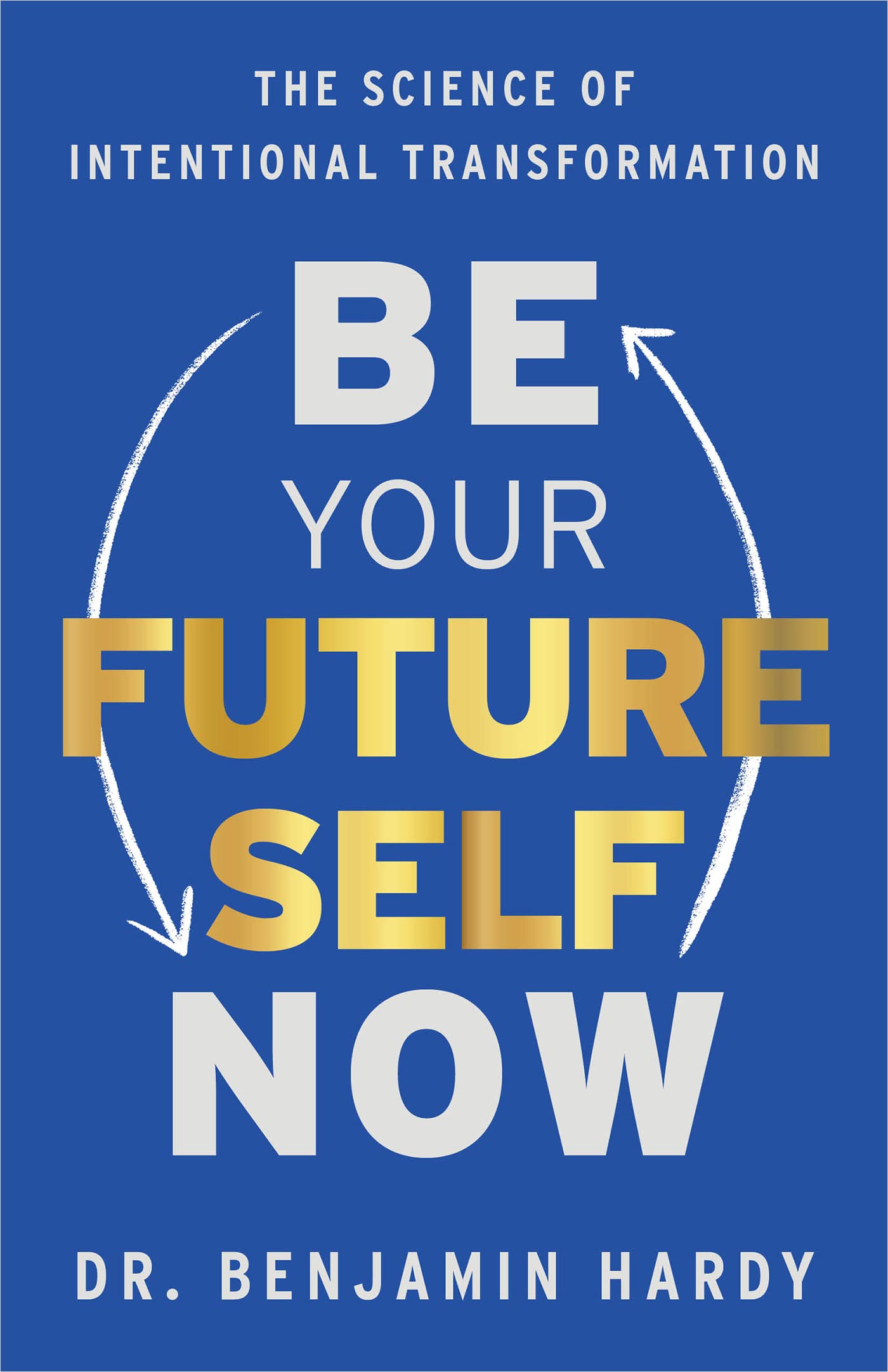
Be Your Future Self Now: The Science of Intentional Transformation


About This Book
Be Your Future Self Now by Benjamin Hardy argues that human beings are not prisoners of their past but are pulled forward by their vision of the future. Drawing on psychology's shift away from determinism toward prospection — the uniquely human capacity to imagine countless future scenarios — Hardy contends that all behavior is goal-driven, and that the quality of your connection to your Future Self determines the quality of your decisions today.
The book is organized into three parts.
- 7 Threats to your Future Self, including living without hope, holding a reactive narrative about your past, being unaware of your environment, disconnection from your Future Self, short-term thinking, staying out of the arena, and letting success become a catalyst for failure.
- 7 Truths, such as your future driving your present, your Future Self being a different person than you expect, and vividness accelerating progress.
- 7 Steps, including clarifying a contextual purpose, eliminating lesser goals, asking for what you want, and aggressively completing imperfect work.
Key ideas recur throughout: hope as will plus way (agency and pathways thinking, drawn from Charles Snyder and Viktor Frankl); the power of reframing your past as a gain rather than a gap; the role of environment, the Pygmalion effect, and the mere-exposure effect in shaping desires; and Hal Hershfield's research showing that empathy and vividness toward your Future Self improve present decisions.
Hardy blends academic psychology with motivational coaching, urging readers to reverse-engineer decisions from a desired outcome — to think and act from your goal, rather than toward it. The throughline is conscious choice: between stimulus and response lies the freedom to become whoever you intend to be.
Key Takeaways
- 1.Your future, not your past, drives your behavior — humans are uniquely capable of prospection, imagining and being pulled toward countless future scenarios.
- 2.Hope is the foundation of a meaningful life: a clear goal plus agency and pathways thinking, far stronger than vague optimism.
- 3.Your past is a story you choose; reframing painful experiences as a gain converts pain into purpose through post-traumatic growth.
- 4.Environment shapes goals unconsciously via the Pygmalion, mere-exposure, and proximity effects, so designing your surroundings and relationships is critical.
- 5.Decisions are best reverse-engineered from a desired outcome — think and act from your goal rather than toward it.
- 6.Deeper, more vivid connection to your Future Self improves the quality of present decisions and makes long-term investing easier.
- 7.Success can become a catalyst for failure through the clarity paradox and upper-limit problem when focus and discipline erode.
Top Highlights
Research now shows that a person’s past does not drive or dictate their actions and behaviors. Rather, we are pulled forward by our future.25
Highlighted by 5 people
All goals or motivations fit within two categories: approach or avoid.29,30 The reason for doing anything is either to approach something you want to happen, or to avoid something you don’t want to happen. As a rule, 80 percent of people are primarily driven by fear or avoidance, while 20 percent of people are driven by approach and courage.
Highlighted by 4 people
According to renowned trauma expert Dr. Peter Levine, “Trauma is not what happens to us, but what we hold inside in the absence of an empathetic witness.”17
Highlighted by 4 people
Decisions and actions are best when reverse-engineered from a desired outcome. Start with what you want and work backward. Think and act from your goal, rather than toward your goal.
Highlighted by 4 people
Psychologists call this unique human ability prospection; as people, everything we do is driven by our prospects of the future.27 Prospection is based on a teleological view of the world, which views all human action and behavior as driven by goals—whether short term or long term.28 From this view, every human action has a purpose. Another word for purpose is goal. All human-action is goal-driven, even if the goal of the behavior isn’t consciously considered by the individual. Take for example, walking to the refrigerator to get food. That behavior is driven by the goal of satisfying hunger, a distraction, or indulgence. Whatever the goal, that purpose is the driver behind walking to the fridge.
Highlighted by 3 people
To be a high-hope person, you commit to the goal, not the process. You don’t get stuck in your current way of doing and thinking. Patiently, persistently you adapt and find new and better ways to get where you want to go. As Frankl knew, hope is rooted in a clear purpose for your future. A high-hope person, like Frankl himself, remains committed 100 percent to a pursuit, and 100 percent flexible around the path to achieve their goal. In the absence of a clear purpose for your life, your critical thinking to find ways deteriorates into finding excuses. After all, without hope, nothing really matters anyway. The first and most fundamental threat to your Future Self is not having hope in your future. Without hope, the present loses meaning. Without hope, you don’t have clear goals or a sense of purpose for your life. Without hope, there is no way. Without hope, you decay.
Highlighted by 3 people
How we handle pain and confusion largely dictates who our Future Self becomes. If you allow the pain of life to swallow you, then your primary goals become to numb yourself through addictions and distractions because you’re unwilling to face and transform those emotions.
Highlighted by 3 people
The gain happens when you transform every experience into personal growth. No matter what occurs, frame the experience as a gain. Proactively and consciously learn from your experiences, and become better, not bitter, as a result. When you go through something terrible, and you frame the experience in the gain, then life is happening for you. Rather than being the byproduct of your experiences, your experiences are the byproduct of your conscious choosing. You determine what your experiences mean. You own your experiences; they don’t own you. Rather than devaluing your experiences because they were painful, you increase their value by learning more and more from them. You also have gratitude for your experiences. In the gain about your past, your Future Self continually grows bigger and better as a result of every experience you have. When you’re in the gain, you are more informed than your former self. You have greater perspective, purpose, and empathy. Your Future Self is better equipped because of your past.
Highlighted by 3 people · 1 left notes
We don’t like to admit this, but our performance and results are often based on the expectations of those around us. Psychologists call this the Pygmalion effect.25 If you’re around people who have low expectations for you, you’ll fall to those standards. If you’re around people with high expectations, you’ll rise to those standards. We are all driven by our goals. But how often are goals unconsciously fed to us by our environment? Is it any wonder that my brother-in-law, with seven dentists on his mother’s side, became a dentist? Can we fault the woman surrounded by drugs as a child, who turns to drugs for respite from her pain? The more mature you become, the more proactive and conscious are the goals you choose for yourself. The less mature you remain, the more reactive and unconscious are the goals you pursue.
Highlighted by 3 people
Performance psychologist Dr. Marshall Goldsmith explained in his book Triggers, “If we do not create and control our environment, our environment creates and controls us.”32
Highlighted by 3 people
AI Review
Based on Glasp's analysis of highlights from 10 readers, this is a resonant, quotable book whose core message about being pulled by the future rather than driven by the past clearly struck a chord.
Pros
- +Strong central thesis grounded in prospection and Frankl's logotherapy
- +Highly quotable passages on hope, agency, and pathways thinking
- +Practical reframing of the past as a gain rather than a deficit
- +Concrete structure of threats, truths, and actionable steps
- +Useful synthesis of research on environment, the Pygmalion effect, and Future Self vividness
Cons
- −Heavy reliance on motivational quotes can feel repetitive
- −Aspirational tone (10X vision, manifestation) may not satisfy readers wanting rigorous science
Glasp AI analysis based on highlights from 10 readers.
Who Should Read This
Readers drawn to self-development and applied psychology who want a framework for intentional change will benefit most. It suits people feeling stuck in short-term, reactive patterns — entrepreneurs, goal-setters, and anyone navigating a life transition. Those who appreciated Hardy's earlier work, or books by Hal Hershfield, Viktor Frankl, and James Clear, will find familiar terrain. Skeptics of motivational coaching or readers seeking rigorous, citation-heavy academic treatment may find the tone too aspirational.
Frequently Asked Questions
What is Be Your Future Self Now about?
Who is the book for?
What are the key lessons?
Is it worth reading?
What does the book mean by the gain versus the gap?
How does the book define hope?
What role does environment play?
How to Apply What You Read
- 1.Write a letter from your Future Self to your current self to make that future person vivid and detailed.
- 2.Clarify a contextual purpose with no more than three core priorities, then set ambitious 12-month targets around them.
- 3.Audit your environment — the people, inputs, and information around you — and realign toward those who hold high expectations for you.
- 4.Reframe a painful past experience as a gain, identifying what it taught you and how it serves your Future Self.
- 5.Enter the arena on one stalled goal now, completing imperfect work rather than waiting on the sidelines.
Discussion Questions
- Q1.Do you agree that we are pulled by our future more than driven by our past? What evidence from your own life supports or challenges this?
- Q2.Which of the seven threats to your Future Self feels most present in your life right now, and why?
- Q3.How has your environment unconsciously shaped the goals you currently pursue?
- Q4.Can you identify a painful past experience you could reframe as a gain — and what would change if you did?
- Q5.How vivid and detailed is your image of your Future Self, and how might that vividness be affecting your present decisions?
- Q6.Where in your life are you choosing a clear path to a lesser goal instead of pursuing what you truly want?
- Q7.If success can be a catalyst for failure, what disciplines would you need to protect to keep expanding rather than backsliding?
Recommended Books



Revisit Your Highlights, Deepen Your Understanding
Import your Kindle highlights to review, organize, and share the ideas that matter most to you.
Get the free browser extension