
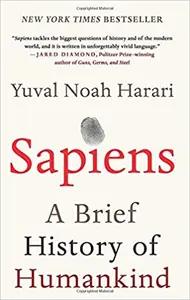
Sapiens: A Brief History of Humankind – The #1 New York Times Bestseller Exploring How We Became Ruler of the Planet
About This Book
Sapiens argues that human dominance is not mainly a story of stronger bodies or better individual intelligence, but of shared imagination. Yuval Noah Harari frames human history through three major revolutions, with the highlights clustering most strongly around the first: the Cognitive Revolution. At some point roughly 70,000 years ago, Homo sapiens developed new linguistic and mental capacities that allowed them not only to exchange practical information, but to speak about things that do not physically exist—spirits, tribes, nations, laws, money, corporations, and human rights.
That ability to create and sustain imagined realities is presented as the decisive advantage of our species. Harari’s central claim is that large numbers of strangers can cooperate only when they believe in common myths. This is why churches, states, legal systems, businesses, and trade networks can function at scale. The book repeatedly contrasts objective reality—rivers, trees, lions—with intersubjective reality—gods, nations, and companies—which becomes powerful precisely because many people believe in it together.
The highlights also stress that this imaginative power made cultural evolution much faster than genetic evolution. Humans can rapidly revise behavior by changing stories, norms, and institutions. This flexibility helped Sapiens outcompete other human species and reshape the planet.
A second major theme is the cost of success. Harari emphasizes that humans rose to the top of the food chain very quickly, with destructive consequences for ecosystems and for other human species. He also challenges progress narratives, especially around agriculture, suggesting that the Agricultural Revolution increased food supply and population while often worsening everyday life for individuals.
Across these passages, the book’s structure moves from biology to culture, and from prehistory to institutions, showing how fiction, cooperation, and belief became the engines of history—and how those same forces still govern modern life.
Key Takeaways
- 1.Shared fictions enable scale: humans can cooperate with countless strangers because they believe in common stories such as nations, money, laws, and gods.
- 2.The Cognitive Revolution matters because it gave Sapiens the ability to discuss things that do not physically exist, not just practical facts about the environment.
- 3.Human history cannot be explained by biology alone; once culture emerged, changing stories could rapidly change behavior and institutions.
- 4.Our modern world still runs on imagined realities, and these abstractions now shape the fate of very real things such as forests, animals, and ecosystems.
- 5.The rise of Sapiens carried major destructive consequences, including extinctions, ecological disruption, and likely violent displacement of other human species.
- 6.The Agricultural Revolution increased food output and population, but it did not necessarily improve the lives of ordinary people.
- 7.Many social hierarchies and institutions persist not because they are natural or logical, but because they are reinforced by collective belief.
Top Highlights
Unlike lying, an imagined reality is something that everyone believes in, and as long as this communal belief persists, the imagined reality exerts force in the world.
Highlighted by 12 people
The appearance of new ways of thinking and communicating, between 70,000 and 30,000 years ago, constitutes the Cognitive Revolution.
Highlighted by 9 people
The appearance of new ways of thinking and communicating, between 70,000 and 30,000 years ago, constitutes the Cognitive Revolution.
Highlighted by 8 people
Much of history revolves around this question: how does one convince millions of people to believe particular stories about gods, or nations, or limited liability companies?
Highlighted by 7 people
Ever since the Cognitive Revolution, Sapiens have thus been living in a dual reality. On the one hand, the objective reality of rivers, trees and lions; and on the other hand, the imagined reality of gods, nations and corporations. As time went by, the imagined reality became ever more powerful, so that today the very survival of rivers, trees and lions depends on the grace of imagined entities such as the United States and Google.
Highlighted by 7 people
The secret was probably the appearance of fiction. Large numbers of strangers can cooperate successfully by believing in common myths.
Highlighted by 6 people
The real difference between us and chimpanzees is the mythical glue that binds together large numbers of individuals, families and groups. This glue has made us the masters
Highlighted by 6 people
6 million years ago, a single female ape had two daughters. One became the ancestor of all chimpanzees, the other is our own grandmother.
Highlighted by 5 people
In Homo sapiens, the brain accounts for about 2–3 per cent of total body weight, but it consumes 25 per cent of the body’s energy when the body is at rest.
Highlighted by 5 people
‘Interbreeding Theory’
Highlighted by 5 people
AI Review
Glasp’s AI analysis of 49 reader highlights suggests a strong consensus that Sapiens is highly impactful, especially for its memorable argument that human cooperation rests on shared myths. The most-highlighted passages are conceptually dense, broadly applicable, and frequently described by readers as eye-opening or thought-provoking.
Pros
- +Memorable core thesis about imagined realities and collective belief
- +Connects biology, history, culture, and institutions in one narrative
- +Highly quotable passages with strong reader resonance
- +Makes abstract systems like money, law, and corporations feel understandable
- +Challenges progress myths, especially around agriculture
- +Provokes reflection on modern values, power, and social order
Cons
- −Some claims are framed very broadly and invite skepticism or follow-up questions
- −The book’s sweeping scope can oversimplify contested historical debates
- −Several highlighted ideas are intentionally provocative, which may feel reductive to specialists
Glasp AI analysis based on highlights from 49 readers.
Who Should Read This
This book is ideal for readers who want a big-picture explanation of why humans dominate the planet despite our biological limits. It suits people interested in history, anthropology, sociology, politics, religion, and economics, especially those who enjoy books that connect ancient evolution to modern institutions like money, nations, and corporations.
It works well for general readers with no specialist background, but it especially rewards people willing to question familiar ideas about progress, civilization, and what is considered “natural” in human society.
Frequently Asked Questions
What is the book about?
Who is this book for?
What are the key lessons of Sapiens?
Why does Harari emphasize myths and imagined realities?
What does the book say about the Cognitive Revolution?
Does the book portray agriculture as progress?
Is Sapiens worth reading?
How to Apply What You Read
- 1.Examine one institution you take for granted—money, citizenship, a company, or rights—and write down the shared beliefs that make it function.
- 2.Question one modern “necessity” in your life and ask whether it began as a luxury that created new obligations.
- 3.Discuss the book’s idea of imagined order with others by using examples from work, politics, religion, or technology.
- 4.Compare biological instincts with cultural habits in your own life, especially around food, status, trust, and belonging.
- 5.Read a counterpoint or specialist critique on human evolution or early agriculture to test Harari’s broad claims.
Discussion Questions
- Q1.If nations, corporations, and human rights are imagined realities, what makes some imagined realities more durable than others?
- Q2.Does calling social institutions “fictions” weaken them, or does it help us understand how they actually work?
- Q3.Was the Agricultural Revolution truly a trap for most individuals, or is that claim too one-sided?
- Q4.How much of your own identity and desire feels personal, and how much seems shaped by inherited cultural stories?
- Q5.If humans dominate through cooperation rather than individual superiority, what does that imply about leadership and power today?
- Q6.Do modern technologies strengthen our ability to coordinate through shared myths, or do they make collective belief more fragile?
- Q7.If another human species had survived alongside Sapiens, how might religion, law, and morality have developed differently?
Recommended Books





Revisit Your Highlights, Deepen Your Understanding
Import your Kindle highlights to review, organize, and share the ideas that matter most to you.
Get the free browser extension