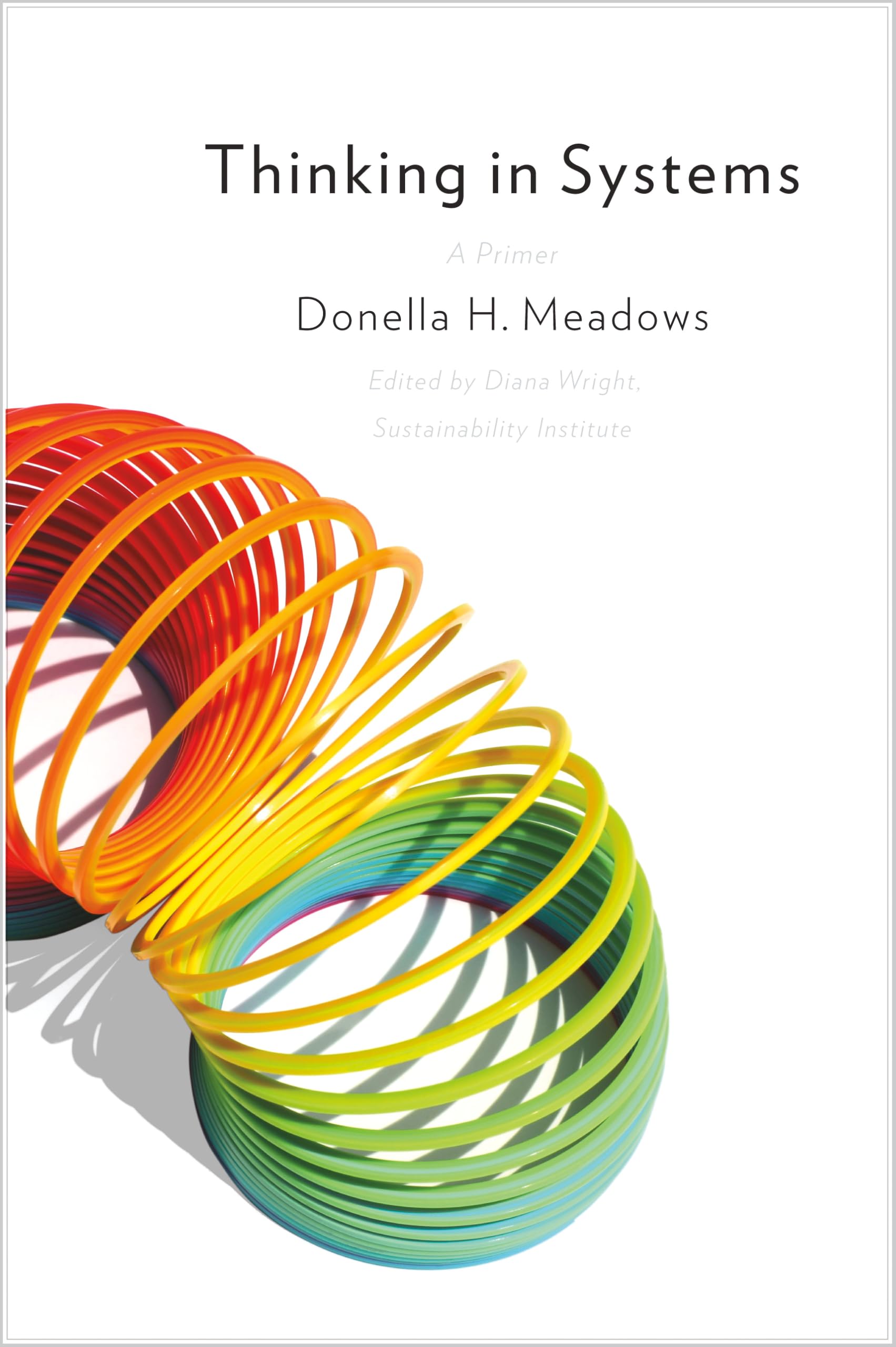
Thinking in Systems: International Bestseller
About This Book
Thinking in Systems argues that the behavior of messy real-world problems comes less from isolated events or individual blame than from the underlying structure of the system itself. Drawing on 26 reader highlights, the book’s most resonant lesson is that a system consists of three things: elements, interconnections, and a function or purpose—and the least visible of these, purpose, is often the strongest determinant of behavior. Change the purpose, and you change the system profoundly, even if the parts stay the same.
The book builds a practical vocabulary for seeing structure. Meadows explains stocks and flows, showing that stocks are accumulations that change slowly and act as memory, buffers, and delays. This helps readers understand why systems often resist quick fixes and why changing outflows can matter as much as increasing inflows. From there, she introduces feedback loops: balancing loops that stabilize systems and reinforcing loops that amplify growth or collapse. Much of what persists over time, she argues, is generated by these feedback processes.
A second major thread is that information flows hold systems together. Missing, delayed, weak, or distorted information leads to malfunction, oscillation, policy resistance, and unintended consequences. Readers also strongly highlighted the importance of watching behavior over time rather than reacting to events, because persistent patterns reveal the loops underneath.
The book then broadens from mechanics to design. Systems are nested, hierarchical, adaptive, and often self-preserving. Healthy systems align subgoals with overall goals, manage not only for productivity and stability but also for resilience, and preserve the capacity for self-organization. Meadows repeatedly reminds readers that every model is only a model, never reality itself.
Overall, the book teaches a shift in mindset:
- Stop asking only who caused the problem.
- Ask what structure is producing the pattern.
- Look for goals, delays, buffers, and feedback.
- Redesign information flows and purposes, not just parameters.
Its central promise is that better ways of seeing make better interventions possible.
Key Takeaways
- 1.System behavior comes from structure, not just from external events or individual intentions.
- 2.A system is defined by its elements, interconnections, and purpose, and the hidden purpose often matters most.
- 3.Stocks store the history of flows, which is why many important changes happen slowly and resist quick intervention.
- 4.Feedback loops create persistent behavior: balancing loops stabilize, while reinforcing loops amplify growth or decline.
- 5.Information flows are crucial; delayed, missing, or distorted information can make systems malfunction or oscillate.
- 6.Subgoals must be aligned with the larger system goal, or well-intended parts can create outcomes no one wants.
- 7.Good system stewardship requires resilience and self-organization, not just short-term productivity or apparent stability.
Top Highlights
Keeping sub-purposes and overall system purposes in harmony is an essential function of successful systems.
Highlighted by 11 people
change in purpose changes a system profoundly, even if every element and interconnection remains the same.
Highlighted by 10 people
A system* is an interconnected set of elements that is coherently organized in a way that achieves something.
Highlighted by 9 people
Many of the interconnections in systems operate through the flow of information.
Highlighted by 9 people
An important function of almost every system is to ensure its own perpetuation.
Highlighted by 9 people
Stocks generally change slowly, even when the flows into or out of them change suddenly. Therefore, stocks act as delays or buffers or shock absorbers in systems.
Highlighted by 9 people
The behavior of a system cannot be known just by knowing the elements of which the system is made.
Highlighted by 8 people
Purposes are deduced from behavior, not from rhetoric or stated goals.
Highlighted by 8 people
Systems thinkers see the world as a collection of stocks along with the mechanisms for regulating the levels in the stocks by manipulating flows.
Highlighted by 8 people
Balancing feedback loops are equilibrating or goal-seeking structures in systems and are both sources of stability and sources of resistance to change.
Highlighted by 8 people
AI Review
Glasp’s AI analysis of 26 reader highlights suggests a strong consensus that this is a highly impactful introduction to systems thinking. The most-highlighted passages focus on purpose, interconnections, feedback, and stocks-and-flows, indicating that readers found the framework both memorable and broadly applicable.
Pros
- +Clear core framework for elements, interconnections, and purpose
- +Memorable explanations of stocks, flows, and feedback loops
- +Strong emphasis on purpose as a hidden driver of behavior
- +Useful shift from blame and events to structure and patterns over time
- +Practical insight into delays, oscillation, and resistance to change
- +Valuable treatment of resilience, hierarchy, and self-organization
- +Readers repeatedly highlighted its relevance to organizations and policy
Cons
- −Some concepts are abstract and require slow, reflective reading
- −Examples can feel more conceptual than step-by-step tactical
- −Systems language may challenge readers looking for quick fixes alone
Glasp AI analysis based on highlights from 26 readers.
Who Should Read This
This book is especially useful for managers, policy makers, product leaders, educators, sustainability professionals, organizational designers, and analysts who deal with recurring problems that don’t respond to simple fixes. It also fits readers in operations, public health, economics, climate, and community leadership.
You should read it if you keep seeing the same failures reappear despite new hires, new programs, or new rules. No advanced math is required; the book is accessible to beginners, though it is most valuable for readers willing to think in terms of patterns, delays, tradeoffs, and redesign rather than blame.
Frequently Asked Questions
What is the book about?
Who is this book for?
What are the key lessons from the book?
Why does the book focus so much on purpose?
What are stocks and flows in simple terms?
How does the book explain change and resistance?
Is it worth reading?
How to Apply What You Read
- 1.Map one recurring problem in your work as a system with elements, interconnections, purpose, stocks, and flows.
- 2.Track the behavior of the problem over time instead of reacting only to recent events or anecdotes.
- 3.Identify the balancing and reinforcing feedback loops that may be stabilizing or worsening the pattern.
- 4.Test whether the current metrics and goals reflect the real purpose of the system or merely a proxy.
- 5.Improve one information flow by making feedback faster, clearer, or more visible to the people making decisions.
Discussion Questions
- Q1.What systems in your life or organization are being misunderstood because people focus on events instead of long-term patterns?
- Q2.How can you tell the real purpose of a system from what it actually does rather than what people say it does?
- Q3.Which is harder to change in practice: elements, interconnections, or purpose? Why?
- Q4.Where have you seen balancing feedback create useful stability, and where has it created harmful resistance to change?
- Q5.What important stocks in your organization are easy to ignore because they are intangible, such as trust, morale, or goodwill?
- Q6.How do delayed feedback and slow-changing stocks contribute to policy mistakes or overreactions?
- Q7.What would it look like to manage a system for resilience and self-organization rather than only for efficiency?
Recommended Books







Revisit Your Highlights, Deepen Your Understanding
Import your Kindle highlights to review, organize, and share the ideas that matter most to you.
Get the free browser extension