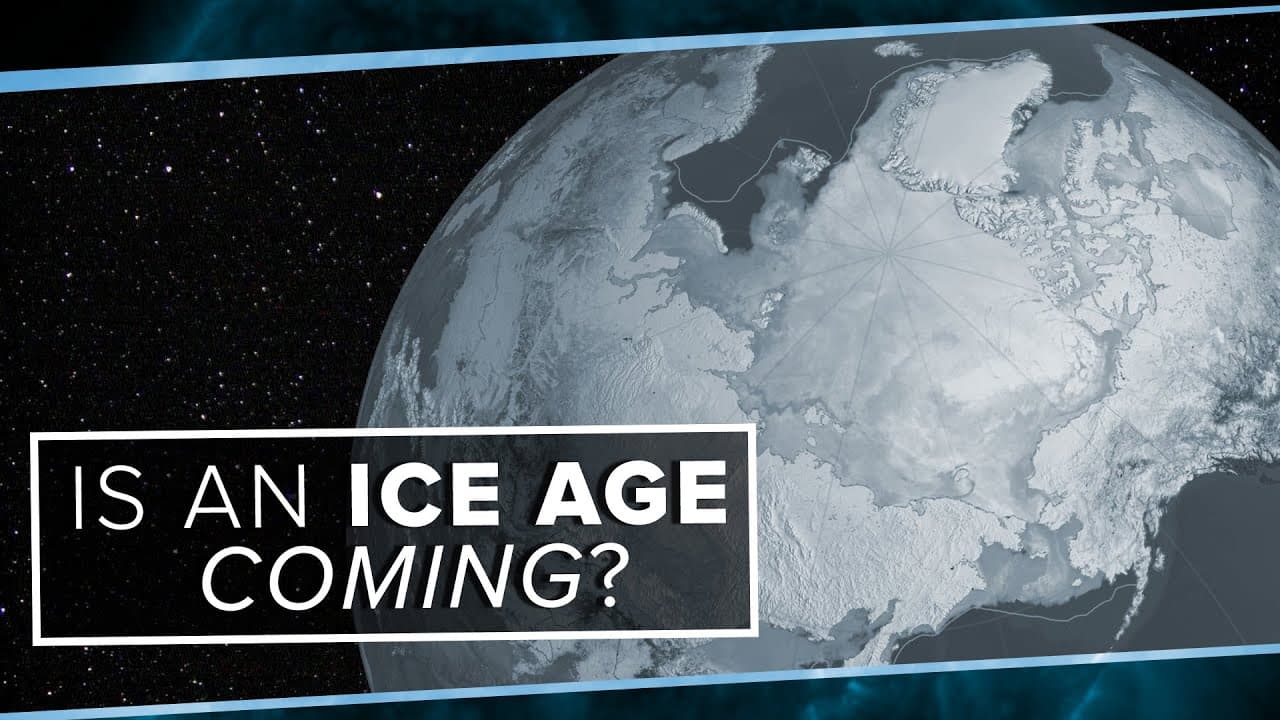
Is an Ice Age Coming? | Space Time | PBS Digital Studios
TL;DR
Earth's climate cycles suggest an ice age isn't imminent.
Transcript
Earth's climate shifts between short periods of warm and long, long periods of frigid cold. Based on past pans, there's reason to think that the current warm period might be nearly done. Is the Ice Age coming back, or will human activity swing us wildly in the opposite direction? We live in an ice age. Our geological period is the Quaternary, and i... Read More
Key Insights
- Earth's climate naturally oscillates between warm interglacial periods and longer glacial periods, driven by changes in Earth's orbit and axial tilt.
- The current interglacial period, the Holocene, has lasted about 11,000 years, longer than typical warm phases.
- Milankovitch cycles, including Earth's orbital eccentricity, axial precession, and tilt, influence the planet's climate over tens of thousands of years.
- Paleoclimatology, through ice and ocean sediment cores, helps reconstruct Earth's climate history, supporting Milankovitch's theories.
- The current interglacial could last another 25,000 to 50,000 years without human influence, due to low eccentricity in Earth's orbit.
- Human activities have increased atmospheric CO2 levels, potentially extending the current interglacial period and impacting future climate cycles.
- The recent rapid rise in greenhouse gases is unprecedented, complicating climate modeling and predictions.
- While an ice age isn't imminent, the risk of a much warmer climate, akin to past greenhouse periods, remains a concern.
Install to Summarize YouTube Videos and Get Transcripts
Explore YouTube Video Summarizer or Get YouTube Transcript Extractor
Questions & Answers
Q: What are Milankovitch cycles and how do they affect Earth's climate?
Milankovitch cycles are long-term changes in Earth's orbit and axial tilt, affecting solar radiation distribution and climate. These cycles include orbital eccentricity (100,000-year cycle), axial precession (21,000-year cycle), and tilt (41,000-year cycle). They drive Earth's climate shifts between warm interglacial and cold glacial periods, influencing ice sheet formation and retreat.
Q: How do scientists reconstruct Earth's climate history?
Scientists use paleoclimatology to reconstruct Earth's climate history by analyzing ice cores and ocean sediment cores. Ice cores, like those from the Vostok Glacier, contain atmospheric bubbles that reveal past climate conditions. Ocean sediment cores show changes in sea life composition, reflecting ocean temperature and salinity variations. These methods provide climate records spanning hundreds of thousands to millions of years.
Q: Why is the current interglacial period longer than usual?
The current interglacial period, the Holocene, has lasted about 11,000 years, longer than typical warm phases. This extended duration is partly due to low eccentricity in Earth's orbit, providing a stable climate. Additionally, human activities have increased atmospheric CO2 levels, potentially further prolonging the interglacial period by offsetting natural cooling trends.
Q: What role does human activity play in Earth's climate cycles?
Human activity significantly impacts Earth's climate cycles by increasing atmospheric CO2 levels, which enhances the greenhouse effect. This anthropogenic influence could extend the current interglacial period and alter natural climate patterns. The recent rise in greenhouse gases is unprecedented, making climate modeling challenging and raising concerns about potential shifts towards a much warmer climate.
Q: Is an ice age imminent based on current climate models?
Current climate models suggest that an ice age is not imminent. The ongoing interglacial period could last another 25,000 to 50,000 years due to low orbital eccentricity. Additionally, human-induced CO2 increases may further delay glaciation. However, the potential for a much warmer climate remains a concern, highlighting the need for careful climate management.
Q: How does Earth's axial tilt influence climate?
Earth's axial tilt, or obliquity, oscillates between 22.1 and 24.5 degrees over 41,000 years, affecting the strength of seasons. High obliquity leads to more extreme seasons, while low obliquity results in milder seasons and a cooler global climate. This influences glaciation, as reduced sunlight at high latitudes promotes ice sheet growth.
Q: What is the significance of the 100,000-year eccentricity cycle?
The 100,000-year eccentricity cycle, part of Milankovitch cycles, affects Earth's orbit shape, influencing climate. Currently, Earth's orbit is relatively circular, contributing to the prolonged interglacial period. This cycle's significance lies in its correlation with glacial and interglacial periods, as shifts in eccentricity can trigger climate changes when combined with other orbital factors.
Q: What are the potential risks of a sweltering greenhouse climate?
A sweltering greenhouse climate could result from continued CO2 emissions and warming, resembling past periods like the Mesozoic or Venus. Such a climate poses risks of extreme heat, sea level rise, and ecosystem disruptions. It emphasizes the importance of addressing climate change to prevent severe environmental and societal impacts.
Summary & Key Takeaways
-
Earth's climate alternates between warm and cold periods, driven by changes in its orbit and axial tilt, known as Milankovitch cycles. Currently, we are in a warm interglacial period, the Holocene, which has lasted about 11,000 years, longer than usual.
-
Paleoclimatology, using ice and ocean sediment cores, supports the influence of Milankovitch cycles on Earth's climate. The current interglacial could last another 25,000 to 50,000 years due to low eccentricity, even without human impact.
-
Human activity has increased CO2 levels, potentially prolonging the interglacial period. The rapid rise in greenhouse gases is unprecedented, complicating climate predictions and raising concerns about a future, much warmer climate.
Read in Other Languages (beta)
Share This Summary 📚
Summarize YouTube Videos and Get Video Transcripts with 1-Click
Try YouTube Summary with ChatGPT & Claude or YouTube Transcript Generator
Explore More Summaries from PBS Space Time 📚

Summarize YouTube Videos and Get Video Transcripts with 1-Click
Try YouTube Summary with ChatGPT & Claude or YouTube Transcript Generator