Products
Features
YouTube Video Summarizer
Summarize YouTube videos
Web & PDF Highlighter
Highlight web pages & PDFs
Chat with PDF
Ask any PDF questions with AI
Ask AI Clone
Chat with your highlights & memories
Audio Transcriber
Transcribe audio files to text
Glasp Reader
Read and highlight articles
Kindle Highlight Export
Export your Kindle highlights
Idea Hatch
Hatch ideas from your highlights
Integrations
Obsidian Plugin
Notion Integration
Pocket Integration
Instapaper Integration
Medium Integration
Readwise Integration
Snipd Integration
Hypothesis Integration
Apps & Extensions
Chrome Extension
Safari Extension
Edge Add-ons
Firefox Add-ons
iOS App
Android App
Discover
Discover
Ideas
Discover new ideas and insights
Articles
Curated articles and insights
Books
Book recommendations by great minds
Posts
Essays and notes from readers
Quotes
Inspiring quotes collection
Videos
Curated videos and summaries
Explore Glasp
Glasp Newsletter
Weekly insights and updates
Glasp Talk
Interview series with great minds
Glasp Blog
Latest news and articles
Glasp Use Cases
Learn how others use Glasp
Build & Support
Glasp API
Access Glasp's API for developers
MCP Connector
Connect Glasp to Claude & ChatGPT
Community
Glasp Reddit Community
Students
Student discount and benefits
FAQs
Frequently Asked Questions
AboutPricing
DashboardLog inSign up

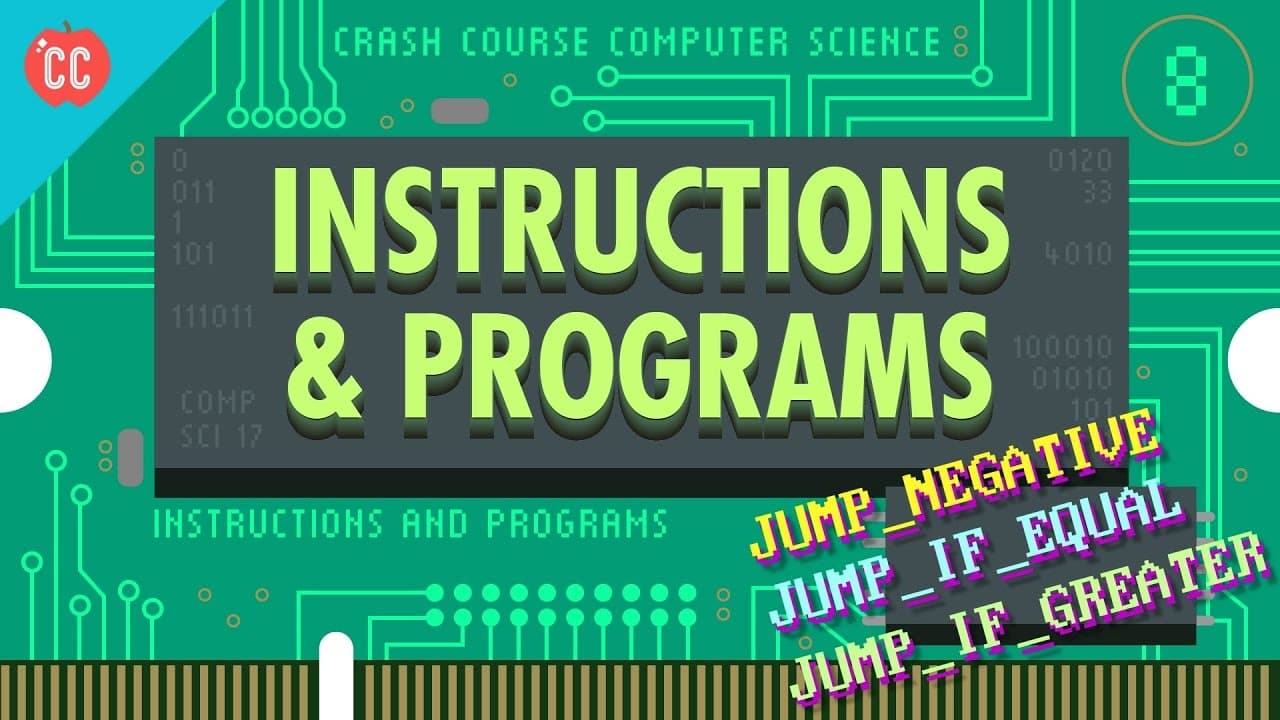
Instructions & Programs: Crash Course Computer Science #8
897.7K views
•
April 12, 2017
by
CrashCourse
YouTube video player
Instructions & Programs: Crash Course Computer Science #8

TL;DR

CPUs are programmable hardware controlled by software, which allows them to perform different tasks based on the instructions given to them.

Transcript

Hi, I’m Carrie Anne and this is Crash Course Computer Science! Last episode, we combined an ALU, control unit, some memory, and a clock together to make a basic, but functional Central Processing Unit – or CPU – the beating, ticking heart of a computer. We’ve done all the hard work of building many of these components from the electronic circuits u... Read More

Key Insights

  • 🎭 CPUs are powerful because they can be programmed to perform different tasks by changing the instructions they execute.
  • ®️ Instructions in CPU programming consist of opcodes and addresses or registers.
  • 👻 Conditional jumps allow programs to change their execution path based on certain conditions.
  • 🍳 Infinite loops can occur in CPU programs, and specific conditions or instructions are used to break out of them.
  • 🔶 Real CPUs use larger instruction lengths or variable length instructions to support more instructions and address a larger range of memory.
  • 🐿️ The 4004 processor by Intel in 1971 was the first CPU on a single chip and supported 46 instructions.
  • ❓ Modern CPUs have thousands of instructions, with varying lengths, to support advanced features and functionalities.

Install to Summarize YouTube Videos and Get Transcripts

Explore YouTube Video Summarizer or Get YouTube Transcript Extractor

Questions & Answers

Q: How is CPU programming different from hardware design?

CPU programming involves creating software instructions that control the hardware, while hardware design focuses on building the physical components of a CPU.

Q: How are instructions represented in computer memory?

Instructions are represented as binary numbers in memory, with opcodes indicating the operation and addresses specifying the location of data or other instructions.

Q: What is the purpose of conditional jumps in CPU programming?

Conditional jumps allow the program to change its execution path based on certain conditions, such as the result of an arithmetic operation or the value of a flag.

Q: How do CPUs handle infinite loops?

CPUs can get stuck in infinite loops, which are programs that run forever. To break the loop, conditional jumps with specific conditions are used to control the program flow.

Summary & Key Takeaways

  • CPUs are powerful because they are programmable and can perform different tasks based on the instructions given to them.

  • Instructions are stored in computer memory and are made up of opcodes and addresses or registers.

  • Programs can be created by combining different instructions to perform specific tasks.


Read in Other Languages (beta)

English

Share This Summary 📚

Summarize YouTube Videos and Get Video Transcripts with 1-Click

Download browser extensions on:

Try YouTube Summary with ChatGPT & Claude or YouTube Transcript Generator

Explore More Summaries from CrashCourse 📚

How to Transfer Colleges | Crash Course | How to College thumbnail
How to Transfer Colleges | Crash Course | How to College
CrashCourse
How to Seek Help and Find Key Partners: Crash Course Entrepreneurship #9 thumbnail
How to Seek Help and Find Key Partners: Crash Course Entrepreneurship #9
CrashCourse
What Are Aldehydes and Ketones in Organic Chemistry? thumbnail
What Are Aldehydes and Ketones in Organic Chemistry?
CrashCourse
What Are Biomaterials in Medical Engineering? thumbnail
What Are Biomaterials in Medical Engineering?
CrashCourse
Soviet Montage: Crash Course Film History #8 thumbnail
Soviet Montage: Crash Course Film History #8
CrashCourse
What Led to the Heliocentric Astronomy Revolution? thumbnail
What Led to the Heliocentric Astronomy Revolution?
CrashCourse

Summarize YouTube Videos and Get Video Transcripts with 1-Click

Download browser extensions on:

Try YouTube Summary with ChatGPT & Claude or YouTube Transcript Generator

Apps & Extensions

  • Chrome Extension
  • Safari Extension
  • Edge Add-ons
  • Firefox Add-ons
  • iOS App
  • Android App

Key Features

  • YouTube Video Summarizer
  • Web & PDF Summarizer
  • Web & PDF Highlighter
  • Chat with PDF
  • Ask AI Clone
  • Audio Transcriber
  • Glasp Reader
  • Kindle Highlight Export
  • Idea Hatch

Integrations

  • Obsidian Plugin
  • Notion Integration
  • Pocket Integration
  • Instapaper Integration
  • Medium Integration
  • Readwise Integration
  • Snipd Integration
  • Hypothesis Integration

More Features

  • APIs
  • MCP Connector
  • Blog & Post
  • Embed Links
  • Image Highlight
  • Personality Test
  • Quote Shots

Company

  • About us
  • Blog
  • Community
  • FAQs
  • Job Board
  • Newsletter
  • Pricing
Terms

•

Privacy

•

Guidelines

© 2026 Glasp Inc. All rights reserved.