How can Tree Diagrams aid in Probability Problems?
TL;DR
Tree diagrams simplify the process of solving probability questions by visually representing possible outcomes of events. These diagrams differentiate results based on whether selections are made with or without replacement, impacting the probabilities calculated for each scenario.
Transcript
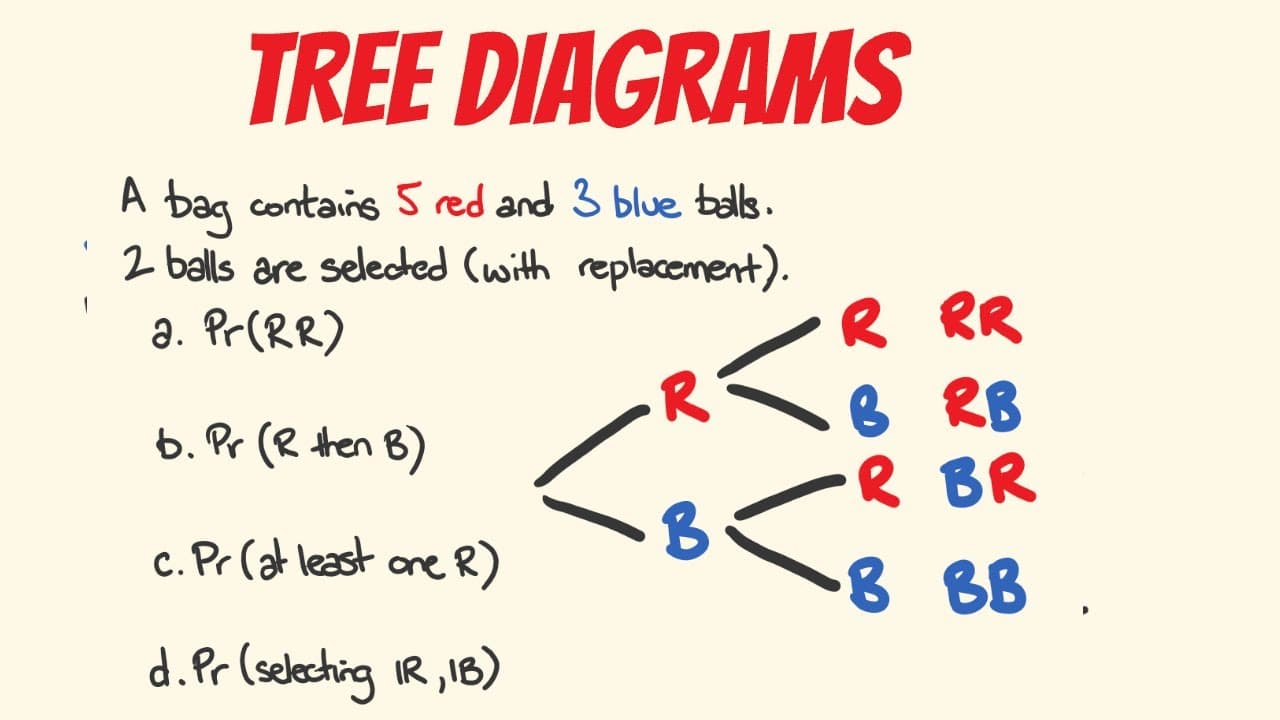
good day welcome to the techmath channel I'm Josh in this video we're going to be looking at tree diagrams and how they can be used to help us solve probability questions that look like this one here so what about we just launch into this example a bag contains five red and three blue balls Al together as you can know that's eight balls so two ball... Read More
Key Insights
- 🌲 Tree diagrams break down sequential events to calculate probabilities effectively.
- 💬 The selection process of balls with replacement or without replacement influences the probabilities of outcomes.
- 💬 Understanding the total number of balls and the remaining balls after each selection is crucial for accurate probability calculations.
- 🦻 Visual representations like tree diagrams aid in solving complex probability questions efficiently.
- 😪 Probability outcomes like red than red, red than blue, and at least one red require careful analysis of event probabilities in tree diagrams.
- 🦻 Simplifying probabilities by reducing fractions aids in interpreting and comparing different outcomes.
- 🌲 The process of multiplication in tree diagrams helps determine the combined probability of sequential events accurately.
Install to Summarize YouTube Videos and Get Transcripts
Explore YouTube Video Summarizer or Get YouTube Transcript Extractor
Questions & Answers
Q: What is the significance of using a tree diagram in solving probability questions?
Tree diagrams visually represent the outcomes of sequential events, making it easier to calculate probabilities by breaking down the possibilities at each step.
Q: How does the process of selecting balls differ when using replacement versus without replacement?
With replacement, the ball selected is returned to the bag, affecting the probability for subsequent selections, while without replacement, the ball chosen is not put back, changing the probabilities for subsequent picks.
Q: Why do probabilities of outcomes vary when calculating with replacement and without replacement?
Probabilities change because the total number of balls available for selection decreases with each pick without replacement, impacting the chances of selecting specific colored balls.
Q: How do tree diagrams simplify the calculation of complex probabilities in probability questions?
Tree diagrams help organize and visualize the possible outcomes at each step, allowing for a clear understanding of how different events affect the overall probability of specific outcomes.
Summary & Key Takeaways
-
Tree diagrams help solve probability questions with replacement (putting the ball back after selection) and without replacement.
-
Calculating probabilities of different outcomes like red than red, red than blue, at least one red, and one red and one blue.
-
Probability calculations differ based on the total number of balls and the type of selection process used.
Read in Other Languages (beta)
Share This Summary 📚
Summarize YouTube Videos and Get Video Transcripts with 1-Click
Try YouTube Summary with ChatGPT & Claude or YouTube Transcript Generator
Explore More Summaries from tecmath 📚

Summarize YouTube Videos and Get Video Transcripts with 1-Click
Try YouTube Summary with ChatGPT & Claude or YouTube Transcript Generator