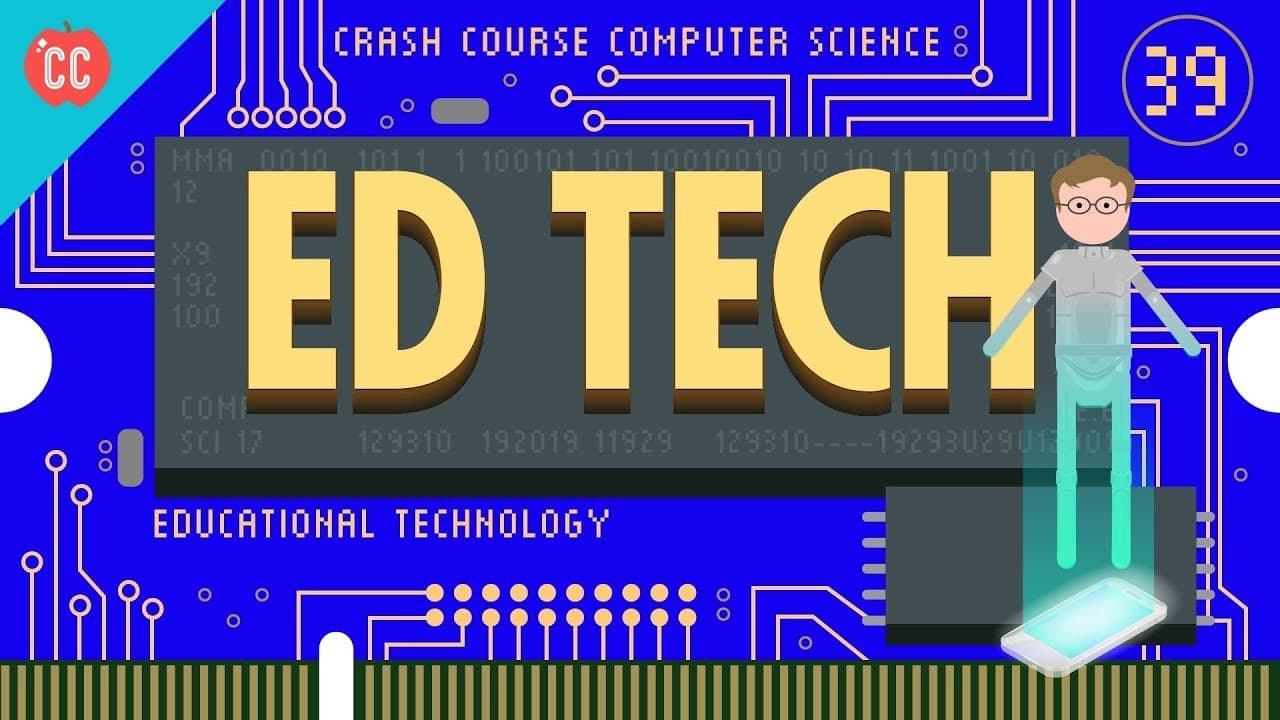
Educational Technology: Crash Course Computer Science #39
TL;DR
Explores educational technology's role in enhancing learning through computer science.
Transcript
Hi, I’m Carrie Anne, and welcome to Crash Course Computer Science! One of the most dramatic changes enabled by computing technology has been the creation and widespread availability of information. There are currently 1.3 billion websites on the internet. Wikipedia alone has five million English language articles, spanning everything from the Danci... Read More
Key Insights
- The internet hosts 1.3 billion websites, providing vast information access, but learning requires more than just availability.
- Educational technology has evolved from ancient cave paintings to modern AI-driven systems, supporting distance learning for centuries.
- Interactive in-class learning and educational technology complement each other, enhancing education both inside and outside classrooms.
- MOOCs, despite initial hype, haven't replaced traditional universities due to scalability and feedback challenges.
- Intelligent Tutoring Systems use AI to personalize learning, adapting content to individual student needs based on their knowledge level.
- Bayesian knowledge tracing helps intelligent systems assess student knowledge, updating estimates based on their problem-solving performance.
- Educational Data Mining analyzes learner interactions to improve personalized learning, identifying common challenges and student behaviors.
- Future educational technologies may include virtual agents, VR experiences, and even direct brain learning, transforming how we acquire knowledge.
Install to Summarize YouTube Videos and Get Transcripts
Explore YouTube Video Summarizer or Get YouTube Transcript Extractor
Questions & Answers
Q: How has educational technology evolved over time?
Educational technology has evolved significantly, beginning with ancient cave paintings that recorded knowledge for posterity. Over centuries, it has progressed through various media, including radio, television, and DVDs, to modern AI-driven systems. Each technological wave aimed to revolutionize education, making learning more accessible and interactive.
Q: What are the challenges of using MOOCs in education?
MOOCs face challenges like scalability and providing timely, relevant feedback to millions of learners with limited instructional staff. The initial hype around MOOCs suggested they might replace traditional universities, but these challenges have prevented that. Effective learning requires personalized feedback and interaction, which MOOCs struggle to provide at scale.
Q: How do Intelligent Tutoring Systems personalize learning?
Intelligent Tutoring Systems personalize learning by using AI to adapt educational content based on individual student needs. They employ techniques like Bayesian knowledge tracing to assess what a student knows and doesn't know, allowing the system to present the right material at the right time, focusing on areas where the student needs more practice.
Q: What is Bayesian knowledge tracing?
Bayesian knowledge tracing is a technique used by Intelligent Tutoring Systems to assess student knowledge. It treats student knowledge as a set of latent variables, updating estimates based on problem-solving performance. By observing whether a student answers correctly, the system adjusts its understanding of the student's knowledge, aiding in personalized learning.
Q: How does Educational Data Mining improve learning?
Educational Data Mining analyzes data from millions of learners to identify common challenges, student behaviors, and areas of frustration. By examining interactions like response times and forum discussions, it helps improve personalized learning experiences, enabling educators to refine educational technology and better support student learning outcomes.
Q: What future technologies are envisioned for education?
Future educational technologies may include virtual agents, VR experiences, and direct brain learning. Inspired by science fiction, these innovations aim to provide immersive, personalized learning experiences, enabling students to explore new environments and acquire skills directly in their brains, potentially transforming how knowledge is acquired and shared.
Q: What role do virtual agents play in education?
Virtual agents in education act as interactive digital tutors, providing personalized feedback and support. They simulate human conversation, building trust and rapport with students. These agents can adapt to student needs, offering guidance and encouragement, potentially enhancing learning experiences by making them more engaging and effective.
Q: How might direct brain learning change education?
Direct brain learning could revolutionize education by allowing skills and knowledge to be uploaded directly to the brain. This futuristic concept would bypass traditional learning methods, enabling rapid acquisition of new abilities. While still speculative, advancements in neuroscience and technology hint at the potential for such transformative educational experiences.
Summary & Key Takeaways
-
The video discusses the transformative impact of educational technology on learning, highlighting its evolution from ancient methods to modern AI systems. It emphasizes the complementary role of interactive learning and educational technology, exploring how tools like MOOCs and Intelligent Tutoring Systems enhance education both inside and outside classrooms.
-
The challenges and potential of scaling educational technology, such as MOOCs, are examined, highlighting the importance of feedback and personalization. Intelligent Tutoring Systems use AI to adapt learning experiences to individual students, employing techniques like Bayesian knowledge tracing to assess and improve student knowledge.
-
Future educational technologies, inspired by science fiction, include virtual agents and immersive experiences like VR. The video speculates on the potential for direct brain learning, where skills could be uploaded directly to the brain, revolutionizing how we acquire and share knowledge.
Read in Other Languages (beta)
Share This Summary 📚
Summarize YouTube Videos and Get Video Transcripts with 1-Click
Try YouTube Summary with ChatGPT & Claude or YouTube Transcript Generator
Explore More Summaries from CrashCourse 📚


Summarize YouTube Videos and Get Video Transcripts with 1-Click
Try YouTube Summary with ChatGPT & Claude or YouTube Transcript Generator