How Similar Are Biblical Hebrew and Biblical Aramaic?
TL;DR
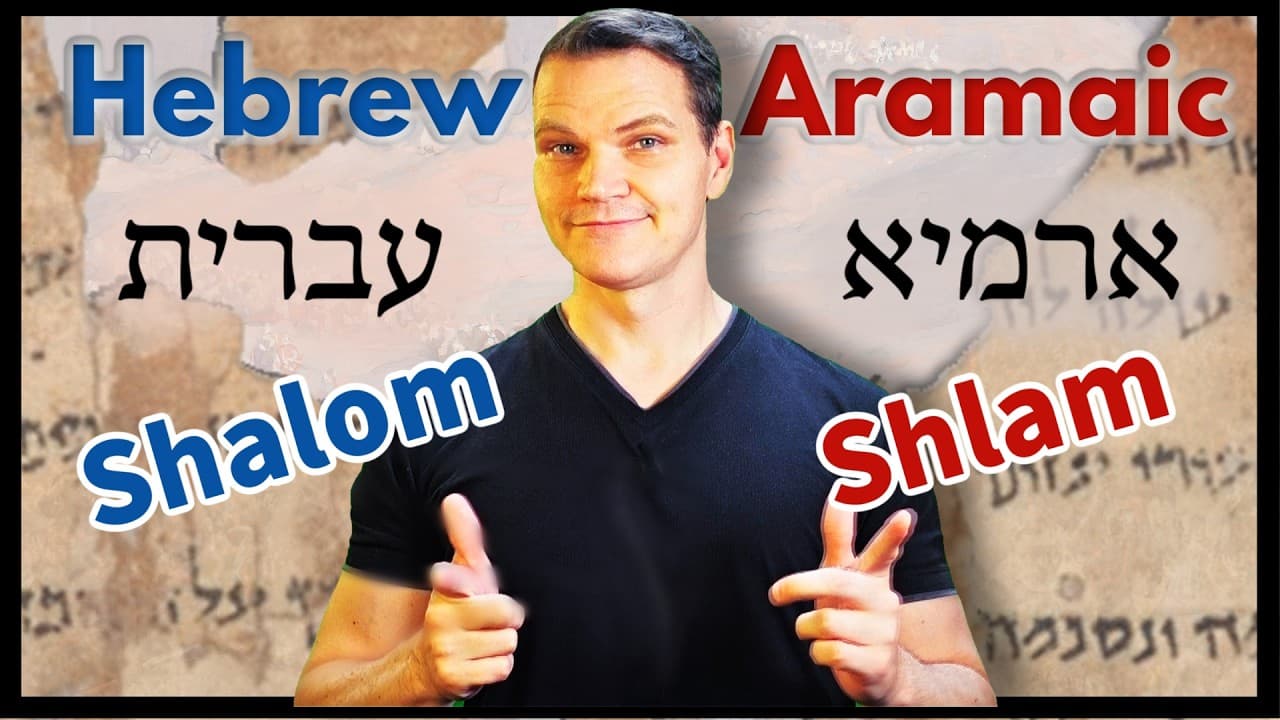
The video covers a deep dive into the similarities and differences between Biblical Hebrew and Biblical Aramaic, exploring their historical contexts, linguistic features, and grammatical structures. It provides a comprehensive guide to understanding how these sister languages relate within the context of the Hebrew Bible and beyond.
Transcript
as you probably know the Hebrew Bible known as the Old Testament by Christians was mainly written in Hebrew the language of the ancient Hebrews 99% of the Bible was written in this ancient form of the language that we now call Biblical Hebrew but you may not know that the remaining one% was written in a different language Aramaic Aramaic was widely... Read More
Key Insights
- Biblical Hebrew and Biblical Aramaic are closely related languages, both part of the Northwest Semitic language family, yet they exhibit distinct linguistic features.
- Aramaic was widely spoken in ancient empires such as the Assyrian and Babylonian, leading to its presence in the Hebrew Bible alongside Hebrew.
- Both languages share a similar system of word formation, using roots typically consisting of three consonants, which are then modified with affixes and vowels.
- Sound correspondences between the languages include notable shifts, such as certain consonants and vowels evolving differently in each language over time.
- While many words are cognates, meaning they share a common origin, there are differences in pronunciation and usage, reflecting historical linguistic developments.
- Grammatical differences include variations in the definite article and the expression of existence, as well as the absence of the waw-conversive in Aramaic.
- The video examines specific verses from the Bible, comparing their Aramaic and Hebrew versions to illustrate linguistic similarities and differences.
- The Targums, Aramaic translations of the Hebrew Bible, offer insights into the language's evolution and its relationship with Hebrew through paraphrased retellings.
Install to Summarize YouTube Videos and Get Transcripts
Explore YouTube Video Summarizer or Get YouTube Transcript Extractor
Questions & Answers
Q: What percentage of the Hebrew Bible is written in Aramaic?
Approximately 1% of the Hebrew Bible is written in Aramaic. This small portion includes sections that were composed during the time when Aramaic was widely spoken in the Assyrian and Babylonian empires, reflecting its historical significance and influence.
Q: How are Biblical Hebrew and Aramaic related linguistically?
Biblical Hebrew and Aramaic are sister languages, both belonging to the Northwest branch of the Semitic language family. They share similarities in word formation and vocabulary, with many cognates and shared linguistic features, though they also have distinct differences in grammar and pronunciation.
Q: What are some examples of cognate words in Biblical Hebrew and Aramaic?
Examples of cognate words include the word for 'house' (bayit in Hebrew and bayta in Aramaic), 'stone' (eben in Hebrew and eben in Aramaic), and 'wisdom' (chokhmah in Hebrew and chokhmata in Aramaic). These words share similar roots and meanings, illustrating their common linguistic heritage.
Q: What are some grammatical differences between Biblical Hebrew and Aramaic?
Grammatical differences include the use of the definite article, with Hebrew using a prefixed 'he' and Aramaic using a suffixed 'alif.' Additionally, Aramaic lacks the waw-conversive found in Hebrew, and the languages differ in how they express existence and negation.
Q: How do the sound correspondences differ between the two languages?
Sound correspondences show that certain consonants and vowels evolved differently. For example, the Hebrew 'shin' (sh) might correspond to Aramaic 'tav' (t), and Hebrew long 'a' class vowels shifted to 'o' class vowels, demonstrating historical linguistic shifts.
Q: What role did the Targums play in the relationship between Hebrew and Aramaic?
The Targums are Aramaic translations of the Hebrew Bible that include additional commentary. They were written centuries after the original Aramaic parts of the Bible and illustrate how Aramaic evolved over time, reflecting its continued use and relationship with Hebrew.
Q: How do the languages handle the expression of existence?
In Biblical Hebrew, the particle 'yesh' indicates existence, while in Biblical Aramaic, 'i' is used. For negation, Aramaic adds 'la' before 'i,' whereas Hebrew uses a different word in place of 'yesh.' These differences highlight variations in expressing fundamental concepts.
Q: What is the significance of the waw-conversive in Biblical Hebrew?
The waw-conversive in Biblical Hebrew is a grammatical feature that reverses a verb's tense or aspect, often used in literary contexts. It adds complexity to Hebrew syntax, offering nuance in expressing time and action, a feature not present in Biblical Aramaic.
Summary & Key Takeaways
-
The video explores the linguistic relationship between Biblical Hebrew and Biblical Aramaic, highlighting their historical and cultural contexts. It delves into their shared origins, examining cognate vocabulary and sound correspondences while outlining their grammatical differences.
-
Key grammatical differences include the use of the definite article and the absence of the waw-conversive in Aramaic. The video also compares specific biblical verses to illustrate these linguistic nuances.
-
The video further discusses the Targums, Aramaic translations of the Hebrew Bible, as paraphrased retellings that demonstrate the language's evolution and its close ties to Hebrew, offering a comprehensive linguistic analysis.
Read in Other Languages (beta)
Share This Summary 📚
Summarize YouTube Videos and Get Video Transcripts with 1-Click
Try YouTube Summary with ChatGPT & Claude or YouTube Transcript Generator
Explore More Summaries from Langfocus 📚





Summarize YouTube Videos and Get Video Transcripts with 1-Click
Try YouTube Summary with ChatGPT & Claude or YouTube Transcript Generator