What Is the Evolution of German Theater?
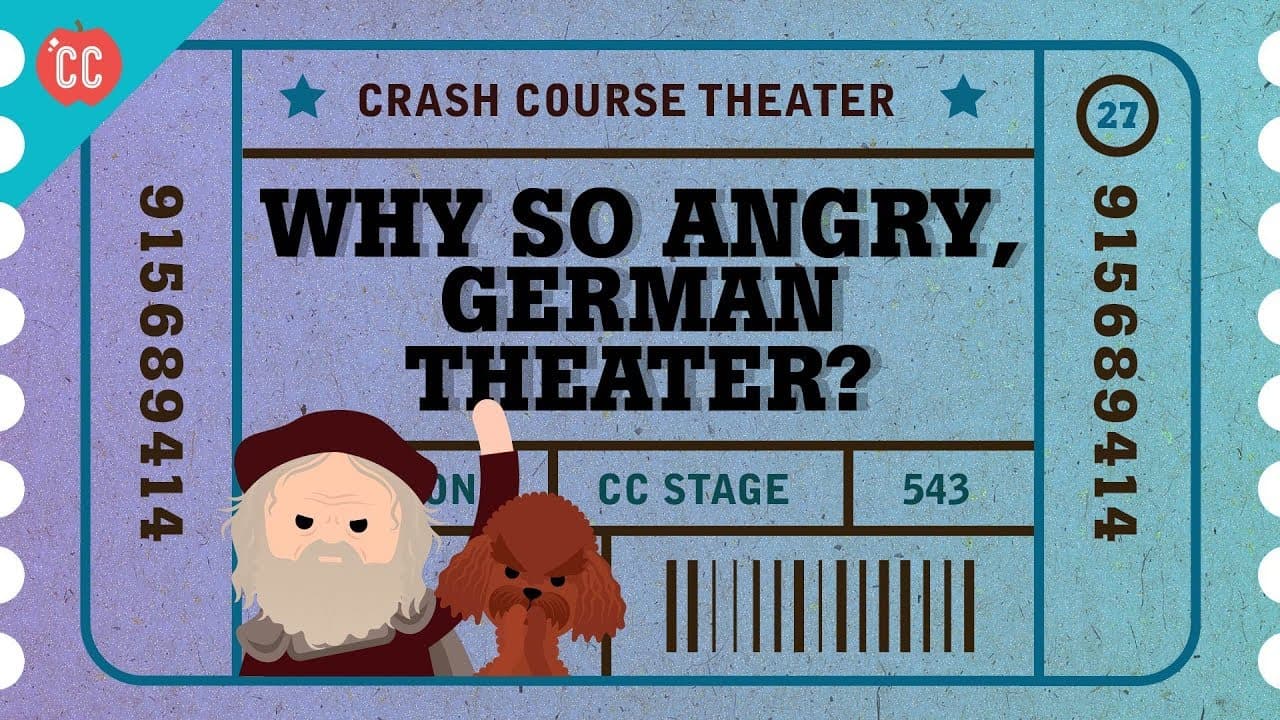
TL;DR
The evolution of German theater features a transition from Enlightenment ideals to Romanticism, marked by movements such as Sturm Und Drang and Weimar Classicism. Key figures include G.E. Lessing, who introduced realistic bourgeois plays, and Goethe, whose seminal work 'Faust' encapsulates these themes of individualism, emotional intensity, and the quest for knowledge and power.
Transcript
Hey, there! I'm Mike Rugnetta. This is Crash Course Theatre, and today, we're feeling stressed, but also romantic and sometimes classical. It's an emotional whatever mileage is in German because we're exploring the German theatre of the late 18th and early 19th centuries when playwrights rebelled against the enlightenment and bourgeois society by... Read More
Key Insights
- German theater's development was delayed due to the country's late unification, with early influences from French and Italian theater.
- Hanswurst, a Bavarian clown, was a significant figure in early German theater, symbolizing popular comedic entertainment.
- G.E. Lessing was a pioneer in German theater, introducing bourgeois comedies and tragedies that attracted middle-class audiences.
- The Sturm Und Drang movement, characterized by emotional intensity and individualism, emerged as a reaction against Enlightenment rationalism.
- Weimar Classicism, inspired by Greek and Roman models, emphasized reason and order, contrasting with Sturm Und Drang's emotional approach.
- Romanticism in theater prioritized emotions and nature over intellect and culture, often depicting idealized or fantastical settings.
- Goethe's 'Faust' embodies elements of Sturm Und Drang, Romanticism, and Weimar Classicism, exploring themes of knowledge, power, and spiritual longing.
- Romantic playwrights often doubted the stageability of their works, leading to the creation of 'closet dramas' meant for reading rather than performance.
Install to Summarize YouTube Videos and Get Transcripts
Explore YouTube Video Summarizer or Get YouTube Transcript Extractor
Questions & Answers
Q: What delayed the development of German theater?
The development of German theater was delayed primarily due to the late unification of Germany. Until the mid-1800s, Germany was a collection of separate provinces and city-states, which made it challenging to establish a cohesive national theater. Additionally, early German theater heavily relied on foreign influences, particularly from France and Italy.
Q: Who was Hanswurst and why was he significant?
Hanswurst, also known as John Sausage, was a Bavarian clown character that became a staple in early German theater. He symbolized popular comedic entertainment and was a favorite among common people. Hanswurst's character was integral to the theatrical tradition before more serious German theater emerged in the mid-18th century.
Q: What was the Sturm Und Drang movement?
The Sturm Und Drang movement, meaning 'Storm and Stress,' emerged in the late 18th century as a reaction against Enlightenment rationalism. It was characterized by emotional intensity, individualism, and a focus on the darker aspects of human nature. The movement's plays often featured passionate characters and dramatic conflicts, challenging societal norms.
Q: How did Weimar Classicism differ from Sturm Und Drang?
Weimar Classicism differed from Sturm Und Drang by emphasizing reason, order, and classical ideals. Inspired by Greek and Roman models, Weimar Classicism sought to create a theater that was beautiful and transformative, in contrast to the emotional and chaotic nature of Sturm Und Drang. It aimed to reveal greater truths through structured and harmonious storytelling.
Q: What role did Romanticism play in German theater?
Romanticism in German theater emerged as a profound reaction against Enlightenment certainties and the industrial revolution's social changes. It emphasized emotions over intellect and instinct over reason. Romantic playwrights often set their works in idealized pasts or imagined futures, exploring themes of individualism and spiritual longing, and frequently doubted the stageability of their plays.
Q: What themes are explored in Goethe's 'Faust'?
Goethe's 'Faust' explores themes of knowledge, power, and spiritual longing. It combines elements of Sturm Und Drang, Romanticism, and Weimar Classicism, depicting Faust's internal torment and quest for a moment of perfect happiness. The play reflects the tension between intellectual ambition and moral consequences, ultimately questioning the nature of human fulfillment.
Q: How did Romantic playwrights approach the staging of their works?
Romantic playwrights often doubted that their plays could be successfully produced on stage, leading them to create 'closet dramas' intended for reading rather than performance. These works focused on representing passion and emotion without adhering to strict theatrical conventions, allowing readers to imagine the dramatic action in their minds rather than witnessing it on stage.
Q: What was the impact of Goethe's tenure at the Weimar court theatre?
During his 26-year tenure at the Weimar court theatre, Goethe significantly advanced German theater by training actors in verse speaking and naturalistic acting. He also introduced more specific and painterly blocking techniques, moving away from haphazard staging. Although his plays formed only a small part of the repertory, his influence helped shape the development of German theater.
Summary & Key Takeaways
-
German theater took time to establish due to the country's late unification, initially relying on foreign influences. The emergence of figures like Hanswurst and playwrights such as G.E. Lessing marked the beginning of a unique German theatrical tradition, eventually leading to movements like Sturm Und Drang and Weimar Classicism.
-
Sturm Und Drang was a reaction against Enlightenment ideals, focusing on emotional intensity and individualism. It was followed by Weimar Classicism, which returned to classical models emphasizing reason and order. Romanticism later emerged, prioritizing emotion and nature, often set in fantastical or idealized worlds.
-
Goethe's 'Faust' is a seminal work in German theater, combining elements of Sturm Und Drang, Romanticism, and Weimar Classicism. It explores themes of knowledge, power, and spiritual longing, reflecting the complex evolution of German theatrical movements and their impact on European drama.
Read in Other Languages (beta)
Share This Summary 📚
Summarize YouTube Videos and Get Video Transcripts with 1-Click
Try YouTube Summary with ChatGPT & Claude or YouTube Transcript Generator
Explore More Summaries from CrashCourse 📚


Summarize YouTube Videos and Get Video Transcripts with 1-Click
Try YouTube Summary with ChatGPT & Claude or YouTube Transcript Generator