How to Conduct Hypothesis Testing Using Z and T Tests?
TL;DR
To conduct hypothesis testing for the population mean, first, state the null and alternative hypotheses. Use a Z test for samples over 30 or T test for smaller samples, then calculate the test statistic and compare it to the critical value to decide if the null hypothesis should be rejected.
Transcript
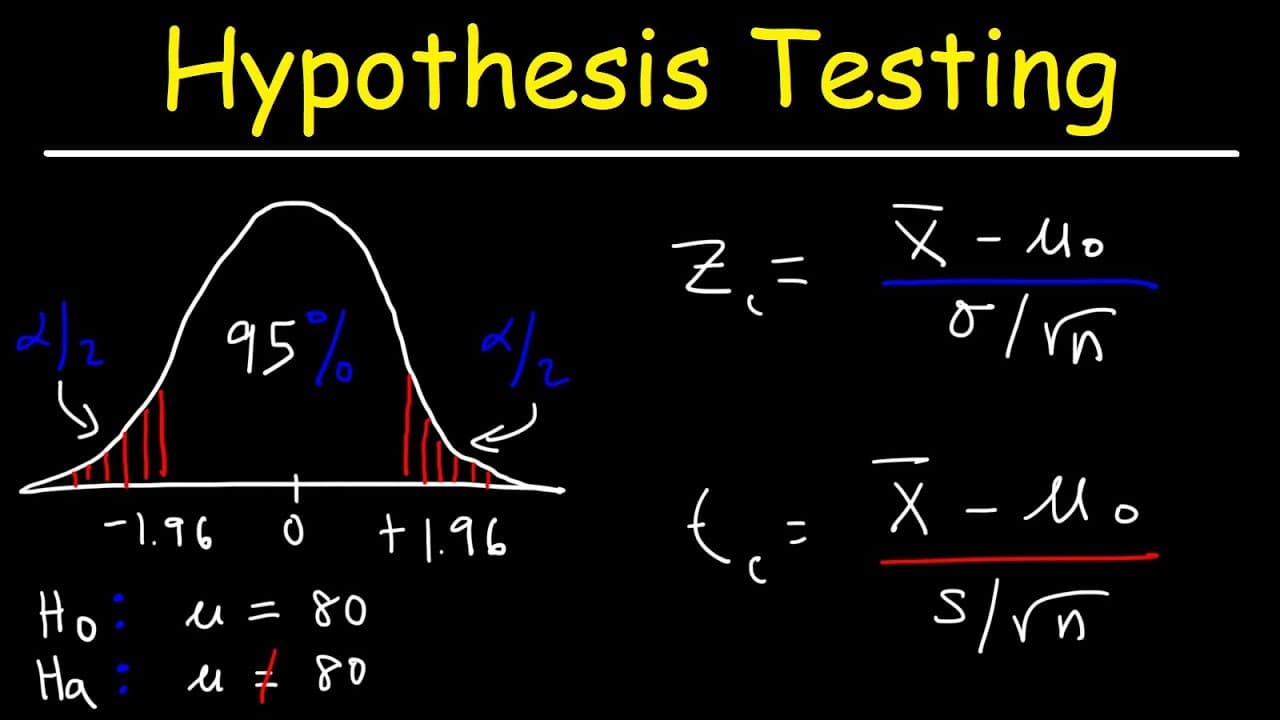
in this video we're going to work on some problems that relates to hypothesis testing of the population mean so let's start with this one number one a factory has a machine that dispenses 80 milliliters of fluid in a bottle an employee believes the average amount of fluid is not 80 milliliters using 40 samples he measures the average amount dispens... Read More
Key Insights
- 🏆 Hypothesis testing involves stating null and alternative hypotheses and comparing a calculated test statistic to a critical value.
- 🍸 The type of test (one-tailed or two-tailed) depends on the alternative hypothesis.
- 🏆 The critical value is determined based on the chosen confidence level and the type of test.
- 🏆 The calculated test statistic is compared to the critical value to determine if the null hypothesis should be rejected or not.
- ⚾ Hypothesis testing enables analysis and decision-making based on sample data.
- 🏆 The size of the sample and nature of the alternative hypothesis can influence the choice between using a z-test or t-test.
- 🎚️ The result of hypothesis testing provides a level of confidence in the conclusion.
Install to Summarize YouTube Videos and Get Transcripts
Explore YouTube Video Summarizer or Get YouTube Transcript Extractor
Questions & Answers
Q: How do you state the null and alternative hypotheses in hypothesis testing?
The null hypothesis represents the status quo or what is being tested against, while the alternative hypothesis is what is being tested. In the first example, for the null hypothesis, the average amount of fluid dispensed by the machine is equal to 80 milliliters. The alternative hypothesis is that the average amount of fluid is not 80 milliliters. In the second example, the null hypothesis is that the average lifespan of car batteries is equal to or greater than two years, while the alternative hypothesis is that the average lifespan is less than two years.
Q: How do you determine the type of test, one-tailed or two-tailed?
In hypothesis testing, the type of test depends on the alternative hypothesis. If the alternative hypothesis specifies a range of values (not equal to), it is a two-tailed test. If the alternative hypothesis specifies a direction (greater than/less than), it is a one-tailed test. In the first example, the alternative hypothesis does not equal 80, so it is a two-tailed test. In the second example, the alternative hypothesis is less than two, making it a one-tailed test.
Q: How do you determine if there is enough evidence to support the alternative hypothesis?
To determine if there is enough evidence to support the alternative hypothesis, compare the calculated test statistic (such as z-value or t-value) to the critical value. The critical value is determined based on the chosen confidence level and the type of test. If the calculated test statistic falls within the rejection region (shaded area), the null hypothesis is rejected. Otherwise, the null hypothesis is not rejected.
Q: What is the significance of the confidence level in hypothesis testing?
The confidence level indicates the proportion of times the statistical procedure (such as hypothesis testing) will produce the correct result. A 95% confidence level means that in repeated sampling, the procedure will produce the correct result 95% of the time. It helps determine the level of certainty or precision desired in the conclusion.
Summary & Key Takeaways
-
The first example involves a factory testing whether the average amount of fluid dispensed by a machine is equal to 80 milliliters or not.
-
The second example involves an engineer testing whether the average lifespan of car batteries is less than two years.
Read in Other Languages (beta)
Share This Summary 📚
Summarize YouTube Videos and Get Video Transcripts with 1-Click
Try YouTube Summary with ChatGPT & Claude or YouTube Transcript Generator
Explore More Summaries from The Organic Chemistry Tutor 📚
Summarize YouTube Videos and Get Video Transcripts with 1-Click
Try YouTube Summary with ChatGPT & Claude or YouTube Transcript Generator