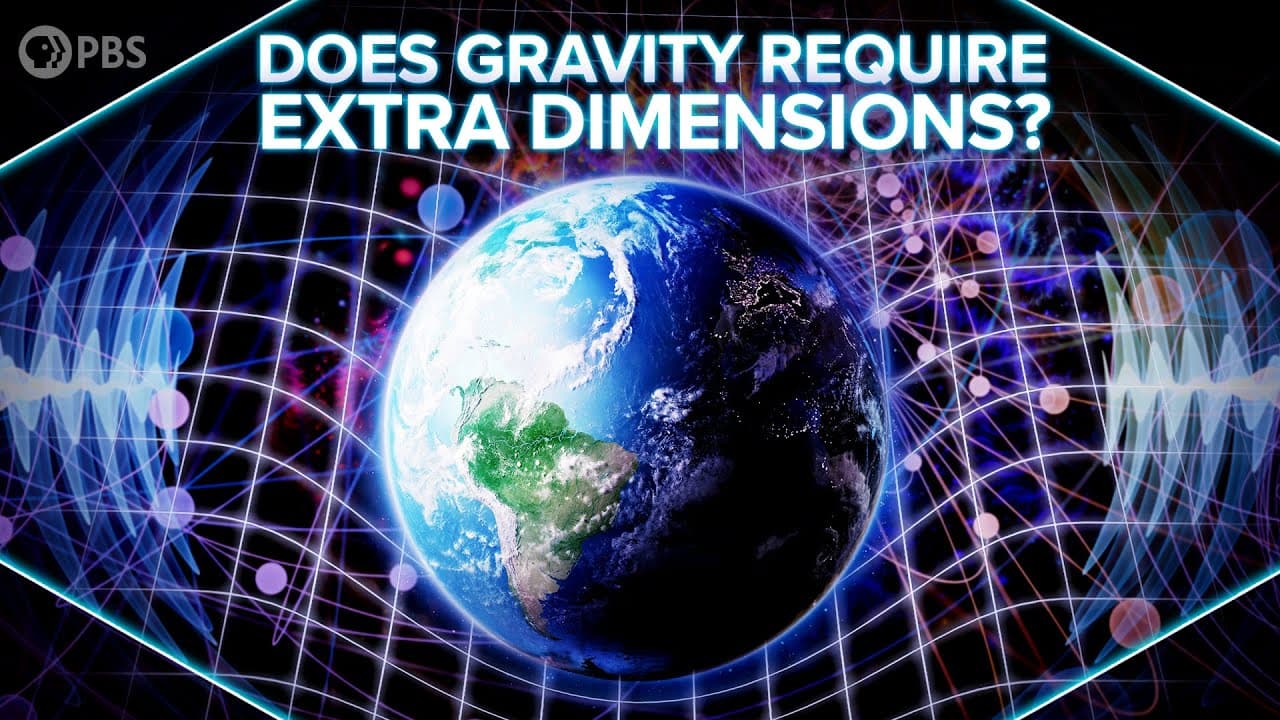
Does Gravity Require Extra Dimensions?
TL;DR
Gravity's mysteries may unveil extra dimensions through Cavendish experiment insights.
Transcript
It’s been 120 years since Henry Cavendish measured the gravitational constant with a pair of lead balls suspended by a wire. The fundamental nature of gravity still eludes our best minds - but those secrets may be revealed by turning back to the Cavendish experiment. That steampunk contraption may even reveal the existence of extra dimensions of sp... Read More
Key Insights
- The Cavendish experiment, initially conducted by Henry Cavendish, remains pivotal in understanding gravity's fundamental nature and may reveal extra spatial dimensions.
- Gravity is significantly weaker than other fundamental forces, a discrepancy known as the hierarchy problem, which may be explained by additional spatial dimensions.
- Newton's inverse square law indicates three spatial dimensions, but theories suggest more dimensions could exist, possibly compactified and affecting gravity's strength.
- String theory proposes six additional compactified dimensions, potentially explaining gravity's weakness compared to other forces.
- Modern Cavendish experiments, with advanced precision, continue to search for deviations from the inverse square law, hinting at extra dimensions.
- Despite advances, current measurements uphold the three-dimensional model, limiting certain theories but leaving room for further exploration of compactified dimensions.
- The inverse square law's consistency down to micrometer scales constrains theories proposing extra dimensions, yet string theory remains untested at these scales.
- The Casimir effect complicates measurements below micrometer scales, posing challenges for future experiments aiming to detect compactified dimensions.
Install to Summarize YouTube Videos and Get Transcripts
Explore YouTube Video Summarizer or Get YouTube Transcript Extractor
Questions & Answers
Q: What is the hierarchy problem in gravity?
The hierarchy problem refers to the vast difference in strength between gravity and the other fundamental forces. Gravity is approximately 10^24 times weaker than the weak nuclear force, and understanding this discrepancy could help unify gravity with the other forces and reveal its true nature.
Q: How does the Cavendish experiment relate to extra dimensions?
The Cavendish experiment, which measures the gravitational constant, could also detect deviations from the inverse square law at small scales. Such deviations might indicate the presence of extra spatial dimensions, possibly compactified, which could explain gravity's relative weakness compared to other forces.
Q: What are compactified dimensions?
Compactified dimensions are additional spatial dimensions that are theorized to be tightly wound or 'compactified' at small scales, making them unobservable at larger scales. These dimensions are a key concept in string theory and could potentially explain why gravity is weaker than other fundamental forces, as gravity might propagate through these extra dimensions.
Q: How do modern Cavendish experiments differ from the original?
Modern Cavendish experiments use advanced technologies such as vacuum environments, precise temperature control, and sophisticated measurement techniques to increase precision. These advancements allow for closer positioning of test masses and more accurate detection of gravitational forces, potentially revealing deviations from the inverse square law indicative of extra dimensions.
Q: What role does string theory play in understanding gravity?
String theory suggests the existence of additional compactified dimensions beyond the familiar three spatial dimensions. These extra dimensions could explain the hierarchy problem by allowing gravity to propagate through them, thus diluting its perceived strength in our observable universe. String theory remains a promising framework for unifying gravity with other forces.
Q: Why is the inverse square law important in studying dimensions?
The inverse square law, which describes how gravitational force decreases with the square of the distance, is fundamental in determining the number of spatial dimensions. Deviations from this law at small scales could indicate the presence of extra dimensions, as gravity would spread differently in a higher-dimensional space.
Q: What challenges exist in detecting compactified dimensions?
Detecting compactified dimensions is challenging due to their small scale, which requires extremely precise measurements. The Casimir effect, which involves quantum vacuum fluctuations, complicates experiments at sub-micrometer scales, making it difficult to isolate potential gravitational deviations indicative of extra dimensions.
Q: How do extra dimensions affect gravity's strength?
Extra dimensions could affect gravity's strength by allowing it to propagate through more than the familiar three spatial dimensions. This would dilute gravity's force more quickly, potentially explaining its relative weakness compared to other forces. Compactified dimensions might also lead to energy sapping within these dimensions, further affecting gravity's behavior.
Summary & Key Takeaways
-
The Cavendish experiment, essential for measuring the gravitational constant, may also uncover extra spatial dimensions, addressing the hierarchy problem of gravity's relative weakness.
-
Newton's inverse square law supports three spatial dimensions, but modern theories suggest additional compactified dimensions could explain gravity's unique characteristics.
-
Despite precise modern experiments affirming the three-dimensional model, the search for compactified dimensions continues, with string theory offering a potential framework for understanding gravity.
Read in Other Languages (beta)
Share This Summary 📚
Summarize YouTube Videos and Get Video Transcripts with 1-Click
Try YouTube Summary with ChatGPT & Claude or YouTube Transcript Generator
Explore More Summaries from PBS Space Time 📚


Summarize YouTube Videos and Get Video Transcripts with 1-Click
Try YouTube Summary with ChatGPT & Claude or YouTube Transcript Generator