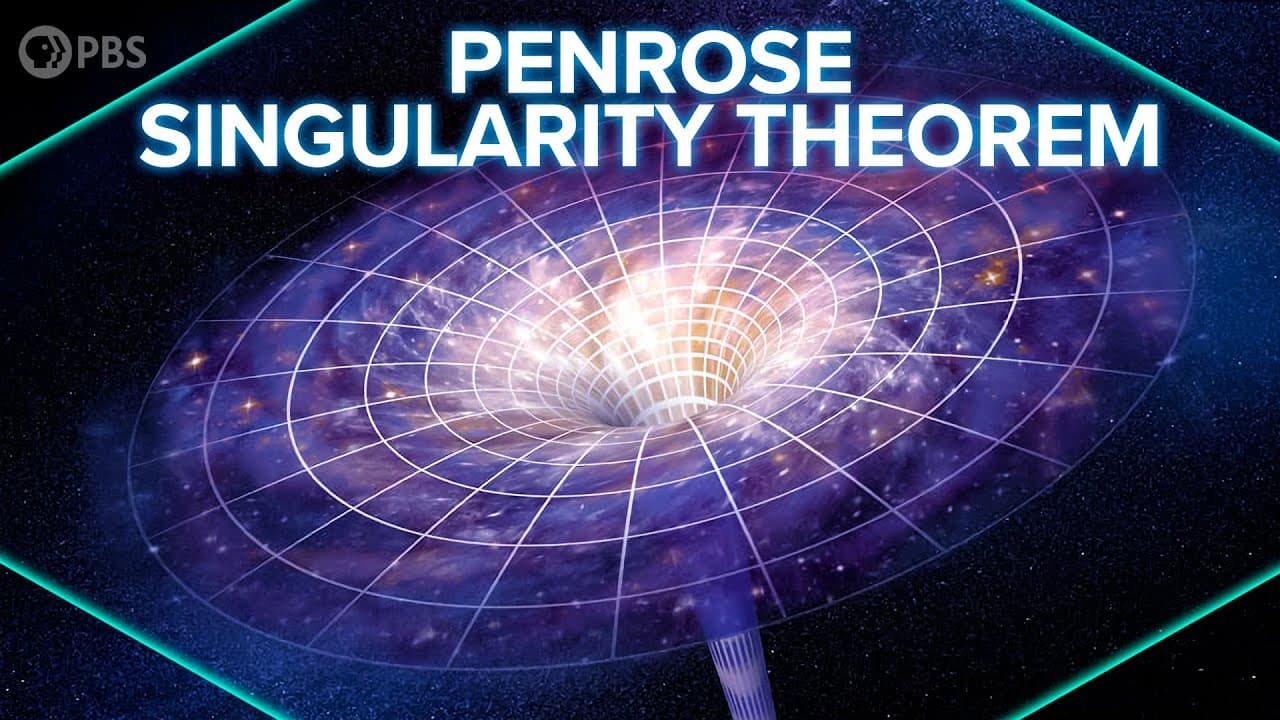
How The Penrose Singularity Theorem Predicts The End of Space Time
TL;DR
Penrose's theorem shows singularities are inevitable in black holes.
Transcript
The Nobel prize in physics this year went to black holes. Generally speaking. Specifically it was shared by the astronomers who revealed to us the Milky Way’s central black hole and by Roger Penrose, who proved that in general relativity, every black hole contains a place of infinite gravity - a singularity. But the true impact of Penrose’s singu... Read More
Key Insights
- Roger Penrose's singularity theorem proves that black holes must contain singularities, challenging the limits of Einstein's general relativity.
- Black holes, once considered theoretical, gained credibility with Penrose's work, proving they contain singularities regardless of formation conditions.
- Penrose's theorem implies that space and time can end at singularities, disrupting the previously held belief of a continuous spacetime manifold.
- The theorem suggests that general relativity breaks down at singularities, indicating the need for a unified theory of quantum gravity.
- Stephen Hawking extended Penrose's theorem to the universe, suggesting the Big Bang was a singularity where time began.
- The Penrose-Hawking Singularity Theorems indicate that geodesics are incomplete at singularities, marking the end of spacetime.
- Penrose's insights paved the way for further exploration into the nature of space, time, and the need for a theory beyond general relativity.
- The discovery of singularities in black holes has profound implications for understanding the universe's origin and the behavior of spacetime.
Install to Summarize YouTube Videos and Get Transcripts
Explore YouTube Video Summarizer or Get YouTube Transcript Extractor
Questions & Answers
Q: What is the significance of Roger Penrose's singularity theorem?
Roger Penrose's singularity theorem is significant because it proves that black holes must contain singularities according to general relativity. This challenges the completeness of Einstein's theory and suggests that space and time can end at these singularities, indicating the need for a new theory that unites general relativity with quantum mechanics.
Q: How did Penrose's theorem influence Stephen Hawking's work?
Penrose's theorem inspired Stephen Hawking to apply the concept of singularities to the universe itself. Hawking showed that the universe's expansion traced backwards leads to a singularity at the Big Bang, suggesting that time began there. This collaboration led to the development of the Penrose-Hawking Singularity Theorems, which have profound implications for cosmology.
Q: Why are singularities considered problematic in physics?
Singularities are problematic because they represent points where physical laws, as described by general relativity, break down. At these points, quantities like gravitational fields become infinite, leading to contradictions and the end of spacetime as we understand it. This suggests that our current theories are incomplete and cannot fully describe these extreme conditions.
Q: What does geodesic incompleteness mean in the context of black holes?
Geodesic incompleteness in black holes means that the paths used to map spacetime, called geodesics, cannot be extended indefinitely. Within a black hole, geodesics terminate at singularities, indicating an end to space and time. This challenges the notion of a continuous spacetime and suggests that singularities are more than mathematical curiosities.
Q: How do Penrose's findings relate to the search for a theory of quantum gravity?
Penrose's findings highlight the limitations of general relativity, as it predicts singularities where spacetime ends. These points of infinite curvature suggest that a new theory, quantum gravity, is needed to reconcile quantum mechanics with general relativity. Understanding singularities could reveal the true nature of space and time and lead to a more complete theory of the universe.
Q: What role did the Nobel Prize play in recognizing Penrose's work?
The Nobel Prize in Physics awarded to Roger Penrose recognized his groundbreaking work on singularities in black holes. It highlighted the importance of his contributions to our understanding of general relativity and the universe's structure. The award also acknowledged the broader implications of his theorem for the future of theoretical physics and cosmology.
Q: What implications do singularities have for the beginning of the universe?
Singularities imply that the universe began with the Big Bang as a singularity, where time itself started. This challenges previous models of a cyclic or eternal universe and suggests that time and space emerged from this initial singularity. Understanding this beginning could provide insights into the fundamental nature of the cosmos and the laws governing it.
Q: How did Penrose's theorem change the perception of black holes in physics?
Penrose's theorem changed the perception of black holes by proving that they must contain singularities, making them more than theoretical constructs. This shifted the scientific view, requiring black holes to be taken seriously as real entities with profound implications for our understanding of spacetime and gravity. It also spurred further research into the nature and behavior of these enigmatic objects.
Summary & Key Takeaways
-
Roger Penrose's singularity theorem demonstrates that black holes inherently contain singularities, challenging the completeness of Einstein's general relativity. This discovery implies that space and time can end, necessitating a new theory that combines quantum mechanics with general relativity.
-
Penrose's work, alongside contributions from Stephen Hawking, shows that the universe's beginning, the Big Bang, was likely a singularity. This challenges the idea of a continuous spacetime and suggests that time itself started at the Big Bang.
-
The existence of singularities in black holes implies that general relativity is not the complete picture, as it breaks down in these extreme conditions. This realization has driven the search for a unified theory of quantum gravity to explain these phenomena.
Read in Other Languages (beta)
Share This Summary 📚
Summarize YouTube Videos and Get Video Transcripts with 1-Click
Try YouTube Summary with ChatGPT & Claude or YouTube Transcript Generator
Explore More Summaries from PBS Space Time 📚
Summarize YouTube Videos and Get Video Transcripts with 1-Click
Try YouTube Summary with ChatGPT & Claude or YouTube Transcript Generator