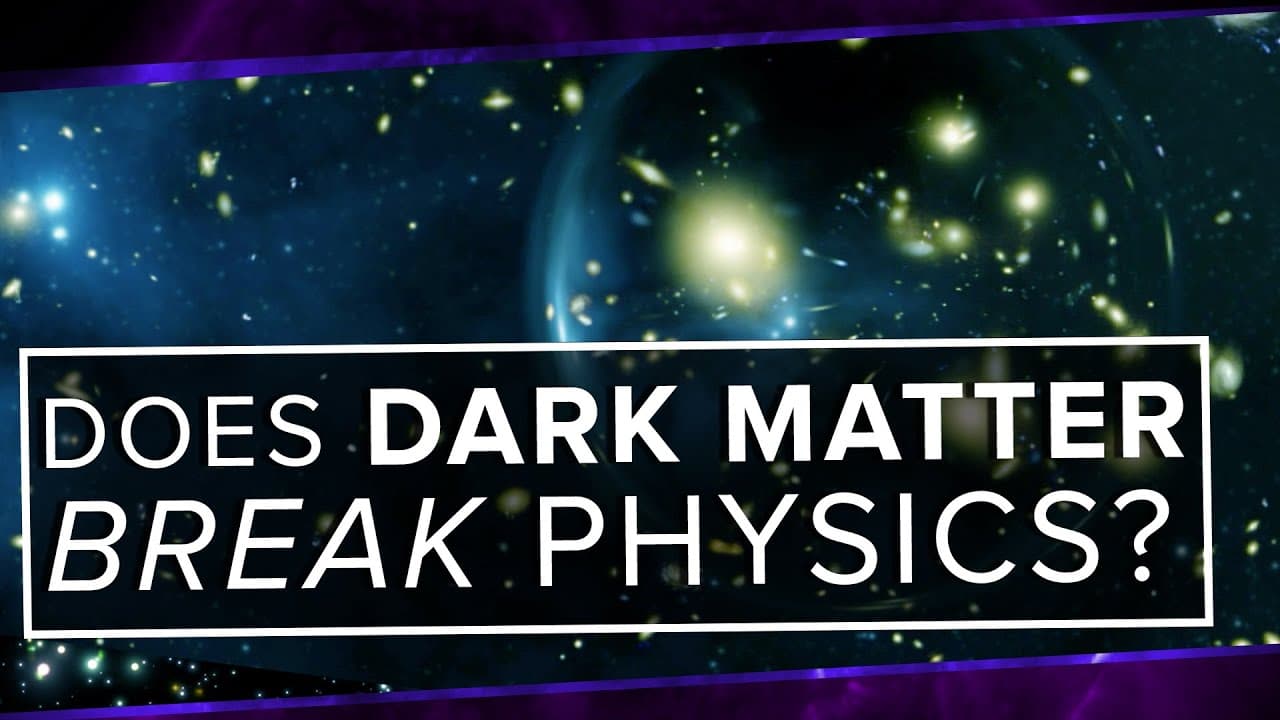
Does Dark Matter BREAK Physics?
TL;DR
Dark matter challenges our understanding of gravity and particle physics.
Transcript
[MUSIC PLAYING] Dark matter literally binds the galaxy together. But there's a problem. Nobody knows what dark matter is. My name is Matt and this is "SpaceTime." Physics has a problem. The Milky Way galaxy is spinning so fast that it should be scattering its stars into the void. Based on the amount of binding gravity that we calculate from every... Read More
Key Insights
- Dark matter is hypothesized to account for the missing mass in galaxies, as they spin too fast to be held together by visible matter alone.
- Gravitational lensing provides independent evidence for dark matter, showing more mass in galaxy clusters than visible stars account for.
- The standard model of particle physics does not currently include dark matter, suggesting it may be a new particle type or require new physics.
- Modified gravity theories, such as altering Newtonian dynamics, attempt to explain galactic behavior without dark matter but struggle with observed data.
- The Bullet Cluster provides strong evidence for dark matter as a particle, showing mass distribution aligned with stars, not gas.
- Dark matter is crucial for galaxy formation, requiring it to be slow-moving, massive, and weakly interacting with regular matter.
- Supersymmetry theories predict particles like WIMPs, which could be candidates for dark matter, but remain unproven.
- Detecting dark matter particles directly on Earth or through cosmic observations remains a major scientific challenge.
Install to Summarize YouTube Videos and Get Transcripts
Explore YouTube Video Summarizer or Get YouTube Transcript Extractor
Questions & Answers
Q: What is the main problem with our current understanding of galaxies?
The main problem is that galaxies, including the Milky Way, spin too fast for the amount of visible mass they contain. This suggests that either we are missing a significant amount of mass, known as dark matter, or our understanding of gravity on large scales is incomplete.
Q: How does gravitational lensing provide evidence for dark matter?
Gravitational lensing occurs when a massive object bends the light of objects behind it. Observations show that galaxy clusters have more mass than can be accounted for by visible stars alone, indicating the presence of additional, unseen mass, which is attributed to dark matter.
Q: What are MACHOs and why are they insufficient to explain dark matter?
MACHOs, or massive compact halo objects, are proposed forms of dark matter consisting of compact, massive objects like black holes or neutron stars. While they exist, they are not abundant enough to account for the total amount of dark matter required to explain galactic dynamics.
Q: What role does the Bullet Cluster play in the dark matter debate?
The Bullet Cluster is a key piece of evidence for dark matter as a particle. Its mass distribution, determined through gravitational lensing, aligns with stars rather than the gas, supporting the idea that dark matter passes through unaffected, unlike gas which is displaced.
Q: Why is dark matter considered essential for galaxy formation?
Dark matter is thought to provide the gravitational pull necessary for the formation of galaxies and large-scale structures in the universe. Its clumping properties allowed the early universe to transition from a smooth plasma to the structured cosmos we observe today.
Q: What are WIMPs and how do they relate to dark matter?
WIMPs, or weakly interacting massive particles, are a leading candidate for dark matter. They are hypothesized particles that interact weakly with normal matter and could form the unseen mass required to explain gravitational effects in the universe.
Q: What challenges exist in detecting dark matter particles?
Detecting dark matter is challenging because it interacts very weakly with ordinary matter. Experiments aim to capture rare collisions between dark matter particles and atomic nuclei or observe gamma rays from dark matter annihilations, but success has been elusive.
Q: How does modified gravity theory attempt to explain dark matter effects?
Modified gravity theories propose changes to the laws of gravity, such as altering the inverse-square law at large scales, to account for galactic dynamics without dark matter. However, these theories struggle to fully match observations, often requiring additional dark matter components.
Summary & Key Takeaways
-
Dark matter is a mysterious substance that seems to hold galaxies together, yet remains undetected directly. It challenges our understanding of physics, suggesting either missing mass or a need for new theories of gravity.
-
Gravitational lensing and galaxy cluster observations strongly suggest the presence of dark matter. However, its nature remains elusive, as it does not fit within the current standard model of particle physics.
-
Efforts to detect dark matter include searching for weakly interacting massive particles and other theoretical particles predicted by supersymmetry. Despite extensive research, dark matter remains one of the greatest mysteries in cosmology.
Read in Other Languages (beta)
Share This Summary 📚
Summarize YouTube Videos and Get Video Transcripts with 1-Click
Try YouTube Summary with ChatGPT & Claude or YouTube Transcript Generator
Explore More Summaries from PBS Space Time 📚




Summarize YouTube Videos and Get Video Transcripts with 1-Click
Try YouTube Summary with ChatGPT & Claude or YouTube Transcript Generator