Could the Higgs Boson Lead Us to Dark Matter?
TL;DR
The Higgs boson may hold the key to discovering dark matter.
Transcript
We’d like to thank NordVPN for supporting PBS. The discovery of the Higgs boson ten years ago in the Large Hadron Collider was the culmination of decades of work and the collaboration of thousands of brilliant and passionate people. It was the final piece needed to confirm the standard model of particle physics as that model now stands. But there a... Read More
Key Insights
- The discovery of the Higgs boson confirmed the standard model of particle physics, but questions about dark matter remain unresolved.
- Dark matter, unlike standard model particles, interacts weakly and is detected through indirect effects like gravitational influence on galaxies.
- Direct detection of dark matter is challenging due to its rare interaction with standard model particles, requiring large detectors and long observation times.
- Indirect detection involves observing annihilation products of dark matter particles, such as gamma rays, but distinguishing these from other sources is difficult.
- Collider experiments like the LHC are exploring the possibility of creating dark matter particles through Higgs boson decays.
- The Higgs boson, which gives mass to standard model particles, might also impart mass to dark matter particles, suggesting a connection.
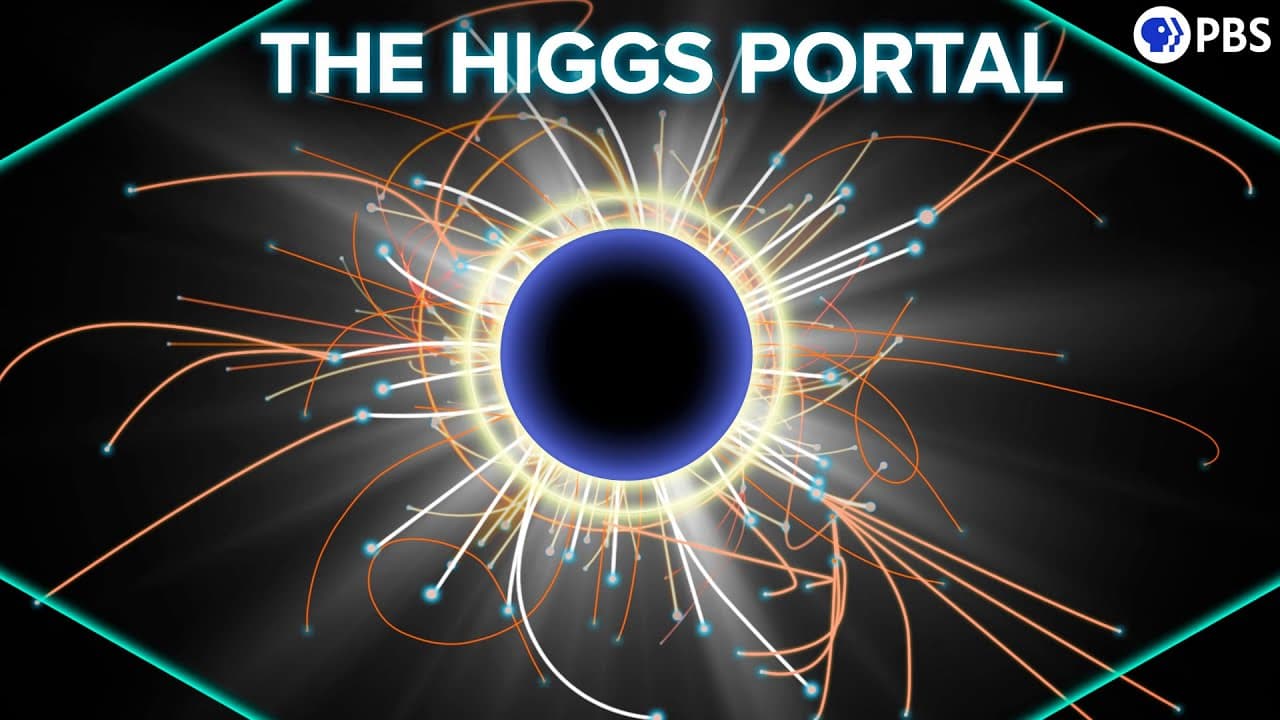
- Higgs portal models propose that the Higgs boson could act as a bridge between standard model particles and a dark sector.
- Recent LHC data suggests a higher than predicted branching fraction of Higgs boson decays into invisible particles, hinting at potential new physics.
Install to Summarize YouTube Videos and Get Transcripts
Explore YouTube Video Summarizer or Get YouTube Transcript Extractor
Questions & Answers
Q: What role does the Higgs boson play in the standard model of particle physics?
The Higgs boson is a fundamental particle in the standard model of particle physics, responsible for giving mass to other particles. Its discovery confirmed the existence of the Higgs field, a critical component of the standard model, and provided a deeper understanding of how particles acquire mass. Despite this, the Higgs boson does not address all questions in physics, such as the nature of dark matter, which remains one of the model's significant gaps.
Q: Why is dark matter difficult to detect directly?
Dark matter is challenging to detect directly because it interacts extremely weakly with standard model particles, making direct interactions rare and difficult to observe. Most detection methods rely on indirect evidence, such as gravitational effects on visible matter, rather than direct interaction. Consequently, experiments require large detectors and prolonged observation periods to capture potential interactions, but none have yet successfully detected dark matter particles.
Q: How do indirect detection methods aim to identify dark matter?
Indirect detection methods seek to identify dark matter by observing the products of dark matter particle annihilations, such as gamma rays, which can be detected by telescopes. These methods are based on the principle that dark matter particles may annihilate each other in high-density regions, producing detectable signals. However, distinguishing these signals from other astrophysical sources, like pulsars or black holes, poses a significant challenge to researchers.
Q: What is the significance of the Higgs boson in the search for dark matter?
The Higgs boson is significant in the search for dark matter because it may serve as a 'portal' to the dark sector, potentially interacting with dark matter particles. The Higgs field gives mass to standard model particles, and it is hypothesized that it might also impart mass to dark matter. This connection is explored in Higgs portal models, which suggest that studying Higgs boson decays could reveal new particles or interactions linked to dark matter.
Q: How do collider experiments like the LHC contribute to dark matter research?
Collider experiments like the Large Hadron Collider (LHC) contribute to dark matter research by creating conditions where Higgs bosons can be produced and studied. These experiments allow scientists to observe how Higgs bosons decay, searching for signs of invisible particles that could be dark matter. By analyzing the momentum of decay products, researchers can infer the presence of undetectable particles, potentially revealing new physics beyond the standard model.
Q: What are Higgs portal models, and why are they important?
Higgs portal models are theoretical frameworks that propose the Higgs boson as a bridge between standard model particles and a hypothetical dark sector. These models are important because they offer a potential explanation for how dark matter might interact with known particles. By studying the Higgs boson's interactions and decays, physicists hope to uncover evidence of dark matter or other unknown particles, shedding light on one of the most significant mysteries in physics.
Q: What recent findings suggest a possible connection between the Higgs boson and dark matter?
Recent findings from the LHC indicate that the branching fraction of Higgs boson decays into invisible particles could be higher than predicted by the standard model. This suggests that the Higgs might decay into unknown particles, potentially linked to dark matter. While the error bars on these measurements are still large, they hint at new physics and motivate further research into the Higgs boson's role in the universe.
Q: What are the future prospects for discovering dark matter through the Higgs boson?
The future prospects for discovering dark matter through the Higgs boson are promising, as ongoing upgrades to the LHC and plans for new colliders aim to produce more Higgs bosons and refine measurements of their decays. As these experiments continue, physicists hope to gather more data that could confirm or refute the presence of dark matter particles. The exploration of Higgs physics may ultimately lead to breakthroughs in understanding dark matter and other unknown aspects of the universe.
Summary & Key Takeaways
-
The Higgs boson, discovered a decade ago, plays a crucial role in the standard model of particle physics, but it may also be key to understanding dark matter, a mysterious substance that interacts weakly with visible matter.
-
Efforts to detect dark matter directly involve large underground detectors awaiting rare interactions, while indirect methods search for annihilation products like gamma rays, though these are hard to distinguish from other cosmic sources.
-
The Large Hadron Collider's experiments focus on the potential of the Higgs boson to decay into dark matter particles, with recent data suggesting unexplained invisible decays, which could indicate new physics beyond the standard model.
Read in Other Languages (beta)
Share This Summary 📚
Summarize YouTube Videos and Get Video Transcripts with 1-Click
Try YouTube Summary with ChatGPT & Claude or YouTube Transcript Generator
Explore More Summaries from PBS Space Time 📚




Summarize YouTube Videos and Get Video Transcripts with 1-Click
Try YouTube Summary with ChatGPT & Claude or YouTube Transcript Generator