Where Are The Worlds In Many Worlds?
TL;DR
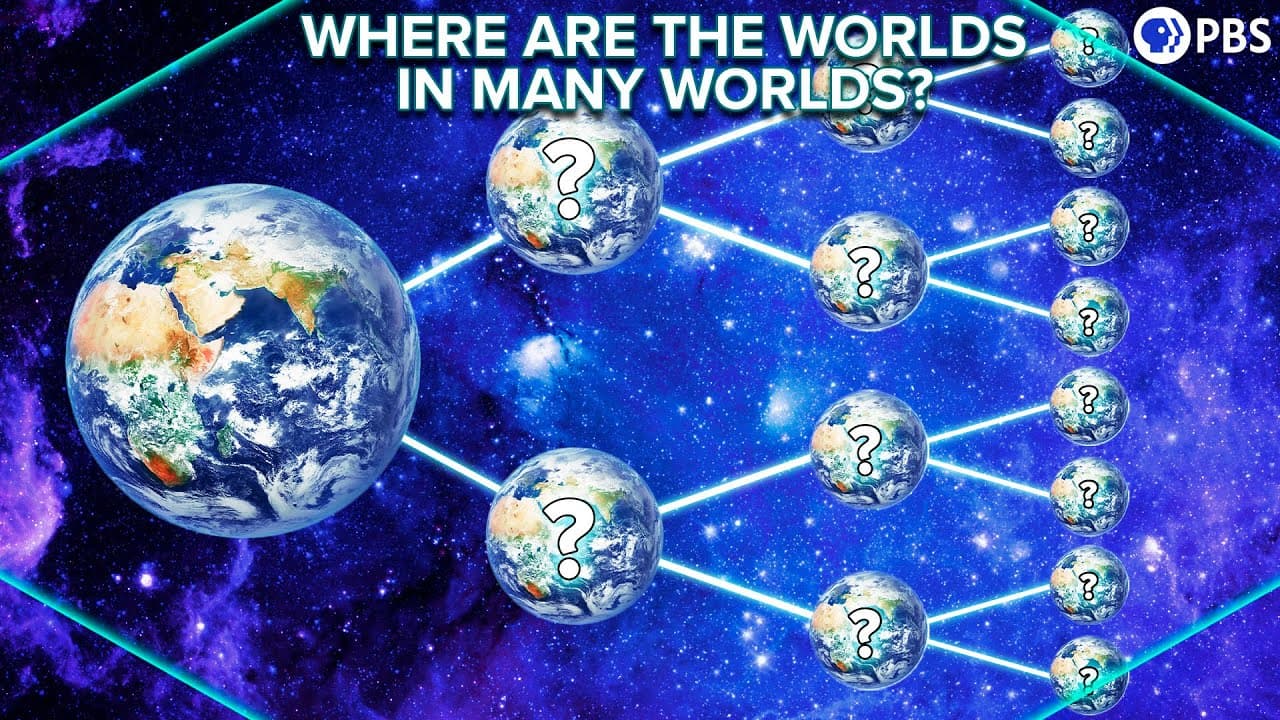
Many Worlds interpretation suggests universe splits with every quantum event.
Transcript
The many worlds interpretation of quantum mechanics proposes that every time a quantum event gets decided, the universe splits so that every possible outcome really does occur. But where exactly are those worlds, and can we ever see them? In one branch of the splitting quantum multiverse a radioactive nucleus decay, in another it doesn’t; in one “w... Read More
Key Insights
- The Many Worlds interpretation of quantum mechanics suggests that every quantum event causes the universe to split into different realities where each possible outcome occurs.
- These alternate worlds, or branches, are considered to be overlapping but out of phase, making them inaccessible to each other.
- The principle of superposition allows wavefunctions to overlap without interference, which is fundamental to the Many Worlds interpretation.
- Quantum mechanics describes reality using wavefunctions, which represent probabilities of different outcomes rather than definite states.
- The Schrodinger equation governs how wavefunctions evolve over time, leading to the complex structure of the universe's wavefunction.
- Decoherence occurs when wavefunction branches lose their phase relationship, leading to the emergence of distinct worlds.
- The Copenhagen interpretation suggests wavefunction collapse, while Many Worlds maintains continuous evolution without collapse.
- Experiments like the double-slit experiment illustrate how wavefunctions interfere, contributing to the debate between interpretations.
Install to Summarize YouTube Videos and Get Transcripts
Explore YouTube Video Summarizer or Get YouTube Transcript Extractor
Questions & Answers
Q: What is the Many Worlds interpretation of quantum mechanics?
The Many Worlds interpretation of quantum mechanics posits that every time a quantum event occurs, the universe splits into multiple branches, each representing a different possible outcome of that event. These worlds coexist, but they are out of phase with each other, making them inaccessible and non-interactive.
Q: How does the superposition principle relate to Many Worlds?
The superposition principle is fundamental to the Many Worlds interpretation, as it allows wavefunctions to overlap without interference. This principle explains how different branches of the universe can coexist without affecting each other, as each branch is a part of the cosmic wavefunction that evolves according to the Schrodinger equation.
Q: What role does the Schrodinger equation play in quantum mechanics?
The Schrodinger equation is a central element of quantum mechanics, governing how wavefunctions change over time and space. It determines the evolution of the cosmic wavefunction, which describes the probabilities of different outcomes in the universe, and is essential for understanding the behavior of particles and the structure of reality.
Q: How does decoherence contribute to the Many Worlds interpretation?
Decoherence is crucial to the Many Worlds interpretation as it describes the process by which wavefunction branches lose their phase relationships due to interactions. This loss of coherence results in the emergence of distinct worlds that no longer interfere with each other, effectively splitting the universe into separate realities.
Q: What is the difference between Many Worlds and the Copenhagen interpretation?
The Many Worlds interpretation suggests continuous evolution of the wavefunction without collapse, resulting in multiple coexisting realities. In contrast, the Copenhagen interpretation posits that the wavefunction collapses to a single outcome upon measurement, with the collapse being random but weighted by the pre-measurement wavefunction.
Q: How does the double-slit experiment relate to quantum mechanics interpretations?
The double-slit experiment demonstrates the wave-like behavior of particles, where wavefunctions interfere to create complex patterns. This experiment highlights the differences between interpretations, as Many Worlds sees the wavefunction evolving without collapse, while Copenhagen suggests a collapse to a single outcome upon measurement.
Q: Can we ever observe the alternate worlds in Many Worlds?
According to the Many Worlds interpretation, alternate worlds are out of phase and cannot be observed or interacted with. They overlap in location but are inaccessible due to decoherence, meaning they pass through each other without interference, making direct observation impossible with our current understanding.
Q: Is the Many Worlds interpretation testable?
Currently, the Many Worlds interpretation is considered untestable, as it relies on the concept of decoherence and non-interactive branches of the universe. However, researchers continue to explore potential tests, such as the possibility of sending messages between worlds, although such ideas remain speculative and require further investigation.
Summary & Key Takeaways
-
The Many Worlds interpretation of quantum mechanics proposes that each quantum event results in a branching of the universe into alternate realities, each representing different outcomes of the event. These worlds coexist but are out of phase, making them inaccessible to each other.
-
Quantum mechanics relies on wavefunctions to describe the universe, representing probabilities rather than definite states. The Schrodinger equation dictates the evolution of these wavefunctions, leading to the complex structure of the cosmic wavefunction.
-
Decoherence is a key concept in Many Worlds, where interactions cause wavefunction branches to lose phase relationships, resulting in distinct worlds. This interpretation contrasts with the Copenhagen interpretation, which suggests wavefunction collapse.
Read in Other Languages (beta)
Share This Summary 📚
Summarize YouTube Videos and Get Video Transcripts with 1-Click
Try YouTube Summary with ChatGPT & Claude or YouTube Transcript Generator
Explore More Summaries from PBS Space Time 📚
Summarize YouTube Videos and Get Video Transcripts with 1-Click
Try YouTube Summary with ChatGPT & Claude or YouTube Transcript Generator