What Are the Corrections for the Sodium-Potassium Pump?
TL;DR
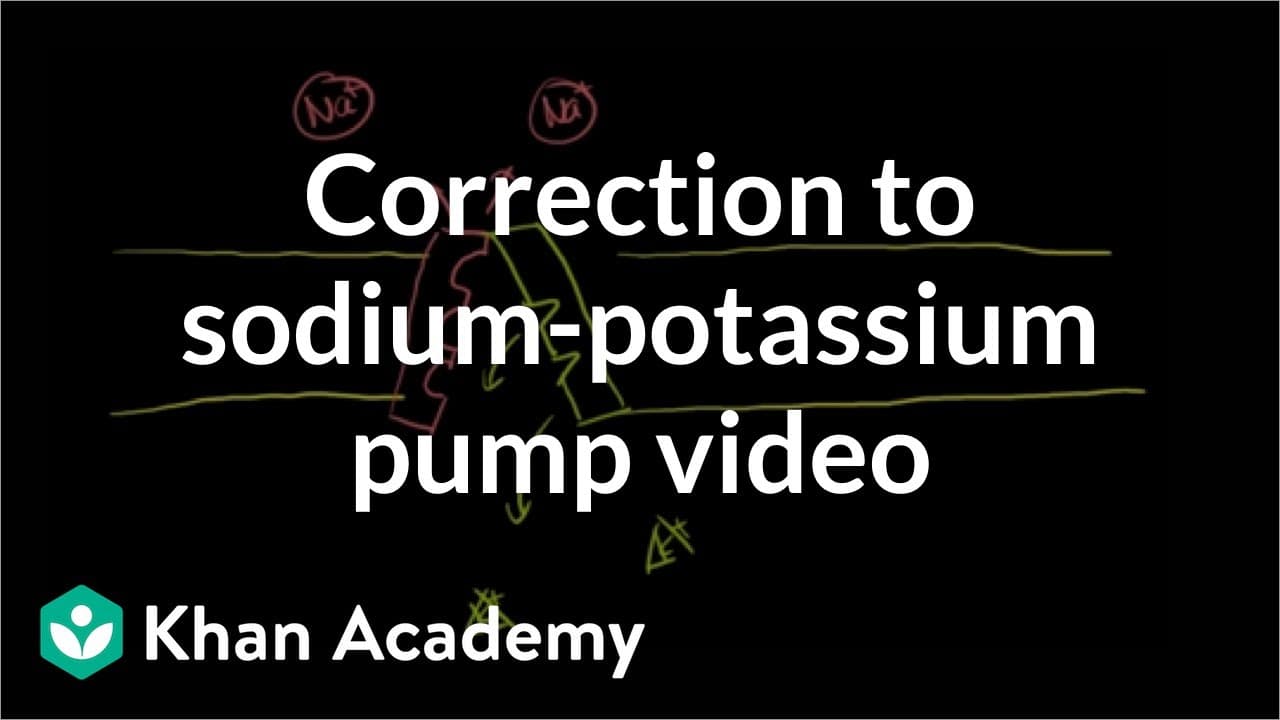
The sodium-potassium pump video contains two key corrections: potassium ions were mistakenly labeled as sodium ions, and the primary cause of the membrane potential difference is actually the membrane's high permeability to potassium, rather than the pump's ion exchange ratio. Even altering the pump's stoichiometry from 3:2 to 2:2 does not significantly change the membrane potential.
Transcript
Two corrections I want to make to the video on the sodium potassium pump. One very minor one-- and I don't think it would trip too many of you guys up, but near the end of the video, as we learned, we have potassium getting pumped into the cell by the sodium potassium pump. Let me draw the membrane. It'll actually be useful in the more significant ... Read More
Key Insights
- 😑 The video had two corrections regarding the sodium potassium pump: referring to potassium ions as sodium ions and misunderstanding the main reason for the potential difference.
- ⛽ Changing the pump stoichiometry from 3:2 to 2:2 does not alter the potential difference significantly.
- ✋ The concentration gradients established by the pump and the membrane's high permeability to potassium are the main factors contributing to the potential difference.
- 😑 The movement of ions across the membrane and the resting permeabilities of the membrane play a role in understanding the sodium potassium pump.
Install to Summarize YouTube Videos and Get Transcripts
Explore YouTube Video Summarizer or Get YouTube Transcript Extractor
Questions & Answers
Q: What minor correction was made in the video?
The minor correction was that potassium ions were mistakenly referred to as sodium ions in certain parts of the video. This might have caused confusion.
Q: What is the main reason for the potential difference across the membrane?
The main reason for the potential difference is the concentration gradients established by the pump in combination with the membrane's high permeability to potassium. It is not solely determined by the stoichiometry of the pump.
Q: How does changing the pump stoichiometry affect the potential difference?
Changing the pump stoichiometry from 3:2 to 2:2 does not have a significant effect on the potential difference. The potential difference only changes slightly, and the cell eventually stabilizes.
Q: What is the significance of the membrane's permeability to potassium?
The membrane's high permeability to potassium allows more potassium ions to exit the cell compared to sodium ions entering. This difference in permeability is the main cause of the potential difference across the membrane.
Summary & Key Takeaways
-
The video made two corrections: potassium ions were mistakenly referred to as sodium ions, and the main reason for the potential difference is the membrane's high permeability to potassium.
-
Changing the pump stoichiometry from 3:2 to 2:2 does not significantly affect the potential difference.
-
The main cause of the potential difference is the concentration gradients established by the pump and the membrane's high permeability to potassium.
Read in Other Languages (beta)
Share This Summary 📚
Summarize YouTube Videos and Get Video Transcripts with 1-Click
Try YouTube Summary with ChatGPT & Claude or YouTube Transcript Generator
Explore More Summaries from Khan Academy 📚



Summarize YouTube Videos and Get Video Transcripts with 1-Click
Try YouTube Summary with ChatGPT & Claude or YouTube Transcript Generator