How to Reflect Functions Over the X and Y Axes
TL;DR
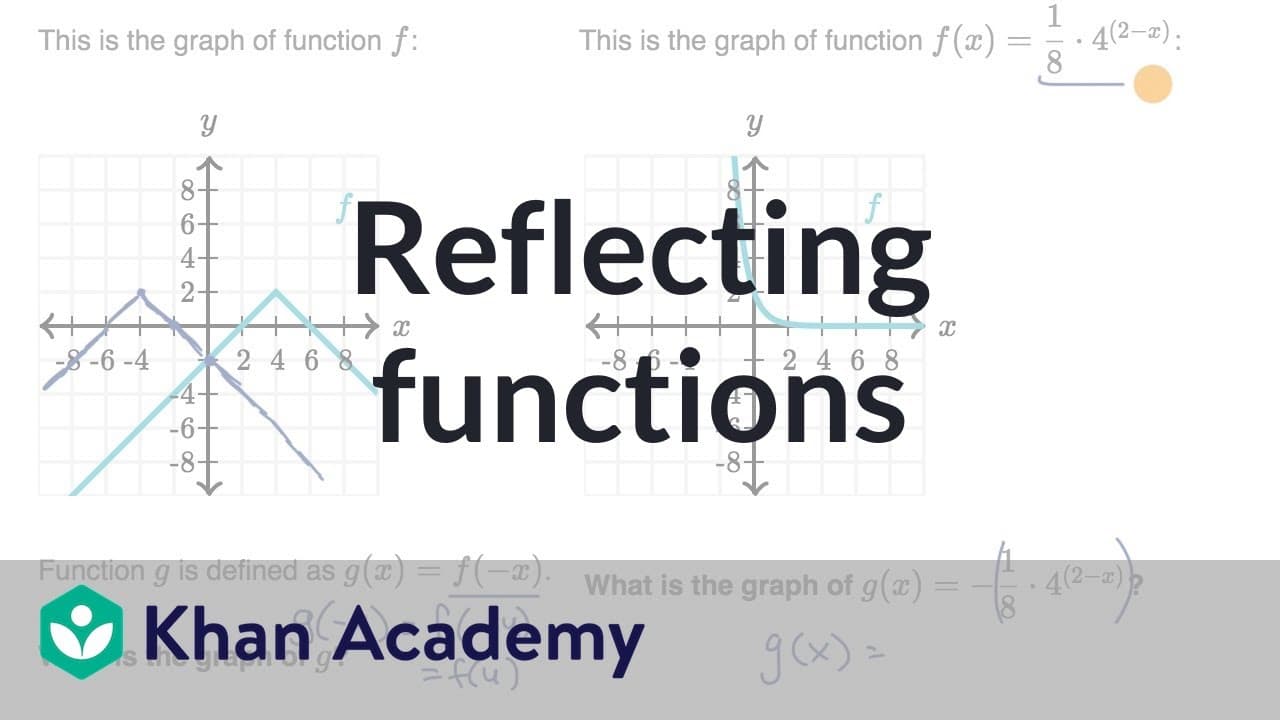
To reflect a function over the y-axis, replace x with -x in its equation, resulting in g(x) = f(-x). To reflect over the x-axis, multiply the function by -1, yielding g(x) = -f(x). Combining both reflections results in g(x) = -f(-x), effectively mirroring the original function across both axes.
Transcript
- [Instructor] What we're going to do in this video is do some practice examples of exercises on Khan Academy that deal with reflections of functions. So this first one says this is the graph of function f. Fair enough. Function g is defined as g of x is equal to f of negative x. Also fair enough. What is the graph of g? And on Khan Academy, it's m... Read More
Key Insights
- ✖️ Reflecting a function over the y-axis involves replacing x with -x, while reflecting over the x-axis involves multiplying the entire function by -1.
- ❣️ By combining both reflections, you can mirror a function over both the x-axis and y-axis.
- 📈 Understanding the concept of reflecting functions is useful when graphing or finding equations of reflected functions.
- 🪩 Graphing g(x) when defined as g(x) = f(-x) results in a mirror image of f(x) over the y-axis.
- ☺️ Graphing g(x) when defined as g(x) = -f(x) results in a mirror image of f(x) over the x-axis.
Install to Summarize YouTube Videos and Get Transcripts
Explore YouTube Video Summarizer or Get YouTube Transcript Extractor
Questions & Answers
Q: How can you graph the function g(x) when it is defined as g(x) = f(-x)?
To graph g(x), you need to reflect the graph of f(x) over the y-axis. Each point on the graph of f(x) will have the same y-value but with the opposite x-value, resulting in the graph of g(x).
Q: What happens when g(x) is defined as the negative of f(x)?
If g(x) = -f(x), the graph of g(x) will be a reflection of f(x) over the x-axis. Each point on the graph of f(x) will have the same x-value but with the opposite y-value, resulting in the graph of g(x).
Q: Can you explain how to find the equation of g(x) when it reflects both over the x-axis and y-axis?
If g(x) = -f(-x), you need to reflect f(-x) over both the x-axis and y-axis. This means that you multiply the entire function f(-x) by -1, resulting in g(x) = -f(-x) as the equation of the reflected function.
Q: How would you find the equation of g(x) when it reflects across the y-axis?
When g(x) reflects across the y-axis, it has the equation g(x) = f(-x). You replace all instances of x in the equation of f(x) with -x to obtain the equation for g(x).
Summary & Key Takeaways
-
The video discusses the reflection of a function f(x) in function g(x) defined as g(x) = f(-x), demonstrating the process of graphing g(x) by reflecting f(x) over the y-axis.
-
Another example is presented where g(x) is defined as the negative of f(x), resulting in a reflection of f(x) over the x-axis.
-
The concept of reflecting a function over both the x-axis and y-axis is explored, where g(x) = -f(-x).
-
The last example involves finding the equation of g(x) by reflecting f(x) across the y-axis.
Read in Other Languages (beta)
Share This Summary 📚
Summarize YouTube Videos and Get Video Transcripts with 1-Click
Try YouTube Summary with ChatGPT & Claude or YouTube Transcript Generator
Explore More Summaries from Khan Academy 📚



Summarize YouTube Videos and Get Video Transcripts with 1-Click
Try YouTube Summary with ChatGPT & Claude or YouTube Transcript Generator