Lecture 11.4 - Graph Recurrent Neural Networks
TL;DR
Explores GRNNs, combining graph and recurrent neural networks.
Transcript
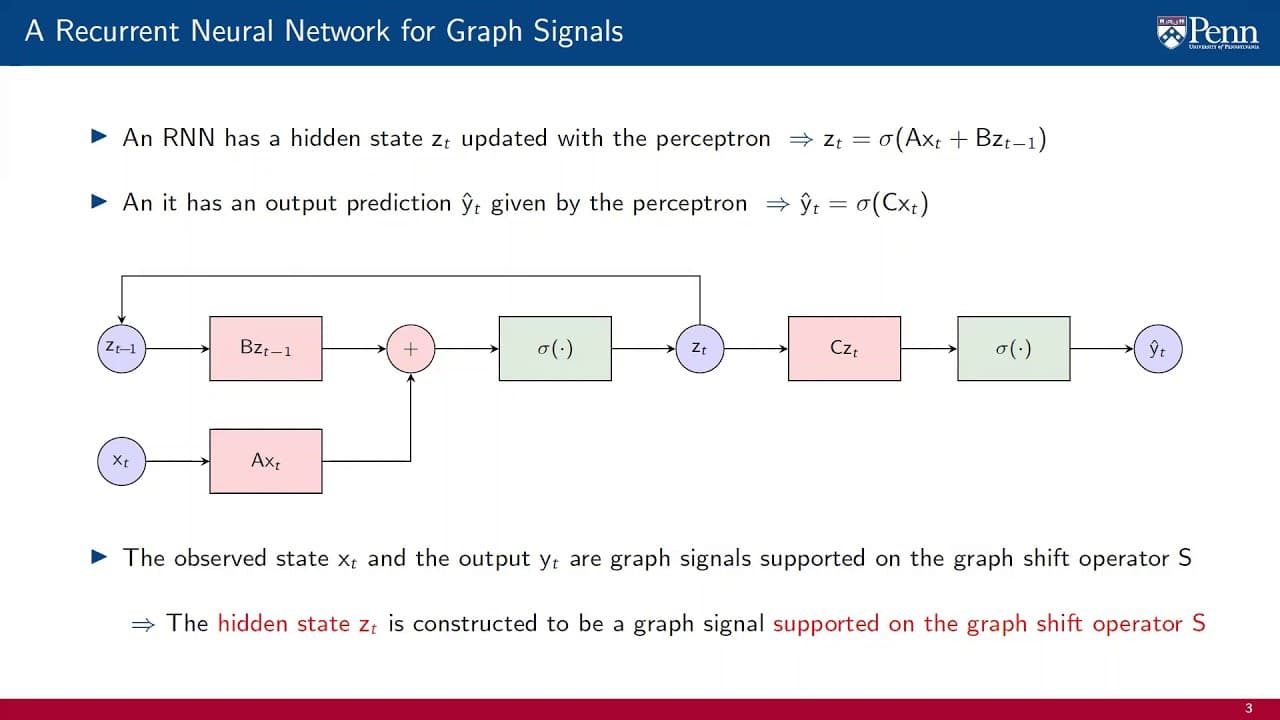
we have introduced rnns as architectures to learn features of time-varying processes we define now graphical neural networks as particular cases in which the signals at each point in time are supported on the graph to be more precise consider a time varying process xt in which each of the signals observed at each point in time is supported in a com... Read More
Key Insights
- Graph Recurrent Neural Networks (GRNNs) integrate graph neural networks and recurrent neural networks to process time-varying signals supported on graphs, leveraging both temporal and spatial information.
- The architecture of GRNNs involves the use of graph filters, which are polynomial functions of a shift operator, allowing for permutation-equivariance and stability in processing graph signals.
- GRNNs maintain a hidden state that is updated using graph filters applied to both the observed state and the previous hidden state, ensuring the hidden state remains a graph signal.
- The output of a GRNN is estimated by propagating the hidden state through a graph filter, followed by a pointwise nonlinearity, which results in the prediction of graph signals.
- The modular block diagram of GRNNs shows how observable states and hidden states are processed through linear blocks, summed, and transformed with nonlinear functions to update the hidden state.
- GRNNs can be extended to handle multiple features at each node by using multiple-input multiple-output (MIMO) graph filters, allowing for greater dimensionality in the hidden state.
- The use of MIMO graph filters enables GRNNs to handle matrix graph signals, where both observable and hidden states are processed as matrices, increasing the network's capacity.
- GRNNs retain the essential properties of graph neural networks, such as transferability and permutation equivalence, while also incorporating the temporal processing capabilities of recurrent neural networks.
Install to Summarize YouTube Videos and Get Transcripts
Explore YouTube Video Summarizer or Get YouTube Transcript Extractor
Questions & Answers
Q: What is the primary function of a Graph Recurrent Neural Network?
A Graph Recurrent Neural Network (GRNN) primarily functions to process time-varying signals that are supported on a graph. It integrates the capabilities of graph neural networks, which handle spatial relationships, and recurrent neural networks, which process temporal sequences. This combination allows GRNNs to effectively model and predict complex data structures where both temporal and spatial dependencies are present.
Q: How does a GRNN update its hidden state?
In a GRNN, the hidden state is updated by applying graph filters to both the current observed state and the previous hidden state. These graph filters are polynomial functions of a shift operator, which ensures that the hidden state remains a graph signal. The results from these filters are summed and passed through a pointwise nonlinearity to produce the updated hidden state, which is then used in subsequent iterations.
Q: What role do graph filters play in GRNNs?
Graph filters in GRNNs play a crucial role in ensuring that operations on graph signals maintain the graph structure's properties, such as permutation equivariance and stability. They are polynomial functions of a shift operator and are used to process both the observed and hidden states. By using graph filters, GRNNs can effectively handle the spatial aspects of data while integrating temporal processing through the recurrent architecture.
Q: How do GRNNs handle multiple features at each graph node?
GRNNs handle multiple features at each graph node by employing multiple-input multiple-output (MIMO) graph filters. These filters allow the network to process matrix graph signals, where both observable and hidden states are treated as matrices. This approach increases the dimensionality of the hidden state, enabling the GRNN to capture more complex relationships and enhance its overall capacity to model intricate data structures.
Q: What are the advantages of using MIMO graph filters in GRNNs?
The use of MIMO graph filters in GRNNs offers several advantages, including the ability to process multiple features at each graph node simultaneously, thereby increasing the network's capacity to model complex data. This approach allows the hidden state to have a larger dimensionality than the observed states, facilitating richer feature extraction and improved performance in tasks requiring the analysis of multi-dimensional graph signals.
Q: How is the output of a GRNN estimated?
The output of a GRNN is estimated by propagating the hidden state through a graph filter, which is a polynomial function of a shift operator with specific coefficients. This process is followed by applying a pointwise nonlinearity to the filtered hidden state. The resulting transformation provides the predicted output, ensuring that the prediction retains the graph structure's properties and effectively captures the temporal and spatial dependencies present in the data.
Q: What ensures permutation equivariance in GRNNs?
Permutation equivariance in GRNNs is ensured by the use of graph filters, which are polynomial functions of a shift operator. These filters maintain the graph structure's inherent properties, allowing the network to process graph signals in a way that is invariant to permutations of the graph nodes. This characteristic is crucial for maintaining consistent performance across different graph configurations and ensuring the stability and transferability of the GRNN architecture.
Q: What is the significance of the hidden state in GRNNs?
The hidden state in GRNNs is significant as it serves as a memory of past information, allowing the network to capture and utilize temporal dependencies in the data. By updating the hidden state using graph filters applied to both the current observed state and previous hidden state, the GRNN effectively integrates temporal and spatial information. This integration is crucial for modeling complex sequences of graph signals and improving the network's predictive capabilities.
Summary & Key Takeaways
-
Graph Recurrent Neural Networks (GRNNs) are specialized architectures that combine graph neural networks and recurrent neural networks to process time-varying signals supported on graphs. The architecture uses graph filters to ensure the hidden state and outputs remain graph signals, allowing for permutation-equivariant and stable processing.
-
The GRNN architecture involves modular blocks where observable states and hidden states are processed through linear transformations, summed, and transformed with nonlinear functions. This process updates the hidden state, which is then used to estimate outputs by propagating through graph filters and applying pointwise nonlinearities.
-
GRNNs can be extended to handle multiple features at each node through MIMO graph filters, enabling the processing of matrix graph signals. This extension increases the dimensionality of hidden states, enhancing the network's capacity while retaining the essential properties of graph neural networks and recurrent neural networks.
Read in Other Languages (beta)
Share This Summary 📚
Summarize YouTube Videos and Get Video Transcripts with 1-Click
Try YouTube Summary with ChatGPT & Claude or YouTube Transcript Generator
Explore More Summaries from Alelab Alelab 📚
Summarize YouTube Videos and Get Video Transcripts with 1-Click
Try YouTube Summary with ChatGPT & Claude or YouTube Transcript Generator