Lecture 4.5 - GNNs vs FCNNs

TL;DR
GNNs generalize better than FCNNs by exploiting graph symmetries.
Transcript
having defined fully connected neural networks and graph neural networks we are ready to compare them graph neural networks and fully connected neural networks have very similar architectures they both use layers which are composed of linear transformations and point-wise non-linearities the difference is that arbitrary neural networks utilize arbi... Read More
Key Insights
- Graph Neural Networks (GNNs) and Fully Connected Neural Networks (FCNNs) have similar architectures but differ in their use of linear transformations. GNNs rely on graph filters, while FCNNs use arbitrary transformations.
- GNNs are a specific case of FCNNs with imposed structure on the linear map. This means FCNNs have a broader optimization set, potentially achieving lower training costs.
- Despite FCNNs' potential for lower training costs, GNNs often perform better in practice due to their ability to generalize to unseen data by exploiting graph signal symmetries.
- An example of a recommendation system illustrates how GNNs can predict ratings for unseen data by understanding the graph structure, unlike FCNNs, which lack this capability.
- GNNs can exploit local signal symmetries, allowing them to process seemingly different examples similarly, effectively increasing the dataset size.
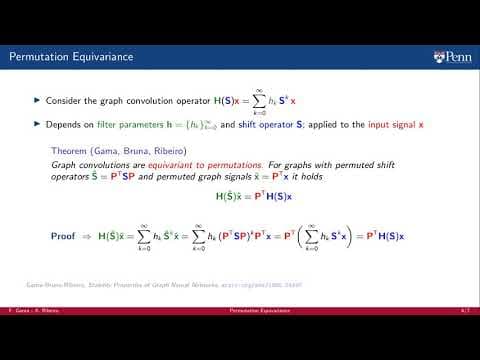
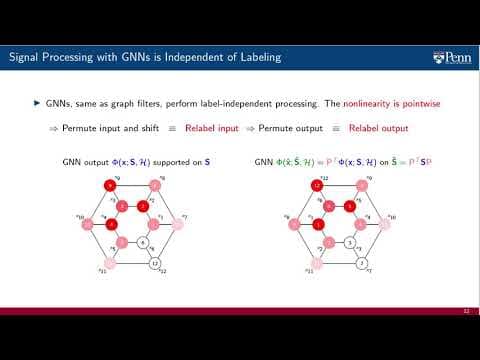
- The concept of permutation equivalence in GNNs will be formalized to explain how they exploit quasi-symmetries, enhancing their practical application.
- The lecture emphasizes the importance of understanding graph structures in GNNs, which allows them to succeed where FCNNs may fail in generalization tasks.
- Similar principles apply to Convolutional Neural Networks (CNNs), which exploit translation quasi-equivalence instead of permutation quasi-equivalence.
Install to Summarize YouTube Videos and Get Transcripts
Explore YouTube Video Summarizer or Get YouTube Transcript Extractor
Questions & Answers
Q: What are the main architectural differences between GNNs and FCNNs?
The main architectural difference between Graph Neural Networks (GNNs) and Fully Connected Neural Networks (FCNNs) lies in their use of linear transformations. GNNs utilize graph filters that exploit the structure of graph data, allowing them to generalize better to unseen examples. In contrast, FCNNs use arbitrary linear transformations, which can potentially achieve lower training costs but may not generalize as effectively as GNNs.
Q: Why do GNNs often perform better in practice compared to FCNNs?
GNNs often perform better in practice because they exploit internal symmetries of graph signals, allowing them to generalize more effectively to unseen data. This ability to recognize and utilize the inherent structure of graph data enables GNNs to predict outcomes that FCNNs, which lack this structural understanding, may struggle with. This generalization capability is crucial in real-world applications.
Q: How does the lecture illustrate the practical application of GNNs?
The practical application of GNNs is illustrated through a recommendation system example. In this scenario, GNNs can predict ratings for unseen data by understanding the graph structure, unlike FCNNs. The GNN's ability to exploit local signal symmetries allows it to process seemingly different examples similarly, effectively increasing the dataset size and improving prediction accuracy.
Q: What is permutation equivalence in the context of GNNs?
Permutation equivalence in the context of GNNs refers to their ability to exploit symmetries in graph signals, allowing for the processing of different examples in a similar manner. This concept will be formalized in the lecture to explain how GNNs utilize quasi-symmetries, enhancing their generalization capabilities and making them more effective in practical applications compared to FCNNs.
Q: How do GNNs increase the effective size of the dataset?
GNNs increase the effective size of the dataset by exploiting local signal symmetries, which allow them to process seemingly disparate examples equivalently. This ability to recognize and utilize the inherent structure of graph data multiplies the dataset size, enabling GNNs to generalize better and make accurate predictions on unseen data, a capability that FCNNs lack.
Q: What role do graph filters play in GNNs?
Graph filters in GNNs play a crucial role by leveraging the structure of graph data to perform linear transformations. These filters enable GNNs to exploit internal symmetries within graph signals, allowing for better generalization to unseen data. This structural advantage is a key reason why GNNs often outperform FCNNs in practical applications, despite potentially higher training costs.
Q: How do CNNs relate to the concepts discussed in the lecture?
Convolutional Neural Networks (CNNs) relate to the concepts discussed in the lecture through their use of translation quasi-equivalence, similar to how GNNs use permutation quasi-equivalence. Both types of neural networks exploit specific symmetries within their respective data types, enabling them to generalize better and process data more effectively, which is a core theme of the lecture.
Q: Why is understanding graph structures important in GNNs?
Understanding graph structures is important in GNNs because it allows these networks to exploit the inherent symmetries in graph data. This understanding enables GNNs to generalize effectively to unseen examples, making accurate predictions where FCNNs may fail. The ability to recognize and utilize graph structures is a key advantage of GNNs in real-world applications, as emphasized in the lecture.
Summary & Key Takeaways
-
Graph Neural Networks (GNNs) differ from Fully Connected Neural Networks (FCNNs) by utilizing graph filters instead of arbitrary linear transformations. This structural difference allows GNNs to generalize better in practice, despite FCNNs potentially achieving lower training costs due to their broader optimization set.
-
GNNs excel in real-world applications by exploiting internal symmetries of graph signals, which FCNNs cannot do. This ability allows GNNs to predict outcomes for unseen data effectively, as demonstrated through a recommendation system example in the lecture.
-
The lecture introduces the concept of permutation equivalence in GNNs, explaining how it enables the exploitation of quasi-symmetries, enhancing their generalization capabilities. Similar principles are applied in CNNs, which utilize translation quasi-equivalence for effective data processing.
Read in Other Languages (beta)
Share This Summary 📚
Summarize YouTube Videos and Get Video Transcripts with 1-Click
Try YouTube Summary with ChatGPT & Claude or YouTube Transcript Generator
Explore More Summaries from Alelab Alelab 📚
Summarize YouTube Videos and Get Video Transcripts with 1-Click
Try YouTube Summary with ChatGPT & Claude or YouTube Transcript Generator