Lecture 10.5 - Transferability of Graph Filters: Remarks
TL;DR
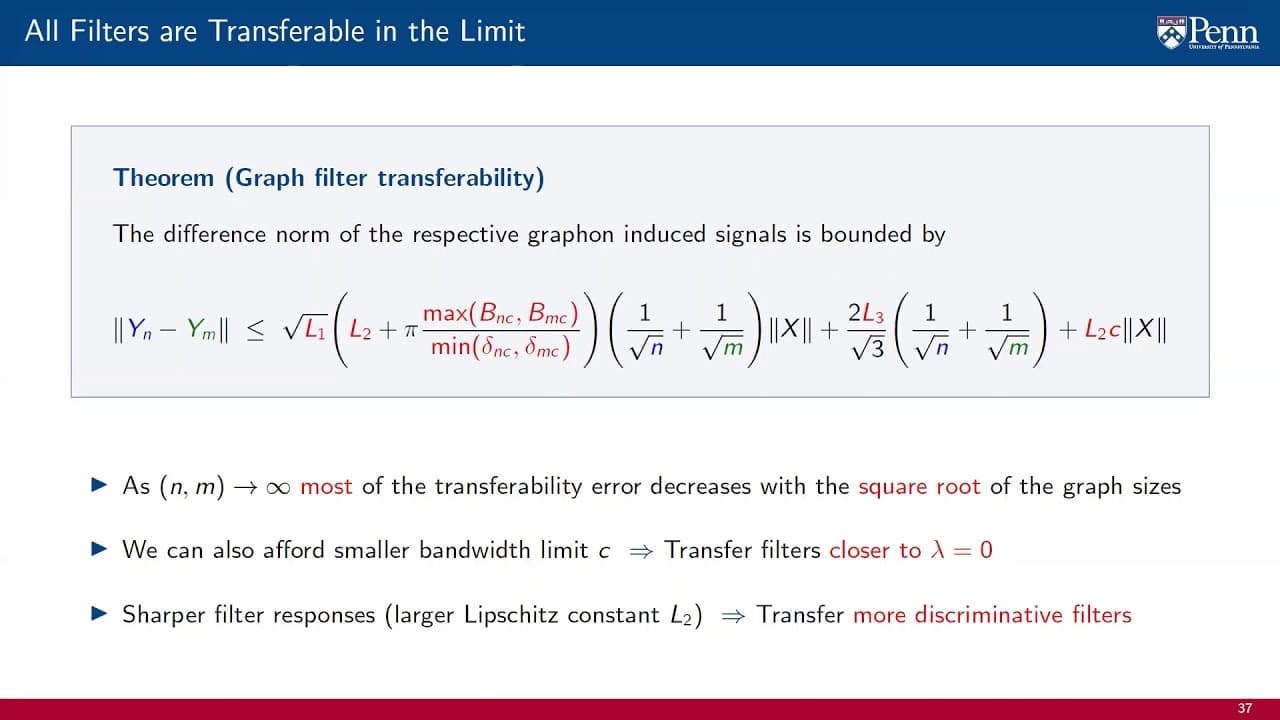
Graph filters are transferable with residual errors due to eigenvalue variability.
Transcript
in the previous section we showed that graph filters are transferable across graphs that are drawn from a common growth phone there are several important remarks that follow from this theorem which we cover in this section let's pay homage to dr seuss and point out that we have three things in this bound thing one is a term that comes from the disc... Read More
Key Insights
- Graph filters can transfer across graphs drawn from a common graphon, but errors arise from eigenvalue variability.
- The transferability bound consists of three main components: discretization error, variability at larger eigenvalues, and variability at smaller eigenvalues.
- The transferability error decreases as the number of nodes in the graphs increases, but residual errors remain for eigenvalues near zero.
- Larger graphs allow for more discriminative filters due to compensation for increased Lipschitz constants and frequency responses.
- Graph signals and graphons with higher variability complicate filter transfer due to sampling approximation errors.
- The Lipschitz constant significantly affects filter discriminability and transferability, with larger constants increasing the transferability bound.
- The spectral properties of graphons, such as bandwidth and eigenvalue margins, impact the transferability bound.
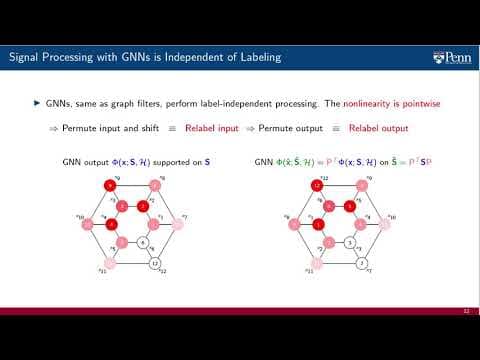
- Graph neural networks can be approximated by graphon neural networks, with an asymptotic error bound for this approximation.
Install to Summarize YouTube Videos and Get Transcripts
Explore YouTube Video Summarizer or Get YouTube Transcript Extractor
Questions & Answers
Q: What are the three main components of the transferability bound?
The transferability bound consists of three main components: discretization error, variability at larger eigenvalues, and variability at smaller eigenvalues. Discretization error arises from the sampling of the graphon signal. Variability at larger eigenvalues relates to components with easier convergence, while variability at smaller eigenvalues pertains to components with more challenging convergence due to clustering near zero.
Q: How does graph size affect transferability errors?
The transferability error decreases as the number of nodes in the graphs increases. Larger graphs allow for a reduction in the residual error associated with small eigenvalues, as the larger node count compensates for increased Lipschitz constants and frequency responses. However, a residual error remains for eigenvalues clustered around zero, which is an inherent limitation in transferring certain spectral components.
Q: What role does the Lipschitz constant play in filter transferability?
The Lipschitz constant significantly affects filter discriminability and transferability. A larger Lipschitz constant increases the transferability bound, making it more challenging to transfer filters. This is because discriminative filters, which require a higher Lipschitz constant, are more sensitive to eigenvalue variability, thus increasing the errors in both transferable and non-transferable spectral components.
Q: How do spectral properties of graphons impact transferability?
The spectral properties of graphons, such as bandwidth and eigenvalue margins, impact the transferability bound. Different choices of bandwidth result in varying bound values, with an optimal bandwidth minimizing the bound. Increases in the bandwidth cardinality or decreases in the eigenvalue margin result in more challenging transferability due to the difficulty in separating eigenvectors and transferring more components.
Q: Why do larger graphs allow for more discriminative filters?
Larger graphs allow for more discriminative filters because they can compensate for increased Lipschitz constants and frequency responses. As the number of nodes increases, the residual error associated with small eigenvalues can be reduced, allowing for sharper filters. This compensatory effect enables the use of filters with higher discriminability, which are generally more challenging to transfer in smaller graphs.
Q: What is the relationship between graph neural networks and graphon neural networks?
Graph neural networks (GNNs) can be approximated by graphon neural networks (WNNs), with an asymptotic error bound for this approximation. WNNs serve as generative models for GNNs, and as the sequence of GNNs converges to a WNN, the approximation error decreases. This relationship highlights the potential for using WNNs to model and understand GNN behavior in large-scale graph data.
Q: How does graph signal variability affect filter transfer?
Graph signals and graphons with higher variability complicate filter transfer due to increased sampling approximation errors. Variability in graph signals is captured by the Lipschitz constants of the graphon and the graphon signal. Larger variability makes it more difficult to approximate the graph signals with their samples, thus increasing the transferability error and complicating the transfer of filters across graphs.
Q: What is the inherent limitation in transferring certain spectral components?
The inherent limitation in transferring certain spectral components lies in the residual error associated with eigenvalues clustered around zero. These components are difficult to transfer due to their proximity to other eigenvalues, leading to convergence challenges. This residual error persists even as graph size increases, highlighting a fundamental limitation in the transferability of certain parts of the spectral representation across graphs.
Summary & Key Takeaways
-
Graph filters are transferable across graphs from a common graphon, with errors due to eigenvalue variability. The transferability bound is influenced by discretization, variability at larger and smaller eigenvalues, and the Lipschitz constant. Larger graphs allow for more discriminative filters, but residual errors persist for eigenvalues near zero.
-
Transferability errors decrease with increased graph size, but residual errors remain for eigenvalues near zero. Larger graphs enable more discriminative filters by compensating for increased Lipschitz constants. The spectral properties of graphons, such as bandwidth and eigenvalue margins, significantly impact the transferability bound.
-
Graph signals and graphons with higher variability complicate filter transfer due to sampling approximation errors. The Lipschitz constant affects filter discriminability and transferability, with larger constants raising the transferability bound. Graph neural networks can approximate graphon neural networks, with an asymptotic error bound for this approximation.
Read in Other Languages (beta)
Share This Summary 📚
Summarize YouTube Videos and Get Video Transcripts with 1-Click
Try YouTube Summary with ChatGPT & Claude or YouTube Transcript Generator
Explore More Summaries from Alelab Alelab 📚
Summarize YouTube Videos and Get Video Transcripts with 1-Click
Try YouTube Summary with ChatGPT & Claude or YouTube Transcript Generator