How Does GFT Converge to WFT in Graph Sequences?
TL;DR
The convergence of the Graph Fourier Transform (GFT) to the Graphon Fourier Transform (WFT) does not generally hold due to eigenvector convergence issues. However, for graphon band-limited signals, the GFT does converge to the WFT. The key challenge is the accumulation of eigenvalues around zero, which affects the convergence of eigenspaces.
Transcript
in this part of the lecture we discussed the convergence of the graph fourier transform to the graphol fourier transform for graph sequences that converge to graphos doing so requires that we review convergence results for sequences of graphs that converge to graphs the graph of heat transform of a graph signal wx is a projection of the signal x in... Read More
Key Insights
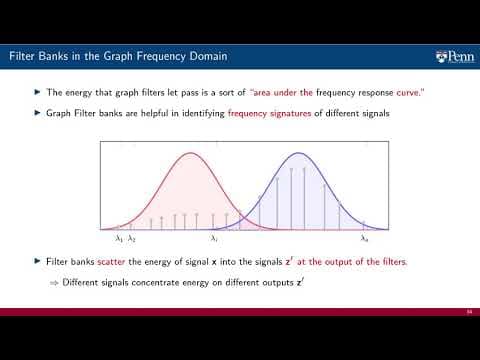
- GFT is the projection of a graph signal in the eigenspace of the graph's eigenvectors.
- WFT is the projection of a graphon signal in the eigenspace of the graphon's eigenfunctions.
- Convergence of eigenvalues alone is insufficient for GFT to WFT convergence; eigenvector convergence is also required.
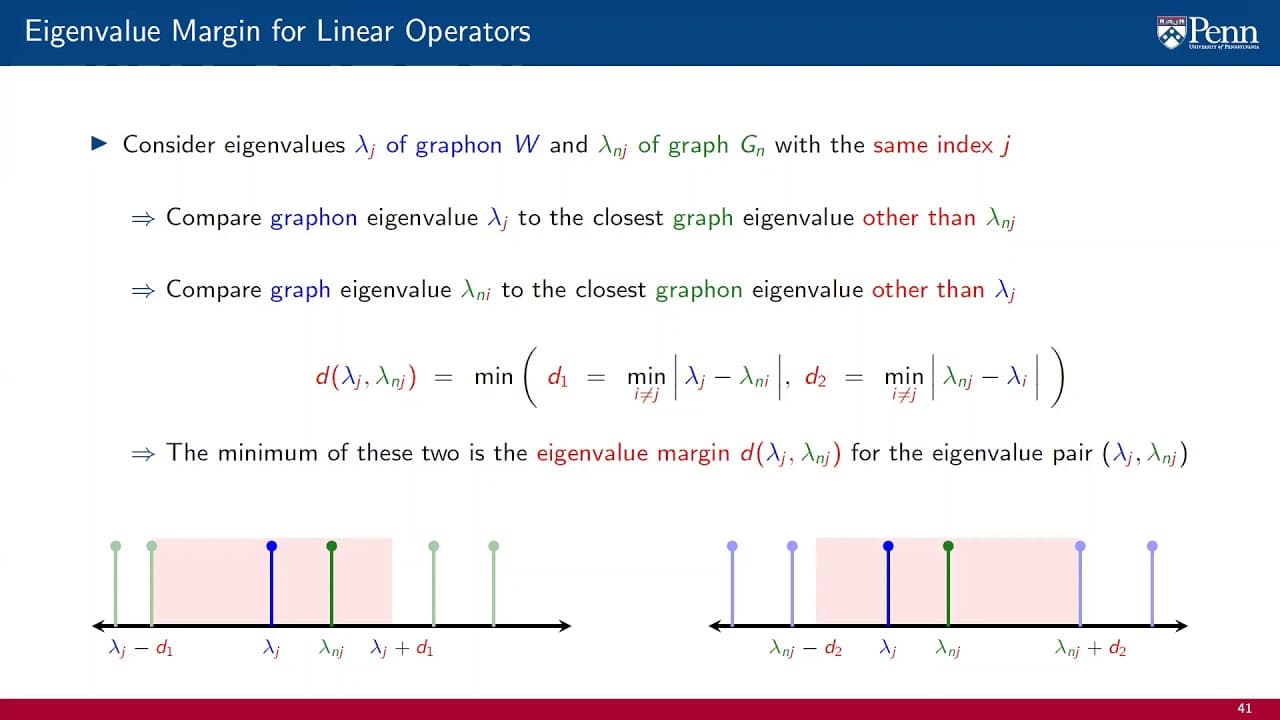
- Eigenvalue margin determines convergence properties of eigenvectors to eigenfunctions.
- Eigenvalues accumulating at zero complicate uniform convergence of eigenvectors.
- GFT converges to WFT for graphon band-limited signals, eliminating eigenvalue accumulation issues.
- Graphon band-limited signals have WFT components nullified for eigenvalues below a threshold.
- Convergence proofs are available in supplementary materials linked to the lecture.
Install to Summarize YouTube Videos and Get Transcripts
Explore YouTube Video Summarizer or Get YouTube Transcript Extractor
Questions & Answers
Q: How does the Graph Fourier Transform (GFT) converge to the Graphon Fourier Transform (WFT)?
The GFT converges to the WFT for graphon band-limited signals by nullifying WFT components associated with eigenvalues below a certain threshold, addressing the issue of eigenvalue accumulation at zero. This allows the eigenspaces to converge effectively, despite eigenvalue accumulation challenges.
Q: What is the main challenge in GFT to WFT convergence?
The main challenge in the convergence of GFT to WFT is the accumulation of eigenvalues around zero, which hinders the uniform convergence of eigenvectors. This issue necessitates additional conditions, such as band-limiting the graphon signal, to ensure convergence.
Q: Why is eigenvalue convergence alone insufficient for GFT to WFT convergence?
Eigenvalue convergence alone is insufficient because GFT and WFT involve projections on eigenvectors and eigenfunctions, respectively. Convergence of eigenvectors to eigenfunctions is also required, and this is complicated by eigenvalue accumulation at zero, affecting the eigenspace convergence.
Q: What is an eigenvalue margin and its role in convergence?
An eigenvalue margin is the distance between an eigenvalue and its closest neighboring eigenvalue in a sequence. This margin determines the convergence properties of the associated eigenvectors to eigenfunctions. Smaller margins require deeper sequence indices for convergence to manifest.
Q: How does band-limiting a graphon signal aid in GFT to WFT convergence?
Band-limiting a graphon signal involves nullifying WFT components for eigenvalues below a threshold, eliminating the issue of eigenvalue accumulation at zero. This ensures that only eigenvalues above the threshold contribute, facilitating effective convergence of GFT to WFT.
Q: What is the significance of eigenvalue accumulation at zero?
Eigenvalue accumulation at zero complicates the uniform convergence of eigenvectors because it narrows the eigenvalue margin. This accumulation makes it difficult for the GFT sequence to converge to the WFT without additional conditions like band-limiting the signal.
Q: What theorem is discussed regarding eigenfunction convergence?
The lecture discusses a classical theorem for the convergence of eigenfunctions of linear operators. It states that the distance between eigenfunctions of graphons and induced graphons is bounded by the product of a constant and the ratio of the norm difference to the eigenvalue margin.
Q: Where can one find the proofs for GFT to WFT convergence?
Proofs for the convergence of GFT to WFT, particularly for graphon band-limited signals, are available in the supplementary materials linked in the lecture. These materials provide detailed mathematical explanations and support the theoretical insights discussed in the lecture.
Summary & Key Takeaways
-
The Graph Fourier Transform (GFT) does not generally converge to the Graphon Fourier Transform (WFT) due to the need for eigenvector convergence, not just eigenvalue convergence. This is primarily due to eigenvalue accumulation around zero, which affects the convergence of eigenspaces.
-
For graphon band-limited signals, where WFT components below a certain threshold are nullified, the GFT does converge to the WFT. This approach addresses the challenge of eigenvalue accumulation and allows for effective convergence analysis.
-
The lecture provides a detailed explanation of the convergence issues and presents the theorem for eigenfunction convergence. Supplementary materials offer proofs and further insights into the convergence of GFT to WFT for graphon band-limited signals.
Read in Other Languages (beta)
Share This Summary 📚
Summarize YouTube Videos and Get Video Transcripts with 1-Click
Try YouTube Summary with ChatGPT & Claude or YouTube Transcript Generator
Explore More Summaries from Alelab Alelab 📚
Summarize YouTube Videos and Get Video Transcripts with 1-Click
Try YouTube Summary with ChatGPT & Claude or YouTube Transcript Generator