How to Graph Linear Equations in Two Forms
TL;DR
To graph linear equations in slope-intercept form, start by plotting the y-intercept and then use the slope to find additional points. For equations in standard form, determine the x-intercept by setting y to zero and the y-intercept by setting x to zero, then connect these points to form the line.
Transcript
in this video we're gonna talk about how to graph linear equations so let's start with a simple example how can we graph y equals 2x minus 3 what do you think we need to do in this problem now this equation is in something known as slope-intercept form perhaps you've seen that equation y equals MX plus B now the number in front of X is the slope an... Read More
Key Insights
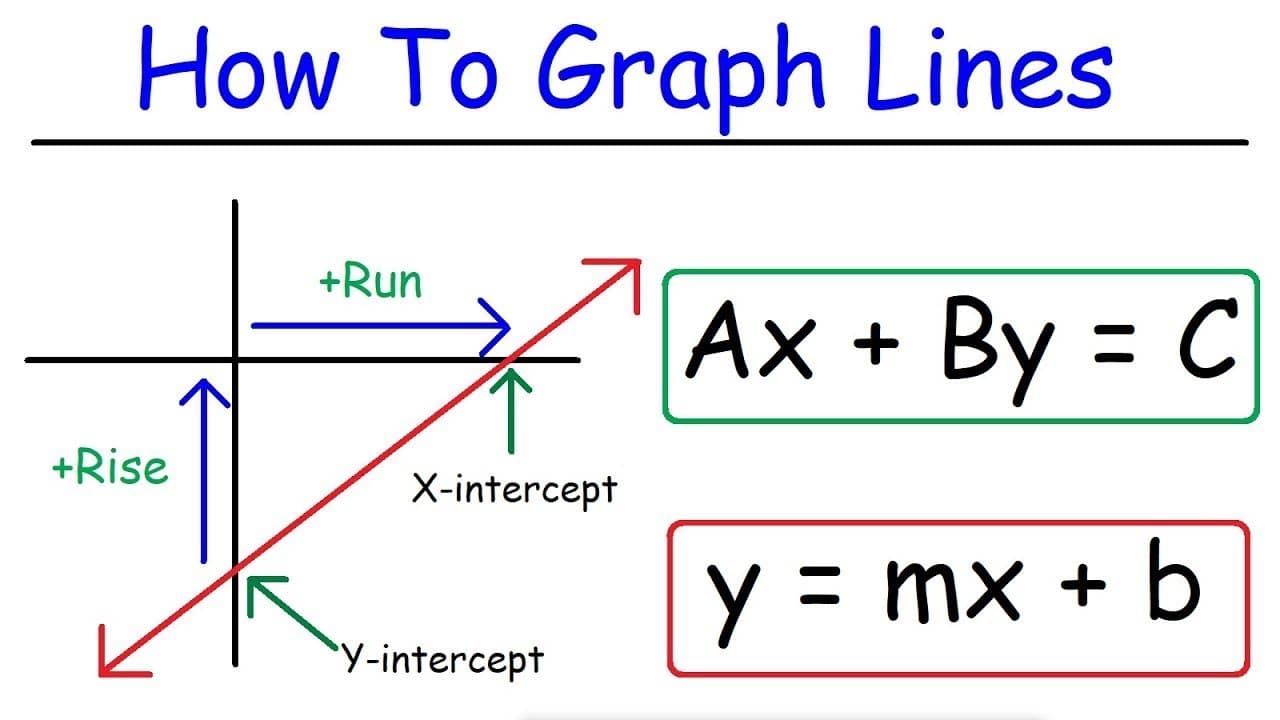
- 😃 Slope-intercept form: y = mx + b, where m is the slope and b is the y-intercept.
- 🏙️ The y-intercept is the point where the line intersects the y-axis.
- 💱 The slope is the ratio of the vertical change to the horizontal change and determines the line's steepness.
- ☺️ Standard form: ax + by = c, where a, b, and c are constants.
- ❣️ X-intercept can be found by setting y = 0, and the y-intercept can be found by setting x = 0.
- 🫥 Graphing a linear equation requires plotting the intercepts and connecting them with a line.
- 😥 Only two points are needed to graph a linear equation.
Install to Summarize YouTube Videos and Get Transcripts
Explore YouTube Video Summarizer or Get YouTube Transcript Extractor
Questions & Answers
Q: What is slope-intercept form and how does it help in graphing linear equations?
Slope-intercept form is y = mx + b, where m is the slope and b is the y-intercept. It helps in graphing linear equations as the slope determines the steepness of the line, and the y-intercept gives the point where the line intersects the y-axis.
Q: How do you graph a linear equation using slope-intercept form?
Start by plotting the y-intercept, which is the point where the line intersects the y-axis. Then, use the slope to find additional points by moving up/down and right/left according to the rise over run.
Q: How do you graph a linear equation in standard form?
In standard form (ax + by = c), you can find the x-intercept by setting y = 0 and calculating the value of x. Similarly, you can find the y-intercept by setting x = 0 and calculating the value of y. Plot these intercepts and connect them to graph the line.
Q: Can you graph linear equations with fractional slopes?
Yes, you can. For a linear equation with a fractional slope, determine the y-intercept first and then use the rise over run to find additional points. The rise is the numerator of the fractional slope, and the run is the denominator.
Summary & Key Takeaways
-
Linear equations can be written in slope-intercept form as y = mx + b, where m is the slope and b is the y-intercept.
-
To graph a linear equation, start by plotting the y-intercept and then use the slope to find additional points.
-
In standard form (ax + by = c), the x-intercept can be found by setting y = 0, and the y-intercept can be found by setting x = 0.
Read in Other Languages (beta)
Share This Summary 📚
Summarize YouTube Videos and Get Video Transcripts with 1-Click
Try YouTube Summary with ChatGPT & Claude or YouTube Transcript Generator
Explore More Summaries from The Organic Chemistry Tutor 📚





Summarize YouTube Videos and Get Video Transcripts with 1-Click
Try YouTube Summary with ChatGPT & Claude or YouTube Transcript Generator