What Makes The Strong Force Strong?
TL;DR
Quantum chromodynamics explains the strong force binding atomic nuclei.
Transcript
Quantum mechanics gets weirder as you go to smaller sizes and higher energies. It’s strange enough for atoms, but positively bizarre when we get to the atomic nucleus. And today we’re going nuclear, as we dive into the weird world of quantum chromodynamics. As you know, atoms consist of a nucleus of protons and neutrons surrounded by electrons. Tho... Read More
Key Insights
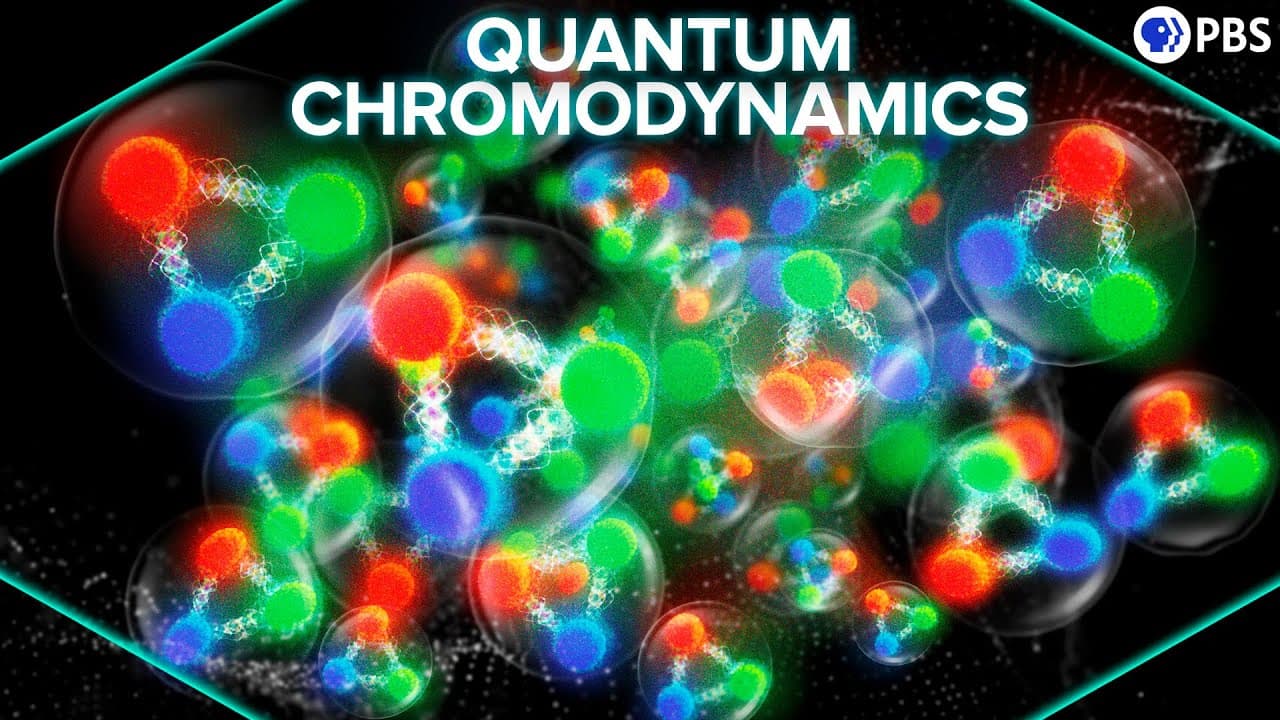
- Quantum chromodynamics (QCD) is the study of the strong force, which binds quarks together to form protons and neutrons.
- The strong force is mediated by particles called gluons, which carry color charge and keep quarks bound within nucleons.
- Quarks exist in different color charges: red, green, and blue, which combine to form color-neutral particles.
- Color confinement ensures that quarks are never found in isolation, only in groups like protons and neutrons.
- The Pauli Exclusion Principle applies to quarks, requiring them to differ in properties like color charge to occupy the same state.
- Gluons carry both positive and negative color charges, preventing them from interacting with color-neutral particles at large distances.
- The strong force is short-ranged, acting only within the atomic nucleus, due to the nature of gluon interactions.
- SU(3) symmetry is a mathematical framework that describes the behavior of color charges in QCD, analogous to RGB color mixing.
Install to Summarize YouTube Videos and Get Transcripts
Explore YouTube Video Summarizer or Get YouTube Transcript Extractor
Questions & Answers
Q: What is quantum chromodynamics?
Quantum chromodynamics (QCD) is the branch of physics that studies the strong nuclear force, which is responsible for binding quarks together to form protons and neutrons. QCD explores the interactions between quarks and gluons, the force carriers of the strong force, and explains how these particles combine to form the atomic nucleus.
Q: Why is the strong force confined to the atomic nucleus?
The strong force is confined to the atomic nucleus due to the nature of gluon interactions and color confinement. Gluons, which carry color charge, are not color-neutral and cannot interact with color-neutral particles over long distances. This ensures that the strong force acts only within the nucleus, binding quarks into protons and neutrons.
Q: What role do gluons play in the strong force?
Gluons are the force carriers in quantum chromodynamics, responsible for mediating the strong nuclear force. They carry color charge and facilitate the binding of quarks within nucleons. Gluons exist in superpositions of color charges, preventing them from interacting with color-neutral particles over long distances, thus confining the strong force to the atomic nucleus.
Q: How do quarks combine to form protons and neutrons?
Quarks combine to form protons and neutrons by sharing color charges in such a way that the resulting particles are color-neutral. Each quark carries a specific color charge (red, green, or blue), and when combined in groups of three, they form particles with no net color charge. This color neutrality is essential for the stability of protons and neutrons within the atomic nucleus.
Q: What is color confinement in quantum chromodynamics?
Color confinement is a phenomenon in quantum chromodynamics where quarks are never found in isolation but are always bound together in groups, such as protons and neutrons. This is due to the nature of gluon interactions and the requirement for particles to be color-neutral, ensuring that the strong force acts only within the atomic nucleus and not over large distances.
Q: How does the Pauli Exclusion Principle apply to quarks?
The Pauli Exclusion Principle states that no two fermions, such as quarks, can occupy the same quantum state simultaneously. In the context of quarks, this means that quarks within a nucleon must differ in properties like color charge to coexist. This principle helps explain the arrangement of quarks within protons and neutrons, ensuring stability and diversity in particle combinations.
Q: What is SU(3) symmetry in the context of quantum chromodynamics?
SU(3) symmetry is a mathematical framework used in quantum chromodynamics to describe the behavior of color charges. It involves combinations of three degrees of freedom, analogous to RGB color mixing, and explains how quarks combine to form color-neutral particles. SU(3) symmetry is fundamental to understanding the interactions and properties of quarks and gluons in QCD.
Q: How does the strong force differ from electromagnetism?
The strong force differs from electromagnetism in several ways. While electromagnetism involves positive and negative charges and acts over long distances, the strong force involves three types of color charges and is confined to the atomic nucleus. The force carriers, gluons, carry color charge and prevent the strong force from acting over large distances, unlike the neutral photons in electromagnetism.
Summary & Key Takeaways
-
Quantum chromodynamics (QCD) explores the strong nuclear force, which binds quarks together into protons and neutrons using gluons. This force is short-ranged and confined to the atomic nucleus because of properties like color charge and color confinement, preventing quarks from existing in isolation.
-
The strong force is unique because it involves three types of charges, labeled as colors: red, green, and blue. Quarks combine these colors to form neutral particles, similar to how RGB colors combine to form white light. This behavior is governed by SU(3) symmetry, a key concept in QCD.
-
Gluons, the force carriers of the strong force, are not color-neutral and exist in superpositions of color charges. This prevents them from interacting over long distances, ensuring the strong force remains confined to the atomic nucleus, unlike electromagnetism, which can act over large distances.
Read in Other Languages (beta)
Share This Summary 📚
Summarize YouTube Videos and Get Video Transcripts with 1-Click
Try YouTube Summary with ChatGPT & Claude or YouTube Transcript Generator
Explore More Summaries from PBS Space Time 📚


Summarize YouTube Videos and Get Video Transcripts with 1-Click
Try YouTube Summary with ChatGPT & Claude or YouTube Transcript Generator