Products
Features
YouTube Video Summarizer
Summarize YouTube videos
Web & PDF Highlighter
Highlight web pages & PDFs
Chat with PDF
Ask any PDF questions with AI
Ask AI Clone
Chat with your highlights & memories
Audio Transcriber
Transcribe audio files to text
Glasp Reader
Read and highlight articles
Kindle Highlight Export
Export your Kindle highlights
Idea Hatch
Hatch ideas from your highlights
Integrations
Obsidian Plugin
Notion Integration
Pocket Integration
Instapaper Integration
Medium Integration
Readwise Integration
Snipd Integration
Hypothesis Integration
Apps & Extensions
Chrome Extension
Safari Extension
Edge Add-ons
Firefox Add-ons
iOS App
Android App
Discover
Discover
Ideas
Discover new ideas and insights
Articles
Curated articles and insights
Books
Book recommendations by great minds
Posts
Essays and notes from readers
Quotes
Inspiring quotes collection
Videos
Curated videos and summaries
Explore Glasp
Glasp Newsletter
Weekly insights and updates
Glasp Talk
Interview series with great minds
Glasp Blog
Latest news and articles
Glasp Use Cases
Learn how others use Glasp
Build & Support
Glasp API
Access Glasp's API for developers
MCP Connector
Connect Glasp to Claude & ChatGPT
Community
Glasp Reddit Community
Students
Student discount and benefits
FAQs
Frequently Asked Questions
AboutPricing
DashboardLog inSign up

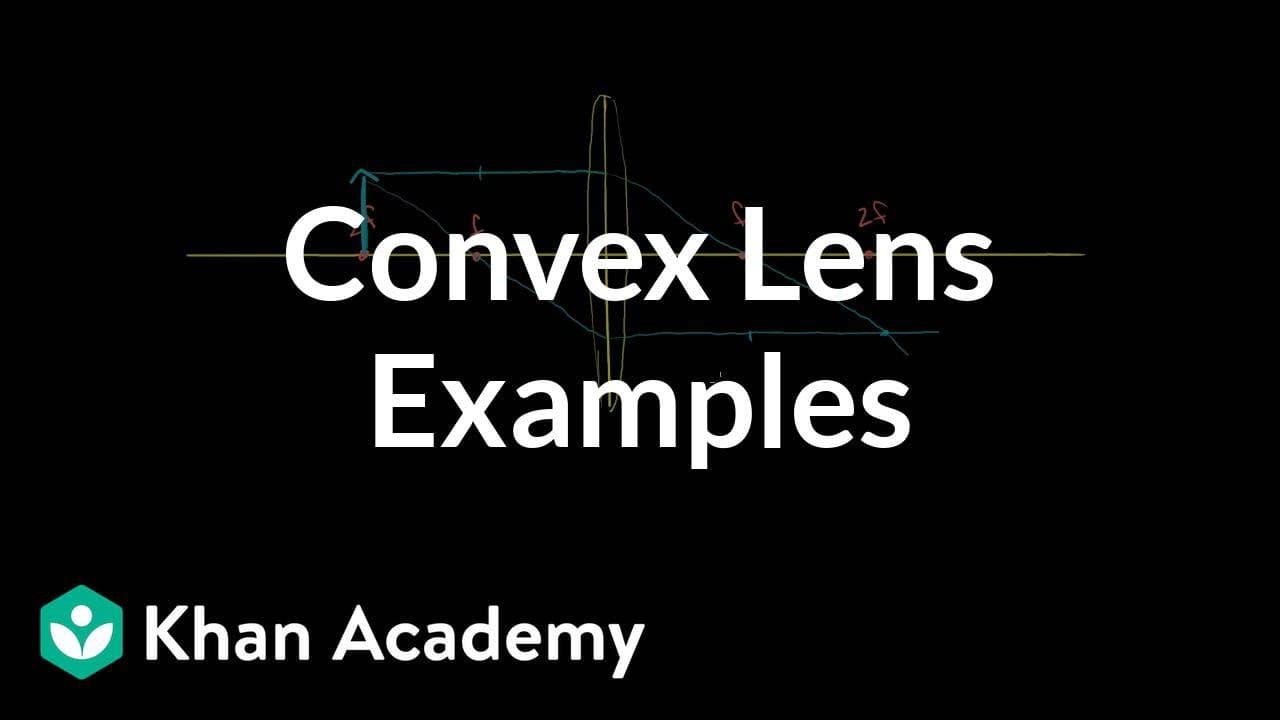
Convex lens examples | Geometric optics | Physics | Khan Academy
December 10, 2010
by
Khan Academy
YouTube video player
Convex lens examples | Geometric optics | Physics | Khan Academy

TL;DR

This video explains how to determine the image formed by a convex lens based on the object's distance from the lens.

Transcript

Like we did with parabolic mirrors, what I really want to do in this video is just for put objects at different distances relative to this convex lens and just think about what its image will look like And the whole point of doing that is going through all the different situations but more is getting practice of how to think about it So let's first... Read More

Key Insights

  • 💁 Different scenarios of object placement relative to the convex lens result in various types of images formed.
  • 😥 The principles of refraction and the properties of focal points play a crucial role in determining the image formation.
  • 💁 Convex lenses are used to form both real and virtual images, depending on the object's position.
  • ⚾ The magnification of the image can vary based on the distance between the object and the lens.

Install to Summarize YouTube Videos and Get Transcripts

Explore YouTube Video Summarizer or Get YouTube Transcript Extractor

Questions & Answers

Q: How does an object's distance from a convex lens affect the image formed?

The distance of the object from the lens determines whether the image formed is real or virtual, inverted or upright, and larger or smaller than the object.

Q: What happens when the object is placed more than two focal lengths away from the convex lens?

In this case, a real, inverted, and smaller image is formed.

Q: What is the image like when the object is placed at two focal distances away?

The image formed is inverted and the same size as the object.

Q: How is the image formed when the object is between one focal length and two focal lengths away?

The image formed is real, inverted, larger, and further away from the lens compared to the object.

Summary & Key Takeaways

  • Placing an object more than two focal lengths away from a convex lens creates a real, smaller, and inverted image.

  • When the object is placed at two focal distances away from the lens, the image formed is inverted and the same size as the object.

  • If the object is between one focal length and two focal lengths away, the image formed is real, inverted, larger, and further away from the lens.

  • Placing the object at the focal point does not create an image, and placing it less than one focal distance away creates a magnified virtual image.


Read in Other Languages (beta)

English

Share This Summary 📚

Summarize YouTube Videos and Get Video Transcripts with 1-Click

Download browser extensions on:

Try YouTube Summary with ChatGPT & Claude or YouTube Transcript Generator

Explore More Summaries from Khan Academy 📚
Finding points with vertical tangents thumbnail
Finding points with vertical tangents
Khan Academy
Worked example: Area enclosed by cardioid | AP Calculus BC | Khan Academy thumbnail
Worked example: Area enclosed by cardioid | AP Calculus BC | Khan Academy
Khan Academy
Addition elimination method 1 | Systems of equations | 8th grade | Khan Academy thumbnail
Addition elimination method 1 | Systems of equations | 8th grade | Khan Academy
Khan Academy
Shells, subshells, and orbitals | Atomic structure and properties | AP Chemistry | Khan Academy thumbnail
Shells, subshells, and orbitals | Atomic structure and properties | AP Chemistry | Khan Academy
Khan Academy
Describing subsets of sample spaces exercise | Probability and Statistics | Khan Academy thumbnail
Describing subsets of sample spaces exercise | Probability and Statistics | Khan Academy
Khan Academy
What Causes the Seasons on Earth? thumbnail
What Causes the Seasons on Earth?
Khan Academy

Summarize YouTube Videos and Get Video Transcripts with 1-Click

Download browser extensions on:

Try YouTube Summary with ChatGPT & Claude or YouTube Transcript Generator

Apps & Extensions

  • Chrome Extension
  • Safari Extension
  • Edge Add-ons
  • Firefox Add-ons
  • iOS App
  • Android App

Key Features

  • YouTube Video Summarizer
  • Web & PDF Summarizer
  • Web & PDF Highlighter
  • Chat with PDF
  • Ask AI Clone
  • Audio Transcriber
  • Glasp Reader
  • Kindle Highlight Export
  • Idea Hatch

Integrations

  • Obsidian Plugin
  • Notion Integration
  • Pocket Integration
  • Instapaper Integration
  • Medium Integration
  • Readwise Integration
  • Snipd Integration
  • Hypothesis Integration

More Features

  • APIs
  • MCP Connector
  • Blog & Post
  • Embed Links
  • Image Highlight
  • Personality Test
  • Quote Shots

Company

  • About us
  • Blog
  • Community
  • FAQs
  • Job Board
  • Newsletter
  • Pricing
Terms

•

Privacy

•

Guidelines

© 2026 Glasp Inc. All rights reserved.