How Do You Describe Subsets of Sample Spaces? Describing Subsets of Sample Spaces Exercise, Probability and Statistics, Khan Academy
TL;DR
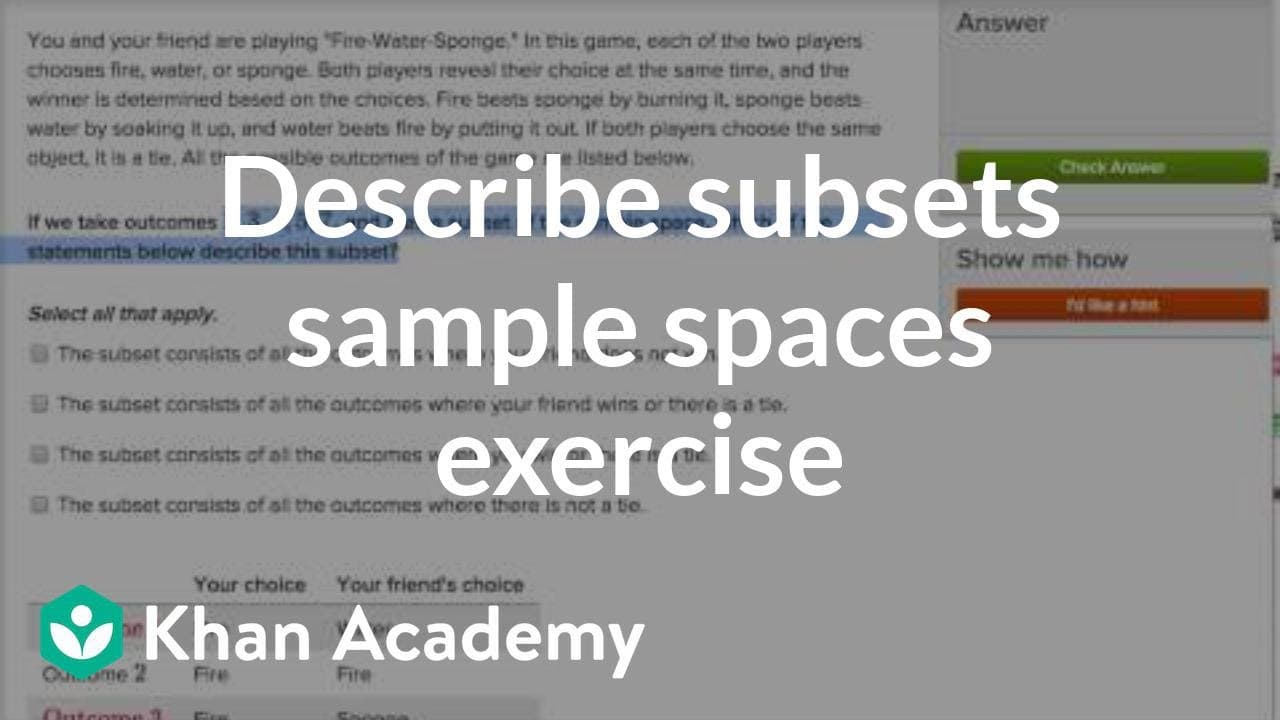
A subset of a sample space is described by finding the condition shared by its selected outcomes. In the Harry Potter wand example, holly or unicorn hair covers 8 of 20 outcomes, while holly and unicorn hair covers only 1. In Fire-Water-Sponge, the six highlighted outcomes are precisely the outcomes without a tie. Read on to see how overlap, logical wording and excluded outcomes determine each result.
Transcript
- So, this right over here is a screenshot of the Describing Subsets of Sample Spaces exercise on Khan Academy, and I thought I would do a couple of examples, just because it's good practice just thinking about how do we describe sets and subsets. So it reads, Harry Potter is at Ollivanders Wand Shop. As we all know, the wand must choose the wizard... Read More
Key Insights
- Count combinations systematically: The wand sample space comes from pairing every available wood with every available core. Four wood types and five core materials produce 20 possible outcomes. The game follows the same structure: three choices for one player paired with three choices for the friend produce nine outcomes. Multiplication organizes the complete sample space before any subset is evaluated.
- State probability assumptions explicitly: The wand exercise lists 20 possible outcomes but does not explicitly say that they are equally likely. The explanation adopts equal likelihood in order to convert a count of favorable outcomes into a probability. Under that assumption, probability is found by dividing the number of outcomes in the event by the 20 outcomes in the full sample space.
- Handle overlapping conditions once: The phrase “holly or unicorn hair” includes every holly wand and every unicorn-hair wand. The holly with unicorn hair outcome appears in both descriptions, but it remains a single outcome in the subset. Counting five holly results and only the three additional unicorn-hair results gives eight, avoiding a duplicate count of the overlapping combination.
- Interpret inclusive or correctly: In the wand example, “or” includes outcomes meeting either condition and also the outcome meeting both. The subset therefore contains the five holly combinations, including holly with unicorn hair, plus three other unicorn-hair combinations. This interpretation explains why the event reaches eight outcomes rather than excluding the shared holly and unicorn hair result.
- Interpret and as intersection: The condition “holly and unicorn hair” is much narrower because both properties must occur in the same wand. Among the 20 wood-core combinations, only the single pairing of holly with unicorn hair qualifies. This event is contained within the broader “holly or unicorn hair” event, rather than forming a separate set of additional outcomes.
- Compare events through containment: A probability comparison does not require converting every result to a percentage. The holly-or-unicorn-hair subset contains the holly-and-unicorn-hair outcome plus seven more outcomes. Since the broader event contains every outcome of the narrower event and additional outcomes, it has the higher probability when the sample outcomes are treated as equally likely.
- Simplify without changing meaning: The eight favorable wand outcomes over the 20 possible outcomes give the fraction 8/20. The explanation simplifies this to 4/10 and then expresses it as a 40% chance. Each form represents the same probability under the stated assumption, while the original 8/20 form makes the favorable-outcome count visible.
- Use rules to classify outcomes: Fire-Water-Sponge outcomes can be evaluated from three game rules. Fire defeats sponge, sponge defeats water and water defeats fire. These relationships determine whether the player wins or the friend wins whenever their choices differ. If their choices match, neither wins because fire-fire, water-water and sponge-sponge are explicitly defined as ties.
- Test claims against counterexamples: The proposed descriptions of the highlighted game subset can be rejected by inspecting individual outcomes. Outcome one has the player choose fire and the friend choose water, so the friend wins. Outcome three has the player choose fire and the friend choose sponge, so the player wins. Because both are highlighted, the subset cannot be characterized solely by which person wins.
- Inspect excluded outcomes too: The most revealing pattern in Fire-Water-Sponge comes from the outcomes that are not highlighted. Outcomes two, six and nine correspond to fire-fire, water-water and sponge-sponge. Those are exactly the three possible ties. Recognizing the shared property of the excluded cases makes it clear that the selected six cases form the complementary condition, all outcomes where there is not a tie.
- Separate outcome labels from properties: Numbers such as one, three, four, five, seven and eight identify positions in the listed game sample space, but the numbers do not explain the subset. A useful description must state the common property of those outcomes. Here, their shared property is that the players chose different objects, ensuring that someone wins and no tie occurs.
- Describe subsets with exact language: Small wording changes alter which outcomes qualify. “Your friend does not win,” “your friend wins or there is a tie,” and “you win or there is a tie” each conflict with at least one highlighted game outcome. “There is not a tie” fits all six selected outcomes and excludes all three unselected ones, so it describes the subset exactly.
Install to Summarize YouTube Videos and Get Transcripts
Explore YouTube Video Summarizer or Get YouTube Transcript Extractor
Questions & Answers
Q: How do you describe subsets of sample spaces?
Describe a subset by identifying the precise condition shared by all selected outcomes. First list or inspect the complete sample space, then test which outcomes satisfy the proposed condition. In the wand example, wood and core properties define the subsets. In Fire-Water-Sponge, the six highlighted outcomes share the property that there is not a tie. Checking both included and excluded outcomes confirms why the description fits.
Q: How is the probability of a holly or unicorn hair wand calculated?
There are five outcomes involving holly, one for each available core. The holly with unicorn hair outcome is already among those five, so only three additional unicorn-hair outcomes, elm, maple and wenge, are added. That produces eight qualifying outcomes among 20 possible wand combinations. Assuming those outcomes are equally likely, the probability is 8/20, equivalent to 4/10 or 40%. The overlap is counted once because it is one outcome, even though it meets both conditions.
Q: Why is holly or unicorn hair more likely than holly and unicorn hair?
The word “or” accepts a wand that is holly, has unicorn hair, or satisfies both conditions. That event contains eight of the 20 outcomes. The word “and” requires the single combination that uses holly wood and unicorn hair together, so it contains only one outcome. The broader event includes that one shared outcome plus seven more. Under the equal-likelihood assumption, having more qualifying outcomes makes the “or” event more likely.
Q: How many outcomes are in the Harry Potter wand sample space?
The shop offers four wood types: holly, elm, maple and wenge. It also offers five core materials: phoenix feather, unicorn hair, dragon scale, raven feather and thestral tail. Each wood can be paired with each of the five cores. Therefore, four groups of five combinations produce 20 possible outcomes. These 20 combinations form the sample space used to compare the wand events.
Q: How many possible outcomes are there in Fire-Water-Sponge?
Each player can choose fire, water or sponge, giving each person three choices. For every choice made by the first player, the friend can make any of the same three choices. Multiplying three by three gives nine possible paired outcomes. The list includes wins for each participant as well as matching-choice ties. These nine outcomes form the complete sample space for the game.
Q: Which Fire-Water-Sponge outcomes are ties?
A tie occurs when both players reveal the same object. The matching pairs are fire-fire, water-water and sponge-sponge. In the listed sample space, these are outcomes two, six and nine. They are the only three ties because there are only three available objects to match. Their exclusion explains why outcomes one, three, four, five, seven and eight form the non-tie subset.
Q: Why do the highlighted Fire-Water-Sponge outcomes mean there is not a tie?
The highlighted outcomes are one, three, four, five, seven and eight. In each case, the two players choose different objects, so one choice defeats the other according to the game rules. The only unhighlighted outcomes are two, six and nine, where both players make the same choice. Those three matching pairs are precisely the ties. Therefore, the highlighted subset contains every outcome where there is not a tie.
Q: How can incorrect descriptions of the game subset be eliminated?
Test each proposed description against specific highlighted outcomes. Outcome one is fire against water, so the friend wins because water puts out fire. Outcome three is fire against sponge, so the player wins because fire burns sponge. Since the highlighted subset contains a friend win and a player win, descriptions based only on one person winning fail. Examining the omitted matching pairs then reveals that “all outcomes where there is not a tie” fits the complete subset.
Summary & Key Takeaways
-
Introducing sample-space subsets: The lesson opens with the Describing Subsets of Sample Spaces exercise on Khan Academy and uses two examples to practice identifying sets and subsets. The first places Harry Potter at Ollivanders Wand Shop, where the wand chooses the wizard and Harry treats the selection as a random process. The possible wands combine four wood types, holly, elm, maple and wenge, with five core materials, producing a sample space of 20 outcomes.
-
Comparing wand conditions: The first proposed event is that Harry’s wand is made of holly or unicorn hair. All five holly outcomes qualify, along with the elm, maple and wenge outcomes containing unicorn hair. The holly and unicorn hair combination belongs to both conditions, so it is counted only once. This gives eight qualifying outcomes. Assuming all 20 outcomes are equally likely, the event has probability 8/20, which simplifies to 4/10 or 40%.
-
Distinguishing or from and: The alternative event requires a wand made of holly and unicorn hair. Only one outcome satisfies both requirements at the same time, so its probability is 1 out of 20 under the equal-likelihood assumption. The holly-or-unicorn-hair event includes that shared outcome plus seven others. It must therefore be more likely than the holly-and-unicorn-hair event, showing how the logical words “or” and “and” create substantially different subsets.
-
Building the game space: The second example introduces Fire-Water-Sponge, a game in which each of two players chooses fire, water or sponge. Fire beats sponge by burning it, sponge beats water by soaking it up and water beats fire by putting it out. Matching choices produce a tie. Because the player has three choices and the friend has three choices for each one, the complete sample space contains 3 times 3, or nine, possible outcomes.
-
Identifying the highlighted subset: The exercise highlights outcomes one, three, four, five, seven and eight, then asks which statement describes them. Options involving who wins fail because the highlighted group includes outcomes won by different players. The decisive pattern appears in the omitted outcomes two, six and nine: fire-fire, water-water and sponge-sponge are the three ties. Therefore, every highlighted outcome is a non-tie in which someone wins, so the correct description is all outcomes where there is not a tie.
Read in Other Languages (beta)
Share This Summary 📚
Summarize YouTube Videos and Get Video Transcripts with 1-Click
Try YouTube Summary with ChatGPT & Claude or YouTube Transcript Generator
Explore More Summaries from Khan Academy 📚



Summarize YouTube Videos and Get Video Transcripts with 1-Click
Try YouTube Summary with ChatGPT & Claude or YouTube Transcript Generator