Shells, subshells, and orbitals | Atomic structure and properties | AP Chemistry | Khan Academy
TL;DR
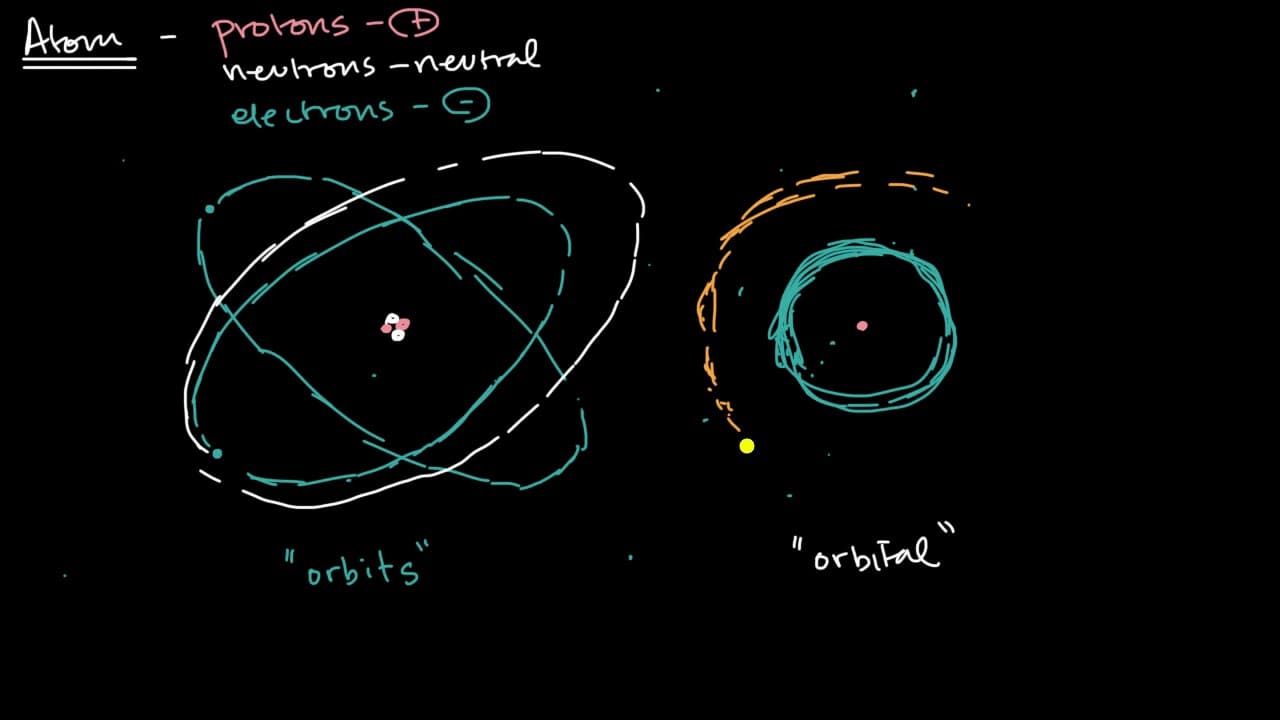
Atoms are composed of protons, neutrons, and electrons. Electrons do not orbit the nucleus in well-defined paths but are found in regions called orbitals.
Transcript
- [Instructor] We've learned in other videos that the atom is in fact made up of even smaller constituent particles which is pretty amazing because atoms are already unimaginably small. And those particles are the protons which have positive charge, you have your neutrons which have neutral charge or no charge and then you have your electrons which... Read More
Key Insights
- 🫀 Atoms are composed of protons, neutrons, and electrons, with the positive charge concentrated in the nucleus.
- 🛰️ Early models proposed that electrons orbit the nucleus in well-defined paths, but this was later found to be inaccurate.
- 😥 Electrons are not in precise orbits but are found in regions called orbitals, which represent the probability of finding the electron at a given point.
- 🎚️ Orbitals are characterized by their energy level and shape, with higher energy levels further from the nucleus.
- 😄 Different types of orbitals (s, p, d, f) have different shapes and capacities for holding electrons.
- 🫀 The distribution of electrons in atoms is determined by the filling of orbitals, following a specific pattern.
- ✋ Adding more energy to an electron can cause it to jump to a higher energy level or orbital.
Install to Summarize YouTube Videos and Get Transcripts
Explore YouTube Video Summarizer or Get YouTube Transcript Extractor
Questions & Answers
Q: What are the three particles that make up an atom?
The three particles are protons, neutrons, and electrons. Protons carry a positive charge, neutrons have no charge, and electrons have a negative charge.
Q: What did early models propose about electron orbits?
Early models suggested that electrons orbit the nucleus in circular or elliptical paths, similar to planets orbiting a star.
Q: How are electrons actually distributed in atoms?
Electrons are not in precise orbits but are found in regions called orbitals, which represent the probability of finding the electron at a given point.
Q: What determines the shape and energy of an orbital?
The energy level of an orbital is determined by the distance from the nucleus, with higher energy levels further away. The shape is determined by the distribution of electron density in that region of space.
Summary & Key Takeaways
-
Atoms are made up of protons, neutrons, and electrons, with the positive charge concentrated in the nucleus.
-
Early models proposed that electrons orbit the nucleus in circular or elliptical paths.
-
However, electrons are not in well-defined orbits but are found in regions called orbitals, which represent the probability of finding the electron at a given point.
Read in Other Languages (beta)
Share This Summary 📚
Summarize YouTube Videos and Get Video Transcripts with 1-Click
Try YouTube Summary with ChatGPT & Claude or YouTube Transcript Generator
Explore More Summaries from Khan Academy 📚



Summarize YouTube Videos and Get Video Transcripts with 1-Click
Try YouTube Summary with ChatGPT & Claude or YouTube Transcript Generator