How Does a Hydrometer Measure Liquid Density?
TL;DR
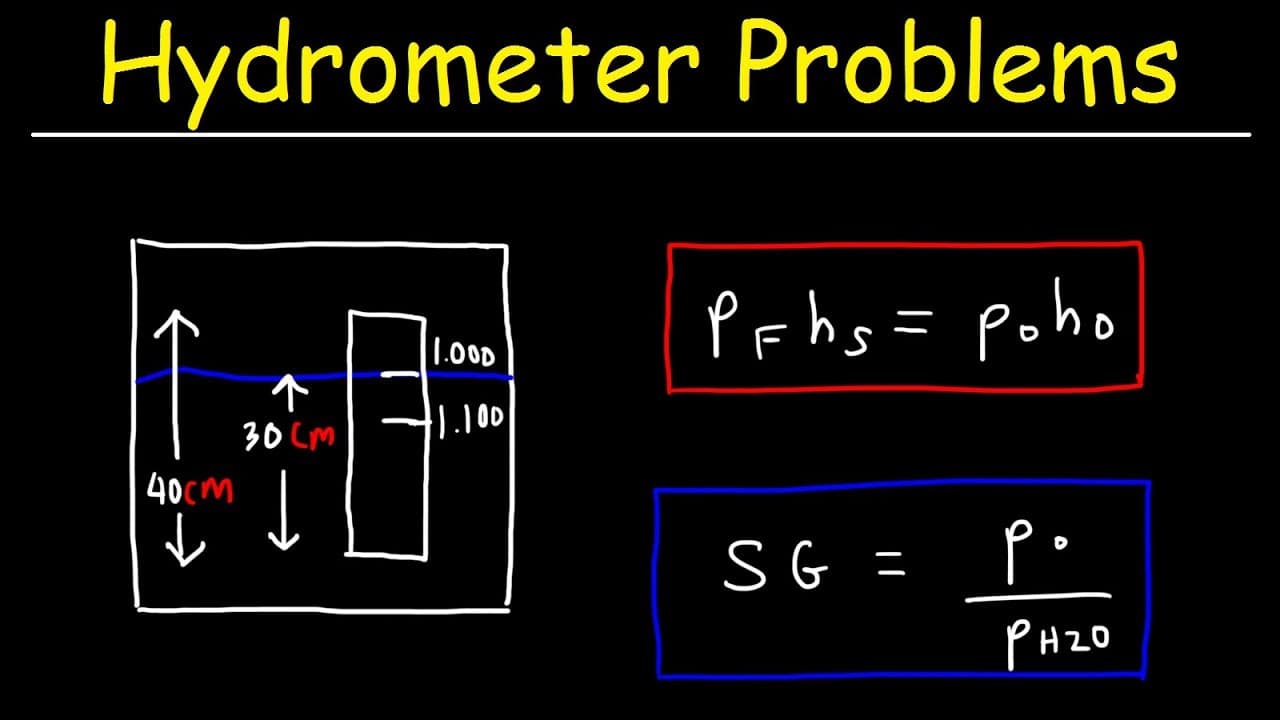
A hydrometer measures liquid density through specific gravity, which is calculated based on the height submerged in the liquid. The submerged height, compared to the hydrometer's total height and its own density, allows for determining the liquid's density. This process relies on the principle that the hydrometer can only measure liquids denser than itself.
Transcript
so this video is all about hydrometers a hydrometer is used to measure the specific gravity of a liquid and the specific gravity is the ratio between the density of the substance and the density of water so water which has a density of a thousand the specific gravity for water is 1.000 now we have a certain hydrometer that is 40 centimeters in leng... Read More
Key Insights
- 💦 Hydrometers are used to measure the specific gravity of liquids, indicating their density relative to water.
- 🫗 The height submerged in the liquid is crucial for calculating the specific gravity and can vary depending on the liquid's density.
- 🫗 The density of the hydrometer itself affects its ability to measure different liquids accurately.
- 💦 Hydrometers are calibrated based on the specific gravity of water, which is assigned a value of 1.000.
- 💦 The specific gravity reading can be used to determine the density of a liquid if multiplied by 1000, as the density of water is 1000 kg/m³.
- 🫗 Liquids with lower density will cause a greater fraction of the hydrometer to be submerged, while liquids with higher density will result in a smaller fraction.
- 🫗 In order to accurately measure a liquid's density, the liquid's density must be higher than the density of the hydrometer.
Install to Summarize YouTube Videos and Get Transcripts
Explore YouTube Video Summarizer or Get YouTube Transcript Extractor
Questions & Answers
Q: What does a hydrometer measure?
A hydrometer measures the specific gravity of a liquid, indicating its density relative to water.
Q: How is the specific gravity of a liquid calculated using a hydrometer?
The specific gravity is calculated by dividing the density of the liquid by the density of water, which can be determined from the reading on the hydrometer.
Q: How does the height submerged in the liquid affect the specific gravity reading?
The height submerged in the liquid is used to calculate the specific gravity, with a greater fraction of the hydrometer submerged in fluids with lower density.
Q: Why can't a hydrometer accurately measure liquids with a density lower than its own density?
A hydrometer floats in liquids, so it must have a density lower than that of water. It can only measure liquids with a density higher than its own density, as it would sink in less dense fluids.
Summary & Key Takeaways
-
A hydrometer measures the specific gravity of a liquid, which is the ratio of its density to the density of water.
-
The specific gravity is determined by the height submerged in the liquid, which can be calculated using the hydrometer's density and total height.
-
The density of the hydrometer itself affects its ability to measure the density of liquids, as it can only accurately measure those with a higher density than the hydrometer.
Read in Other Languages (beta)
Share This Summary 📚
Summarize YouTube Videos and Get Video Transcripts with 1-Click
Try YouTube Summary with ChatGPT & Claude or YouTube Transcript Generator
Explore More Summaries from The Organic Chemistry Tutor 📚





Summarize YouTube Videos and Get Video Transcripts with 1-Click
Try YouTube Summary with ChatGPT & Claude or YouTube Transcript Generator