How To Determine The Number of Paired and Unpaired Electrons
TL;DR
Learn how to determine the number of paired and unpaired electrons in elements by writing electron configurations and drawing orbital diagrams.
Transcript
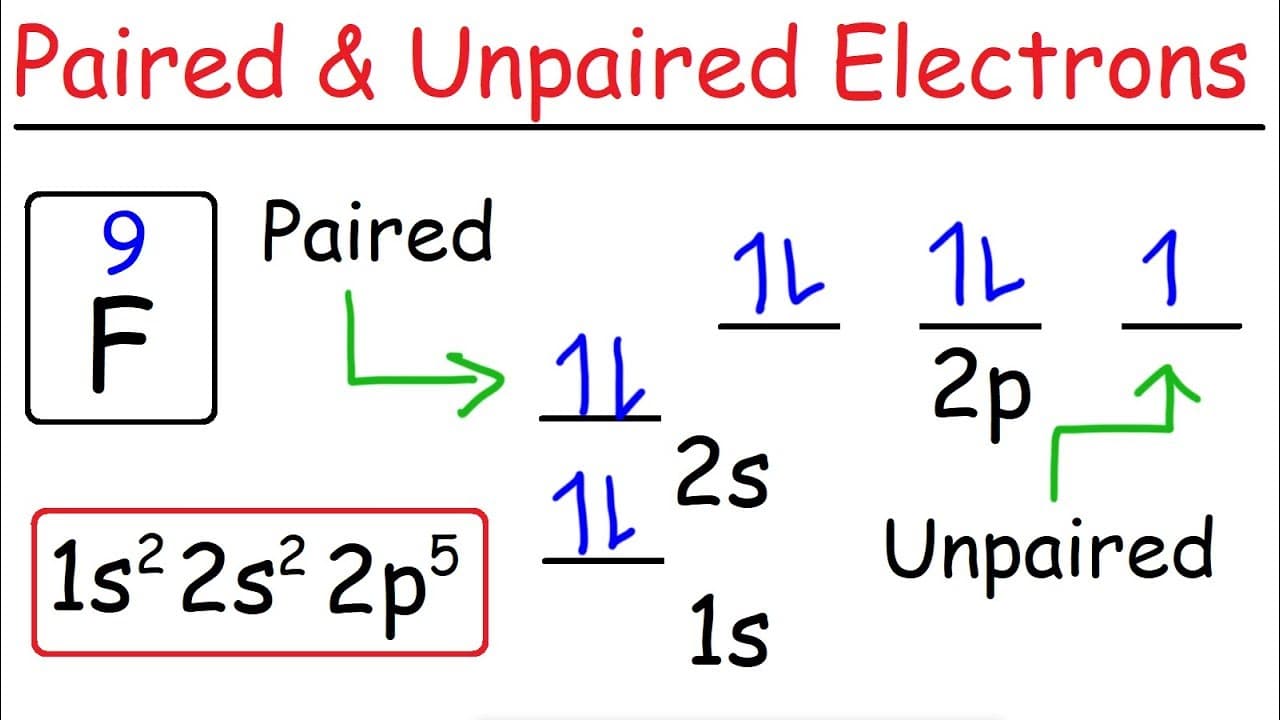
in this video we're going to talk about how to determine the number of paired and unpaired electrons so we're going to start with the element fluorine which has an atomic number of 9. how can we determine how many paired and unpaired electrons fluorine has the first thing we need to do is to write the electron configuration so i'm going to create a... Read More
Key Insights
- 🎚️ The electron configuration of an element is determined by writing the energy levels and the number of electrons in each sublevel.
- ❓ The orbital diagram illustrates the distribution of electrons in orbitals.
- 😘 The off-ball principle states that lower energy levels should be filled first, while Hund's rule explains how electrons are distributed in degenerate orbitals.
- #️⃣ The number of paired and unpaired electrons can be determined from the electron configuration and orbital diagram.
- ❓ Fluorine has 1 unpaired electron and 8 paired electrons.
- ❓ Phosphorus has 3 unpaired electrons and 12 paired electrons.
- 🤘 Iron metal has 4 unpaired electrons and 22 paired electrons.
Install to Summarize YouTube Videos and Get Transcripts
Explore YouTube Video Summarizer or Get YouTube Transcript Extractor
Questions & Answers
Q: How do you determine the number of paired and unpaired electrons in an element?
To determine the number of paired and unpaired electrons, write the electron configuration by filling up the energy levels according to the electron capacity of each sublevel. Then, draw the orbital diagram, following the off-ball principle and Hund's rule for degenerate orbitals.
Q: What is the electron configuration and orbital diagram for fluorine?
The electron configuration for fluorine is 1s2 2s2 2p5. The orbital diagram would show one unpaired electron in the 2p sublevel and eight paired electrons in the 1s, 2s, and 2p sublevels.
Q: How many unpaired electrons does phosphorus have?
Phosphorus has three unpaired electrons. The orbital diagram for phosphorus would show three unpaired electrons in the 3p sublevel and twelve paired electrons in the other sublevels.
Q: Is phosphorus a paramagnetic or diamagnetic element?
Phosphorus is a paramagnetic element because it has three unpaired electrons. Paramagnetic elements are weakly attracted to an external magnetic field, while diamagnetic elements have only paired electrons and are weakly repelled by an external magnetic field.
Summary & Key Takeaways
-
To determine the number of paired and unpaired electrons in an element, write the electron configuration by filling up the energy levels following the electron capacity for each sublevel.
-
The orbital diagram can be drawn by filling up the orbitals with electrons, following the off-ball principle and Hund's rule for degenerate orbitals.
-
Fluorine, with an atomic number of 9, has 1 unpaired electron and 8 paired electrons. Phosphorus, with an atomic number of 15, has 3 unpaired electrons and 12 paired electrons. Iron metal, with an atomic number of 26, has 4 unpaired electrons and 22 paired electrons.
Read in Other Languages (beta)
Share This Summary 📚
Summarize YouTube Videos and Get Video Transcripts with 1-Click
Try YouTube Summary with ChatGPT & Claude or YouTube Transcript Generator
Explore More Summaries from The Organic Chemistry Tutor 📚

Summarize YouTube Videos and Get Video Transcripts with 1-Click
Try YouTube Summary with ChatGPT & Claude or YouTube Transcript Generator