How to Solve Calculus II Problems for Final Exam
TL;DR
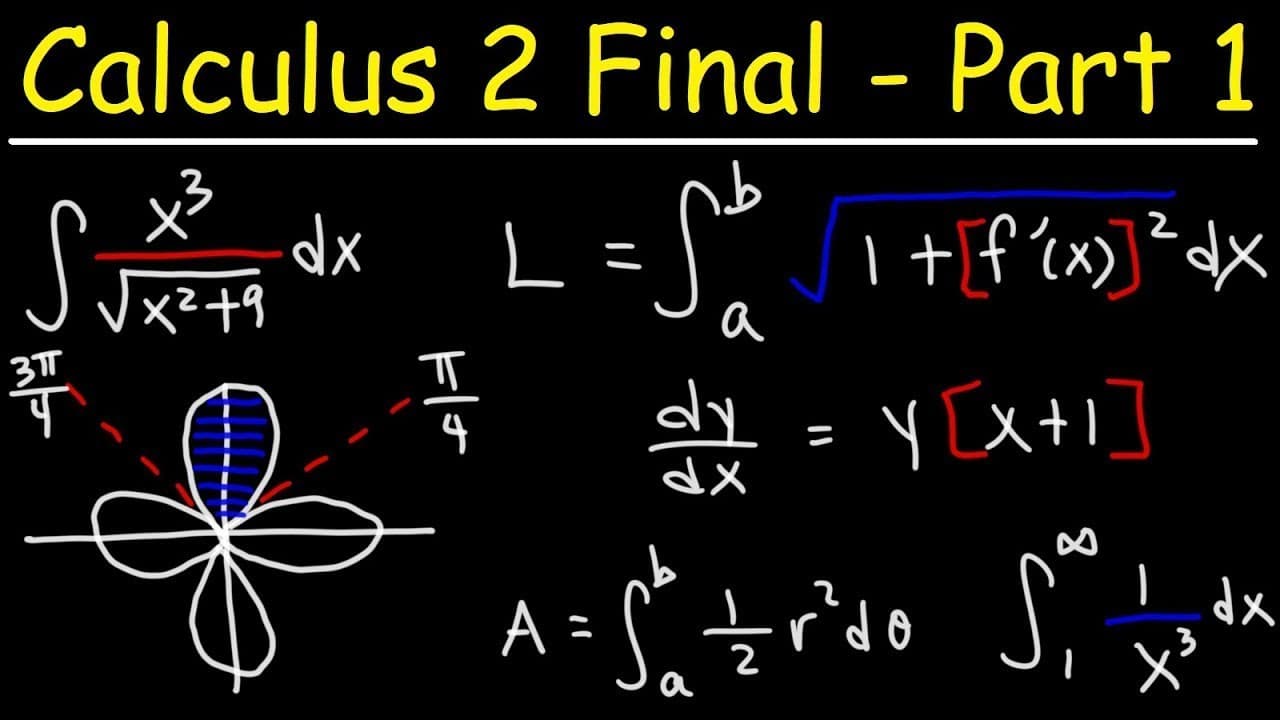
To effectively prepare for your Calculus II final exam, focus on mastering techniques like integration by parts and u-substitution for solving indefinite integrals. Use numerical methods such as the trapezoidal rule for estimating work and Simpson's rule for calculating displacement. Additionally, understand how to apply formulas for arc length and surface area to solve related calculus problems.
Transcript
so this video is for those of you who are studying to take the final for calculus ii let's begin with this problem feel free to pause the video and try it yourself number one find the indefinite integral so what is the anti-derivative of x squared sine x dx what technique do we need to use we need to use something called integration by parts the in... Read More
Key Insights
- 🛫 Integration by parts and u-substitution are helpful techniques for finding indefinite integrals with complex functions.
- 😄 Applying trigonometric identities and u-substitution can simplify trigonometric integrals.
- 💦 The trapezoidal rule is a method for approximating work done by a force using smaller intervals.
- 🗂️ Simpson's rule is useful for estimating displacement by dividing the interval into subintervals and applying the formula.
Install to Summarize YouTube Videos and Get Transcripts
Explore YouTube Video Summarizer or Get YouTube Transcript Extractor
Questions & Answers
Q: How do you find the indefinite integral of x^2 sin(x) using integration by parts?
To find the indefinite integral of x^2 sin(x), we use integration by parts. We set u = x^2 and dv = sin(x) dx. After applying the integration by parts formula, we obtain the final answer: -x^2 cos(x) + 2x sin(x) + C.
Q: What technique can be used to find the indefinite integral of cosine^5(x)?
To find the indefinite integral of cosine^5(x), we use u-substitution. By letting u = sin(x), we can rewrite the integral in terms of u, which simplifies the problem. The resulting integral becomes (1/5)u^5 + C, and we substitute sin(x) back in to obtain the final answer: (1/5)sin^5(x) + C.
Q: How can we estimate the work done by a force using the trapezoidal rule?
To estimate the work done by a force using the trapezoidal rule, we divide the interval into smaller subintervals and approximate the area under the curve using trapezoids. We multiply each subinterval by the average of the corresponding y-values and sum them up to get the estimated work.
Q: What is the process for using Simpson's rule to estimate displacement?
To use Simpson's rule to estimate displacement, we divide the interval into subintervals and apply the Simpson's rule formula. It involves multiplying the first and last y-values by 1, and the rest by alternating 4 and 2. We then sum up these values to obtain the estimated displacement.
Summary & Key Takeaways
-
The video covers various calculus II problems, including finding indefinite integrals using integration by parts and u-substitution.
-
It explains how to solve trigonometric integrals and use u-substitution to modify the problem.
-
It demonstrates the use of the trapezoidal rule to estimate work done by a force and Simpson's rule to estimate displacement.
-
It also shows how to use the arc length formula and surface area formula to solve related problems.
Read in Other Languages (beta)
Share This Summary 📚
Summarize YouTube Videos and Get Video Transcripts with 1-Click
Try YouTube Summary with ChatGPT & Claude or YouTube Transcript Generator
Explore More Summaries from The Organic Chemistry Tutor 📚

Summarize YouTube Videos and Get Video Transcripts with 1-Click
Try YouTube Summary with ChatGPT & Claude or YouTube Transcript Generator