Response to Oscillating Input
TL;DR
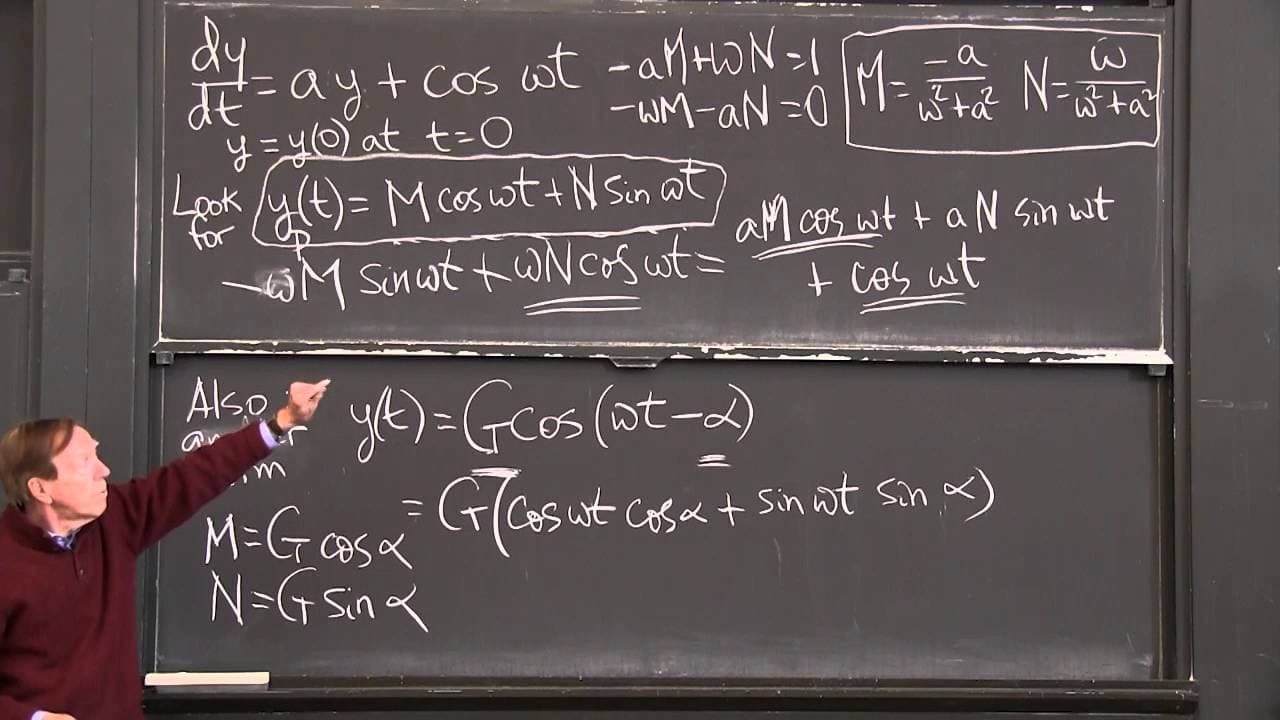
This video explains how to solve first-order differential equations with oscillating solutions and introduces three different forms of the solution: rectangular coordinates, polar form, and complex numbers.
Transcript
GILBERT STRANG: OK. So this is the next step for a first-order differential equation. We take-- instead of an exponential, now we have an oscillating. Exponentials, the previous lecture, grew or decayed, now we have an oscillate. We have AC, alternating current in this problem, instead of real exponentials, we have oscillation, vibration, all the a... Read More
Key Insights
- 👨💼 First-order differential equations with oscillating solutions require including both cosine and sine terms in the particular solution.
- 🇲🇰 The values of M and N in the particular solution are determined by solving equations derived from matching cosine and sine terms on both sides of the differential equation.
- 💁 There are three forms of the solution: rectangular coordinates (M and N), polar form (magnitude and phase), and complex numbers.
- 💁 The polar form of the solution involves determining the gain (magnitude) and phase (angle) using trigonometric identities.
Install to Summarize YouTube Videos and Get Transcripts
Explore YouTube Video Summarizer or Get YouTube Transcript Extractor
Questions & Answers
Q: What is the significance of allowing signs in the particular solution for first-order differential equations with oscillating solutions?
Allowing signs in the particular solution is necessary because the derivative of cosine is a sine function. By including both cosine and sine terms, the solution can accurately capture the oscillations present in the differential equation.
Q: How are the values of M and N determined in the particular solution for oscillating first-order differential equations?
To find the values of M and N, two equations are derived by matching the cosine and sine terms on both sides of the differential equation. These equations are then solved to obtain the values of M and N.
Q: What are the three different forms of the solution discussed in the video?
The three forms of the solution are rectangular coordinates (M and N), polar form (magnitude and phase), and complex numbers. The video focuses on the first two forms and introduces complex numbers as a topic for a future lecture.
Q: How is the gain (magnitude) and phase (angle) of the oscillating solution determined in the polar form?
The gain (G) and phase (alpha) of the oscillating solution in the polar form are determined by solving equations involving M and N. The gain is calculated as the square root of M squared plus N squared, while the tangent of the phase angle is given by N over M.
Summary & Key Takeaways
-
The video discusses the next step in solving first-order differential equations, which involve oscillating solutions.
-
The particular solution to these equations includes both cosine and sine terms, due to the presence of signs in the derivative of cosine.
-
Two equations are derived to find the values of M and N, which are needed to obtain the particular solution.
-
The video also introduces two forms of the solution: rectangular coordinates (M and N) and polar form (magnitude and phase).
Read in Other Languages (beta)
Share This Summary 📚
Summarize YouTube Videos and Get Video Transcripts with 1-Click
Try YouTube Summary with ChatGPT & Claude or YouTube Transcript Generator
Explore More Summaries from MIT OpenCourseWare 📚


Summarize YouTube Videos and Get Video Transcripts with 1-Click
Try YouTube Summary with ChatGPT & Claude or YouTube Transcript Generator