What Is Superposition in Quantum Mechanics?
TL;DR
Superposition in quantum mechanics combines states to form a new one that behaves unpredictably. When measuring the new state, results vary based on probabilities drawn from the original states, illustrating the unique nature of quantum properties.
Transcript
We spoke about superposition, and we showed how, when you have two states that are superimposed, the resulting state that is built up doesn't have properties that are intermediate between the two states that you're superimposing. But rather, when you do a measurement, you obtain the result that you would sometimes-- you sometimes obtain the result ... Read More
Key Insights
- 🥺 Superposition in quantum mechanics leads to the creation of a new state with unique properties.
- ❓ Measurements of superposed states yield results from the original states with different probabilities.
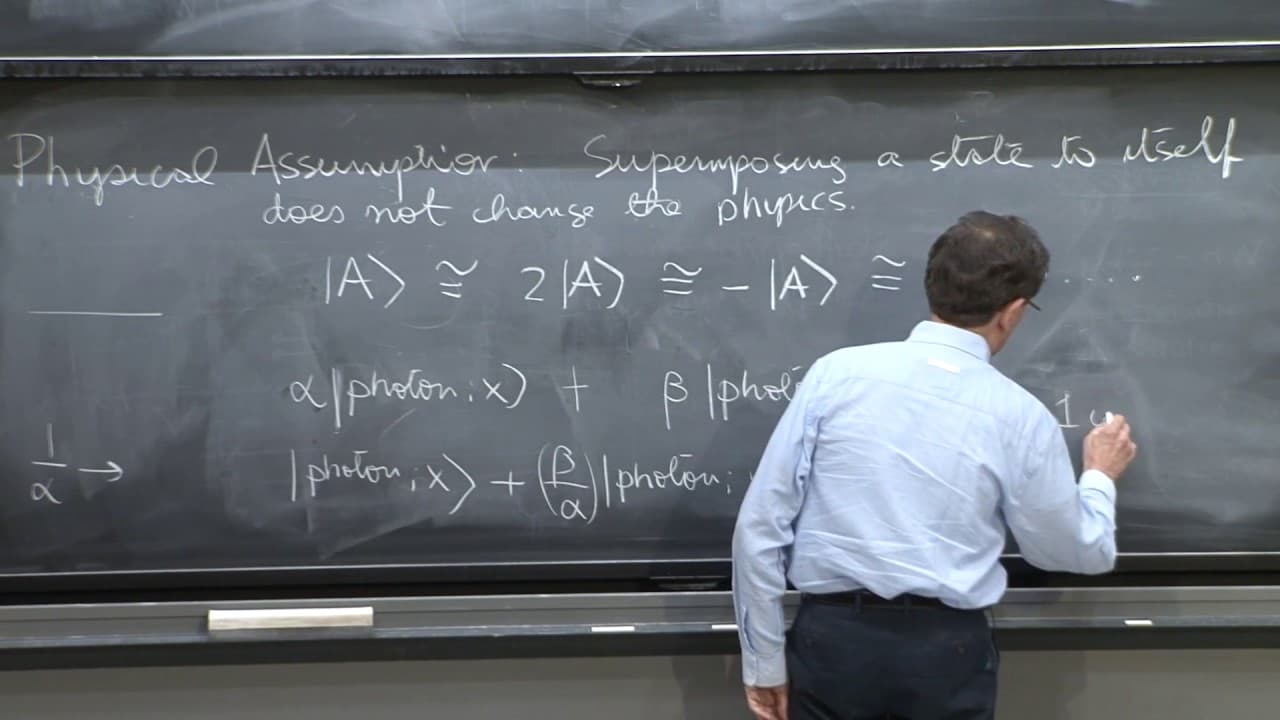
- 🪘 Superimposing a state to itself produces a physically equivalent state as long as the coefficient is non-zero.
- 👋 The overall coefficient in a wave function has no relevance to the physics of the state.
- #️⃣ Photons' polarization states can be described using just two real parameters, showcasing the impact of superposition in determining the number of parameters in a state.
- 👋 The most general polarization state of a wave is elliptical polarization, characterized by two real parameters related to the shape and angle of the electric field's ellipse.
- 🏆 Superposition can be observed and tested experimentally by measuring the spin of particles in different directions, which yield distinct outcomes depending on the nature of the ensemble of states.
Install to Summarize YouTube Videos and Get Transcripts
Explore YouTube Video Summarizer or Get YouTube Transcript Extractor
Questions & Answers
Q: What is superposition in quantum mechanics?
Superposition refers to the combining of two quantum states to create a new state that exhibits unique properties, with measurements having probabilities of yielding results from either of the original states.
Q: How does superposition affect the measurements of quantum states?
When measuring a superposed state, the outcome can be either of the original states with different probabilities, leading to a non-intuitive behavior where the resulting state does not have properties intermediate to the original states.
Q: Why is it assumed that superimposing a state to itself does not change the physics?
Superimposing a state to itself is assumed to have no physical impact because the resulting state is physically equivalent to the original state, as long as the coefficient of the state is non-zero.
Q: How does the concept of superposition apply to photons' polarization states?
Photons' polarization states, which can be expressed with just two real parameters, can be superimposed to create the most general photon state with a complex parameter. This highlights the idea that the overall coefficient in a wave function does not impact the physics underlying the state.
Summary & Key Takeaways
-
Superposition is a fundamental concept in quantum mechanics where two states are combined to create a new state with unique properties.
-
The resulting state does not have intermediate properties between the original states.
-
When measuring the resulting state, the outcome can be either of the original states with different probabilities.
Read in Other Languages (beta)
Share This Summary 📚
Summarize YouTube Videos and Get Video Transcripts with 1-Click
Try YouTube Summary with ChatGPT & Claude or YouTube Transcript Generator
Explore More Summaries from MIT OpenCourseWare 📚


Summarize YouTube Videos and Get Video Transcripts with 1-Click
Try YouTube Summary with ChatGPT & Claude or YouTube Transcript Generator