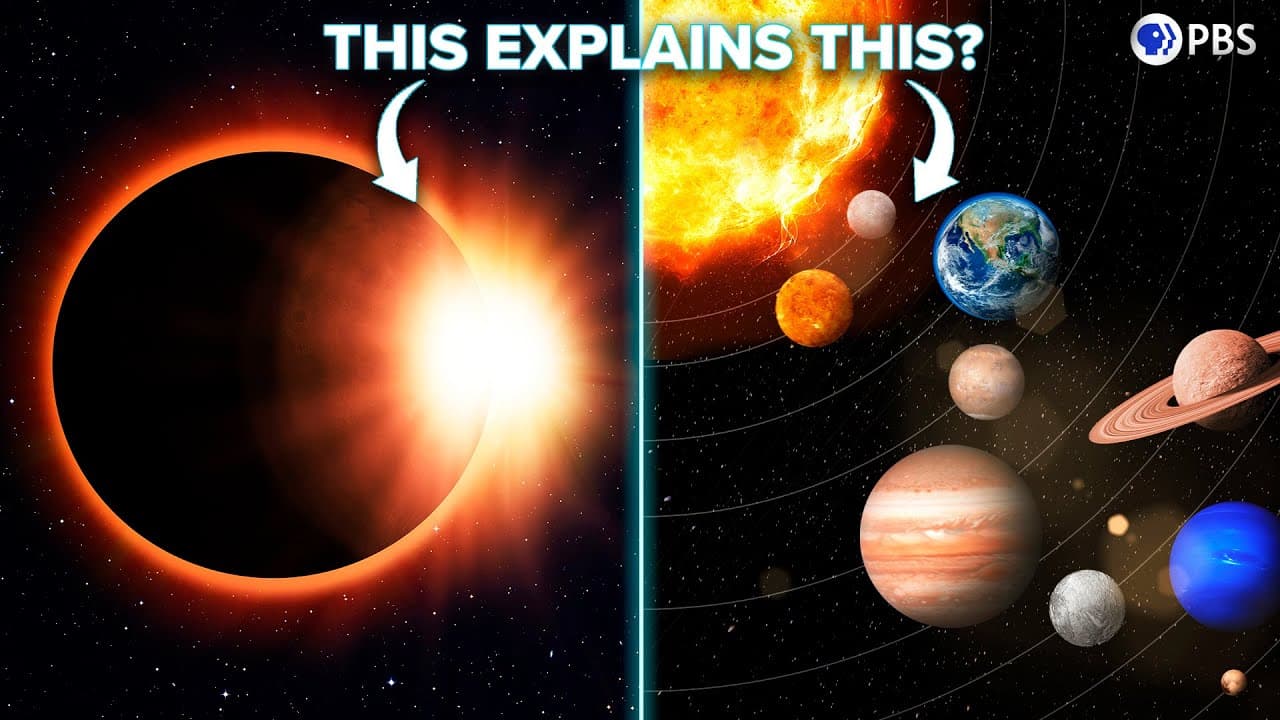
How Eclipses Revealed Our Solar System
TL;DR
Eclipses have been key to understanding our solar system.
Transcript
A little later today (April 8th) a ball of rock the size of Australia will drift directly between the Earth and theSun. That ball—our Moon—will cast a shadow that will pass across the North American continent, carving a narrow line from Mexico to Newfoundland. For anyone lucky enough to be on that line the sky will go twilight-dark for up to fo... Read More
Key Insights
- Total solar eclipses are among the most visceral astronomical phenomena, serving as a reminder of the celestial mechanics involving Earth, the Moon, and the Sun.
- Ancient Greeks, notably Anaxagoras and Aristarchus, used eclipses to deduce the spherical nature of Earth and the relative positions of celestial bodies.
- The shape of Earth's shadow during lunar eclipses was crucial in establishing the roundness of Earth, contrary to the flat Earth belief.
- Aristarchus of Samos developed methods to estimate the relative distances and sizes of the Sun, Moon, and Earth using eclipses and lunar phases.
- Eratosthenes calculated Earth's circumference with remarkable accuracy using simple geometry and observations of the Sun's position at different latitudes.
- The transit of Venus provided a breakthrough in calculating the Astronomical Unit, leading to a precise model of the solar system.
- Collaborative international efforts during the 18th century led to the first accurate measurement of the solar system's scale through Venus transits.
- Modern understanding of the solar system is built on centuries of observations and calculations, beginning with eclipses and culminating in precise astronomical measurements.
Install to Summarize YouTube Videos and Get Transcripts
Explore YouTube Video Summarizer or Get YouTube Transcript Extractor
Questions & Answers
Q: How did ancient Greeks use eclipses to understand the solar system?
Ancient Greeks, such as Anaxagoras and Aristarchus, used eclipses to deduce the spherical nature of Earth and the relative positions of celestial bodies. They observed the shape of Earth's shadow during lunar eclipses and developed methods to estimate the relative distances and sizes of the Sun, Moon, and Earth, laying the foundation for modern astronomy.
Q: What was Aristarchus's contribution to our understanding of the solar system?
Aristarchus of Samos made significant contributions by developing methods to estimate the relative sizes and distances of the Sun, Moon, and Earth using eclipses and lunar phases. He used the shadows cast during eclipses and the time the Moon spent in different phases to deduce these celestial relationships, advancing our understanding of celestial mechanics.
Q: How did Eratosthenes calculate the circumference of the Earth?
Eratosthenes calculated Earth's circumference by using simple geometry and observations of the Sun's position at different latitudes. He noted that the Sun was directly overhead in Syene at noon during the summer solstice, while in Alexandria, a shadow was cast. By measuring the shadow's angle and the distance between the two cities, he accurately estimated Earth's circumference.
Q: What role did the transit of Venus play in measuring the solar system?
The transit of Venus was pivotal in measuring the solar system's scale, specifically the Astronomical Unit. Observations of Venus transiting the Sun from different global locations allowed astronomers to calculate the distance between Earth and the Sun accurately. This international effort in the 18th century marked a significant advancement in astronomy, leading to a precise model of the solar system.
Q: Why are eclipses important in the history of astronomy?
Eclipses have been crucial in the history of astronomy as they provided the first tools for understanding the solar system's mechanics. Observations of solar and lunar eclipses helped ancient civilizations deduce the spherical nature of Earth, the relative positions of celestial bodies, and laid the groundwork for more complex astronomical calculations and models.
Q: How did Aristarchus estimate the distance to the Sun?
Aristarchus estimated the distance to the Sun by observing the time the Moon spent in its different phases and using the shadows during eclipses. He noted that the Moon appeared gibbous longer than crescent, indicating the Sun's distance affected these phases. Though his measurements were imprecise, they provided a framework for understanding celestial distances.
Q: What was the significance of the 18th-century Venus transit observations?
The 18th-century Venus transit observations were significant as they represented one of the first large-scale international scientific collaborations. By observing the transit from various global locations, astronomers could calculate the Astronomical Unit accurately, which was crucial for determining the solar system's scale and enhancing our understanding of planetary motion.
Q: How did the understanding of eclipses evolve from ancient to modern times?
The understanding of eclipses evolved from ancient times, where they were used to deduce Earth's roundness and celestial mechanics, to modern times, where they are integral in precise astronomical measurements. This evolution involved contributions from Greek philosophers, advances in geometry and mathematics, and international collaboration, culminating in a detailed and accurate model of the solar system.
Summary & Key Takeaways
-
Eclipses have played a crucial role in our understanding of the solar system. Ancient Greeks like Anaxagoras and Aristarchus used them to deduce the roundness of Earth and the relative positions of celestial bodies, laying the groundwork for modern astronomy.
-
Aristarchus developed methods to estimate the relative sizes and distances of the Sun, Moon, and Earth using lunar phases and eclipses. His work, along with Eratosthenes' accurate calculation of Earth's circumference, advanced our understanding of celestial mechanics.
-
The transit of Venus in the 18th century allowed astronomers to measure the Astronomical Unit accurately, leading to a precise model of the solar system. This international effort marked a pivotal moment in astronomy, showcasing the power of collaborative scientific inquiry.
Read in Other Languages (beta)
Share This Summary 📚
Summarize YouTube Videos and Get Video Transcripts with 1-Click
Try YouTube Summary with ChatGPT & Claude or YouTube Transcript Generator
Explore More Summaries from PBS Space Time 📚



Summarize YouTube Videos and Get Video Transcripts with 1-Click
Try YouTube Summary with ChatGPT & Claude or YouTube Transcript Generator