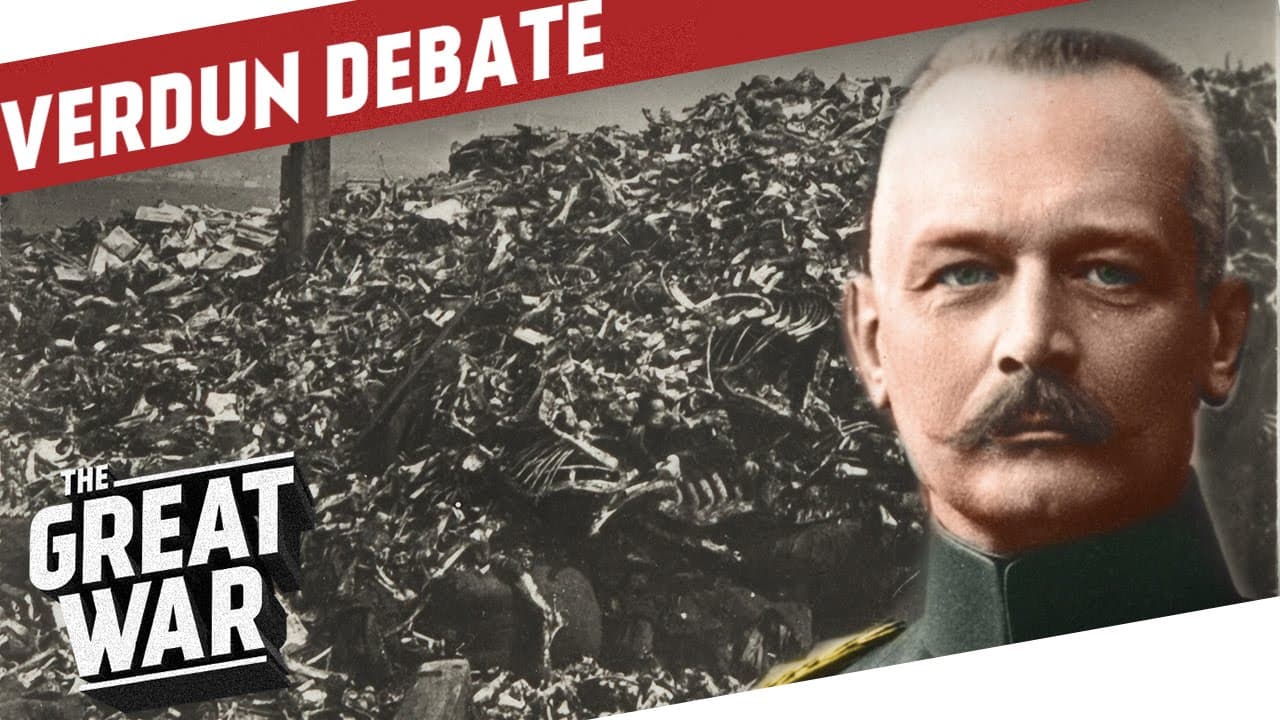
Justifying The Failure At Verdun? - The Falkenhayn Controversy I THE GREAT WAR Special
TL;DR
Debate over Falkenhayn's true intentions at Verdun persists.
Transcript
The Battle of Verdun is now a month old and with absolutely no end in sight. German Army Chief of Staff Erich von Falkenhayn had launched the assault as a plan to bleed France to death in a war of attrition... or had he? Was that really his plan, or a justification made after the fact? Well, in the comments to our regular Thursday episodes about Ve... Read More
Key Insights
- The Battle of Verdun was launched by German Chief of Staff Erich von Falkenhayn with the supposed plan to bleed France to death in a war of attrition.
- Falkenhayn's claim of a memorandum detailing his plan has never been found, leading historians to question its existence.
- Falkenhayn was a secretive individual, which has fueled speculation about his true intentions during the Battle of Verdun.
- Several of Falkenhayn's contemporaries believed Verdun was only a part of a larger strategy aimed at triggering a British attack.
- The Christmas Memorandum, which allegedly outlined Falkenhayn's plan, is considered by some historians to be a post-war fabrication.
- The lack of evidence for the memorandum supports the theory that it was created to justify the failure at Verdun.
- Historians like Paul Jankowski and Alistair Horne have contributed to the debate, examining the historiography of Falkenhayn's intentions.
- The controversy highlights the challenges of interpreting historical events when key documents and firsthand accounts are absent or contradictory.
Install to Summarize YouTube Videos and Get Transcripts
Explore YouTube Video Summarizer or Get YouTube Transcript Extractor
Questions & Answers
Q: What was Falkenhayn's supposed plan for the Battle of Verdun?
Falkenhayn's supposed plan for the Battle of Verdun was to bleed France to death in a war of attrition. He believed that by attacking Verdun, he could force the French to commit massive resources to its defense, resulting in significant French casualties and weakening their overall war effort.
Q: Why is there skepticism about Falkenhayn's claim of a memorandum?
Skepticism about Falkenhayn's claim of a memorandum arises because no one has ever found any trace of it. Despite being cited in historical accounts, the memorandum's absence from archives, many of which were destroyed in 1945, has led historians to question its existence and consider it a possible post-war fabrication.
Q: How did Falkenhayn's contemporaries view his plan for Verdun?
Falkenhayn's contemporaries had mixed views on his plan for Verdun. Some believed Verdun was part of a larger strategy to provoke a British attack, while others were unaware of any detailed plans due to Falkenhayn's secretive nature. The lack of communication and documentation led to varying interpretations of his intentions.
Q: What role did the destruction of German army archives play in the controversy?
The destruction of German army archives in 1945 played a significant role in the controversy by eliminating potential evidence of Falkenhayn's memorandum. Without these archives, historians lack primary sources to verify the existence of the memorandum, fueling debate about whether it was real or a fabrication.
Q: What are the arguments of historians like Paul Jankowski and Alistair Horne?
Paul Jankowski and Alistair Horne have contributed to the debate by examining the historiography of Falkenhayn's intentions. Jankowski argues that the memorandum bears signs of contrivance, while Horne initially gave credence to Falkenhayn's claims. Their works highlight the evolving interpretation of Falkenhayn's plan over time.
Q: What impact does Falkenhayn's secretive nature have on understanding his plans?
Falkenhayn's secretive nature complicates understanding his plans, as he kept his intentions hidden from even his closest advisors. This secrecy has led to speculation and conflicting accounts about his true goals at Verdun, making it difficult for historians to definitively determine his strategy.
Q: How has the historiography of Falkenhayn's plan changed over time?
The historiography of Falkenhayn's plan has shifted from early acceptance of his claims to increased skepticism. Initially, historians took his statements at face value, but as more historians like Jankowski examined the evidence, doubts emerged about the memorandum's authenticity and the true nature of his intentions.
Q: What does the controversy reveal about historical interpretation?
The controversy reveals the challenges of historical interpretation, particularly when key documents are missing or potentially fabricated. It underscores the difficulty of reconstructing past events with incomplete evidence and highlights the role of historiography in shaping our understanding of history.
Summary & Key Takeaways
-
The video explores the controversy surrounding Erich von Falkenhayn's intentions at the Battle of Verdun, questioning whether his plan to bleed France dry was genuine or a post-failure justification. Historians are divided, with some suggesting that the supposed memorandum outlining the plan never existed.
-
Falkenhayn was known for his secretive nature, which complicates understanding his true goals. While some contemporaries believed Verdun was part of a larger strategy, the absence of the memorandum has led to skepticism about his stated intentions.
-
The historiography of Falkenhayn's plan has evolved, with early historians accepting his claims and later scholars challenging them. The debate illustrates the difficulties in historical interpretation and the impact of missing documentation on understanding past events.
Read in Other Languages (beta)
Share This Summary 📚
Summarize YouTube Videos and Get Video Transcripts with 1-Click
Try YouTube Summary with ChatGPT & Claude or YouTube Transcript Generator
Explore More Summaries from The Great War 📚
Summarize YouTube Videos and Get Video Transcripts with 1-Click
Try YouTube Summary with ChatGPT & Claude or YouTube Transcript Generator