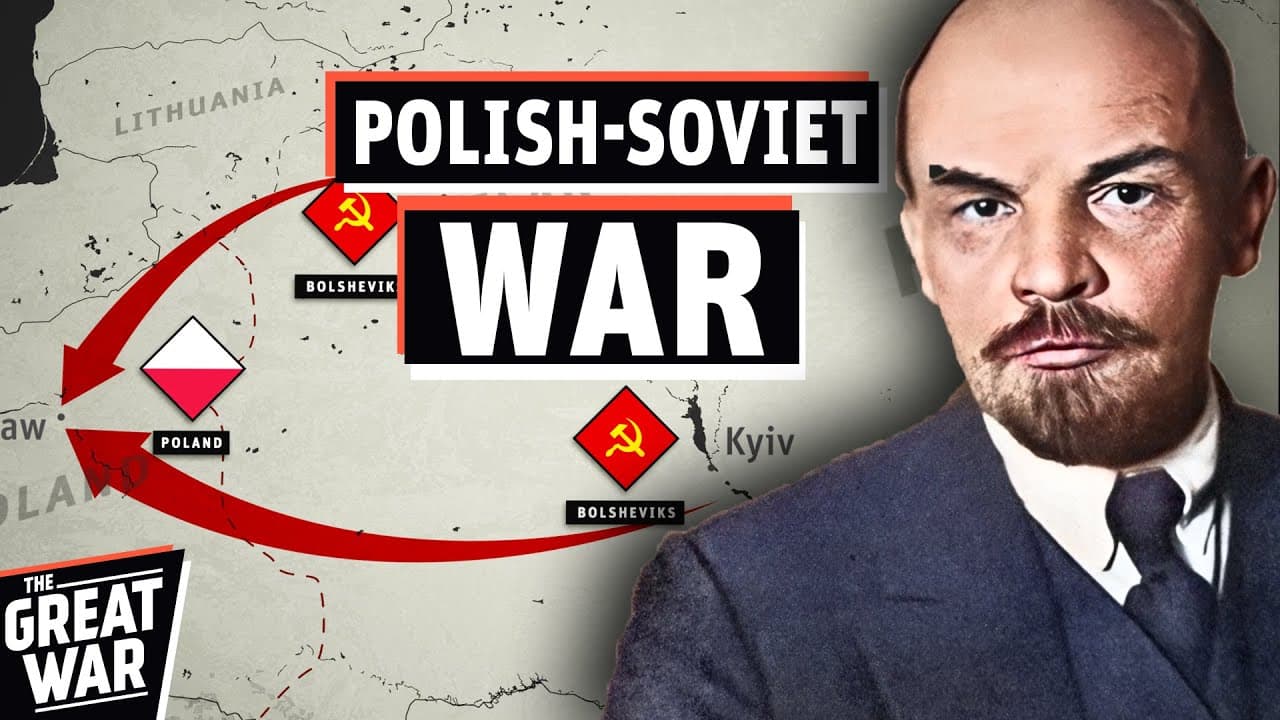
What Was the Polish-Soviet War 1919-1921?
TL;DR
The Polish-Soviet War of 1919-1921 was a conflict between the newly established Polish Republic and Bolshevik Russia, each aiming to expand their territories and influence in Eastern Europe. The war culminated in the Battle of Warsaw, a decisive Polish victory that halted the spread of Bolshevism into Europe, leading to the Peace of Riga in 1921, which defined the borders in Eastern Europe for the next two decades.
Transcript
By 1919, the First World War had left the old European order in ruins and radically redrawn the map. A new Polish republic struggled to establish itself, while the Bolsheviks struggled to secure their revolution in Russia. In the midst of the chaos, the two new states launched into a full-scale war that will ravage Eastern Europe again: it’s th... Read More
Key Insights
- The Polish-Soviet War was fought between 1919 and 1921, involving newly formed Poland and Bolshevik Russia.
- Both Poland and the Bolsheviks aimed to expand their territories, with Poland seeking a federation and Bolsheviks wanting to spread revolution westward.
- The war was characterized by skirmishes, guerilla tactics, and significant cavalry engagements.
- The Battle of Warsaw in 1920 was a turning point, with Poland achieving a surprising victory known as the Miracle on the Vistula.
- The Peace of Riga in 1921 ended the conflict, establishing borders that included parts of Ukraine and Belarus within Poland.
- Poland's victory prevented the spread of Bolshevism into Western Europe and stabilized the region temporarily.
- The war highlighted ethnic and political tensions, with various factions and nationalities involved in the conflict.
- The aftermath of the war left unresolved issues and set the stage for future conflicts in Eastern Europe.
Install to Summarize YouTube Videos and Get Transcripts
Explore YouTube Video Summarizer or Get YouTube Transcript Extractor
Questions & Answers
Q: What was the main cause of the Polish-Soviet War?
The Polish-Soviet War was primarily caused by the territorial ambitions of both Poland and Bolshevik Russia following World War I. Poland sought to establish a federation stretching from the Baltic to the Black Sea, while the Bolsheviks aimed to spread their revolution westward into Europe. The power vacuum and shifting borders in Eastern Europe after the war further fueled the conflict.
Q: How did the Battle of Warsaw impact the Polish-Soviet War?
The Battle of Warsaw, fought in August 1920, was a decisive moment in the Polish-Soviet War. Often referred to as the Miracle on the Vistula, the battle saw the Polish forces achieve a surprising victory against the advancing Bolshevik army. This victory halted the Bolshevik advance into Europe, shifted the momentum in Poland's favor, and eventually led to the signing of the Peace of Riga, ending the war.
Q: What were the outcomes of the Peace of Riga?
The Peace of Riga, signed in March 1921, ended the Polish-Soviet War and established new borders in Eastern Europe. The treaty granted Poland territories east of the Curzon Line, including parts of Ukraine and Belarus. It also ended Ukrainian and Belarusian hopes for independence, as these regions were divided between Poland and Soviet Russia. The treaty temporarily stabilized the region but left unresolved ethnic and political tensions.
Q: Why is the Polish victory at Warsaw called the Miracle on the Vistula?
The Polish victory at Warsaw is called the Miracle on the Vistula due to the unexpected nature of the outcome. Facing a larger and seemingly unstoppable Bolshevik force, the Polish army managed to achieve a decisive victory, turning the tide of the war. Many in Catholic Poland attributed the victory to divine intervention, as it saved the country from Bolshevik conquest and preserved its independence.
Q: What role did ethnic tensions play in the Polish-Soviet War?
Ethnic tensions played a significant role in the Polish-Soviet War, as the conflict involved various nationalities and factions with competing interests. Poland's attempts to integrate diverse populations in newly acquired territories led to resistance from non-Polish groups. The Bolsheviks also faced hostility from local populations in occupied areas, complicating their efforts to spread revolution and maintain control.
Q: How did the Polish-Soviet War affect Eastern Europe post-World War I?
The Polish-Soviet War significantly impacted Eastern Europe by reshaping borders and influencing political dynamics in the region. The war's outcome, particularly the Peace of Riga, established new territorial boundaries and temporarily stabilized the area. However, unresolved ethnic and political tensions persisted, setting the stage for future conflicts and influencing interwar relations between Poland, Soviet Russia, and other neighboring states.
Q: What were the strategic goals of Poland and the Bolsheviks in the war?
Poland's strategic goal in the war was to establish a federation under its leadership, stretching from the Baltic to the Black Sea, while securing its eastern borders. The Bolsheviks aimed to spread their revolution westward into Europe, using military force to expand Soviet influence and potentially ignite further revolutionary movements. Both sides sought to consolidate power and control in the region during a period of geopolitical upheaval.
Q: What challenges did Poland face after the Polish-Soviet War?
After the Polish-Soviet War, Poland faced several challenges, including integrating newly acquired territories with diverse populations and resolving ongoing border disputes. Internally, political divisions persisted between different factions, complicating governance. Externally, Poland had to navigate complex relations with neighboring countries and major powers like Britain and France, which were wary of further conflicts in the region. These challenges foreshadowed future tensions and conflicts in Eastern Europe.
Summary & Key Takeaways
-
The Polish-Soviet War of 1919-1921 was a pivotal conflict in Eastern Europe as Poland and Bolshevik Russia vied for control in the power vacuum left by World War I. The war saw intense battles, including the decisive Battle of Warsaw, which resulted in a Polish victory and halted the westward spread of Bolshevism.
-
Poland's victory in the Battle of Warsaw, often called the Miracle on the Vistula, was a strategic turning point that led to the signing of the Peace of Riga in 1921. This treaty established new borders in Eastern Europe, incorporating parts of Ukraine and Belarus into Poland, and temporarily stabilized the region.
-
The war underscored ethnic tensions and political ambitions in the region, with various factions and nationalities involved. Despite the victory, Poland faced ongoing challenges, including unresolved border disputes and the integration of diverse populations, setting the stage for future conflicts.
Read in Other Languages (beta)
Share This Summary 📚
Summarize YouTube Videos and Get Video Transcripts with 1-Click
Try YouTube Summary with ChatGPT & Claude or YouTube Transcript Generator
Explore More Summaries from The Great War 📚
Summarize YouTube Videos and Get Video Transcripts with 1-Click
Try YouTube Summary with ChatGPT & Claude or YouTube Transcript Generator