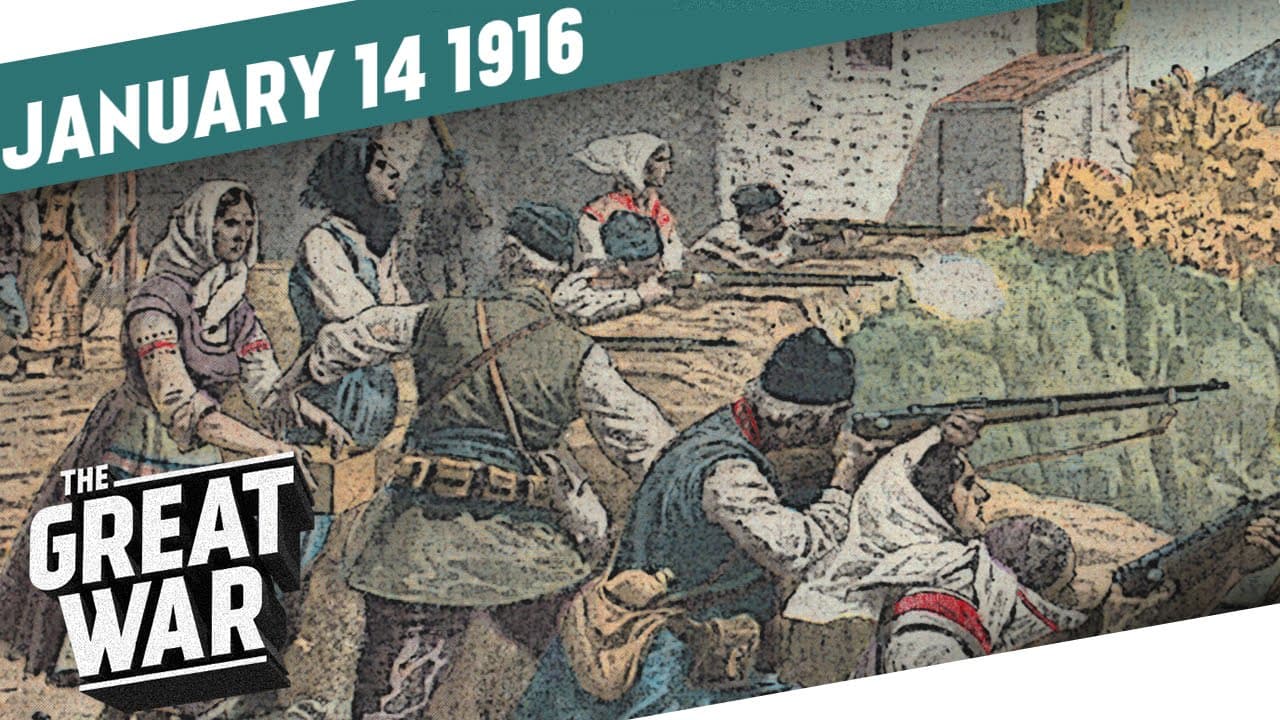
The Invasion Of Montenegro - The End of Gallipoli I THE GREAT WAR - Week 77
TL;DR
Austro-Hungarians invade Montenegro; Gallipoli evacuation concludes.
Transcript
Last fall the Austrians, Germans, and Bulgarians overran and conquered Serbia, and now that the dust had settled from that campaign, the Balkans were kicking into high gear again, as this week, Austria-Hungary invades Montenegro. I’m Indy Neidell; welcome to the Great War. Last week the Russians attacked up and down the eastern front, but didn’t do... Read More
Key Insights
- The Austro-Hungarian forces launched an invasion of Montenegro, capitalizing on their recent success in Serbia, and quickly advanced into the country.
- The complete evacuation of Gallipoli marked a significant retreat for the British, despite the operation being executed with minimal casualties.
- The Gallipoli campaign was a major drain on Allied resources, with significant losses in manpower and equipment that could have been used more effectively elsewhere.
- The evacuation at Gallipoli allowed Ottoman forces to redirect troops to other fronts, notably to reinforce their siege of British forces at Kut Al-Amara in Mesopotamia.
- German forces attempted new offensives on the Western Front but were largely unsuccessful, with significant casualties and little territorial gain.
- Strikes in Russia highlighted internal unrest, with significant labor actions occurring at naval bases and spreading to major cities like Petrograd.
- The Allied forces faced logistical challenges in supporting Montenegro due to its mountainous terrain and lack of seaports, limiting their ability to offer effective aid.
- The Gallipoli campaign, despite its failure, played a crucial role in shaping national identities for Australia and New Zealand, known as the ANZAC legacy.
Install to Summarize YouTube Videos and Get Transcripts
Explore YouTube Video Summarizer or Get YouTube Transcript Extractor
Questions & Answers
Q: What was the significance of the Austro-Hungarian invasion of Montenegro?
The Austro-Hungarian invasion of Montenegro was significant as it demonstrated the Central Powers' continued momentum in the Balkans following their conquest of Serbia. Montenegro's resistance was weakened by limited resources and challenging terrain, allowing the Austrians to advance quickly, capturing strategic positions and threatening the capital, Cetinje.
Q: How was the Gallipoli evacuation carried out successfully?
The Gallipoli evacuation was executed with meticulous planning and precision, involving the gradual withdrawal of troops by night to avoid detection. Deceptive tactics, such as booby traps and automated rifles, were employed to mask the retreat. The operation's success lay in its ability to minimize casualties and prevent Turkish forces from launching a successful counterattack during the withdrawal.
Q: What were the consequences of the Gallipoli campaign for the Allies?
The Gallipoli campaign was a costly endeavor for the Allies, resulting in significant loss of life, with over 200,000 British Imperial and 47,000 French casualties. The campaign diverted valuable resources and manpower that could have been utilized on other fronts. Its failure also allowed Ottoman forces to redirect troops to reinforce their positions in Mesopotamia, complicating Allied efforts in the region.
Q: How did the Gallipoli campaign impact Australian and New Zealand national identity?
The Gallipoli campaign is considered a defining moment in Australian and New Zealand national identity, marking the emergence of the ANZAC legend. Despite the campaign's failure, the bravery and sacrifice of the ANZAC troops became a source of national pride and a symbol of the two nations' contributions to the war effort, fostering a sense of unity and identity distinct from their colonial ties to Britain.
Q: What challenges did the Allies face in supporting Montenegro?
Supporting Montenegro posed significant challenges for the Allies due to its mountainous terrain and lack of accessible seaports. These geographical constraints made it difficult to deliver supplies and reinforcements. Additionally, the limited size and resources of the Montenegrin army, coupled with the overwhelming Austro-Hungarian forces, further complicated Allied efforts to provide effective assistance.
Q: What internal issues did Russia face during this period?
During this period, Russia faced significant internal issues, including widespread labor strikes that began at the naval base in Nikolaev and spread to Petrograd. These strikes involved thousands of workers and highlighted the growing unrest and dissatisfaction within the country. The internal turmoil was compounded by ongoing military engagements on multiple fronts, stretching Russia's resources and complicating its war efforts.
Q: How did the situation on the Western Front evolve during this week?
On the Western Front, German forces attempted new offensives, including a three-day battle near Tahure and a large-scale attack at Massiges. Despite initial gains, the Germans were ultimately repelled by French defenses, resulting in significant casualties. These actions reflected the ongoing stalemate and the high human cost of trench warfare, with little strategic advantage gained by either side.
Q: What strategic shifts occurred following the evacuation of Gallipoli?
Following the evacuation of Gallipoli, strategic shifts included the redeployment of Ottoman troops to Mesopotamia, strengthening their siege at Kut Al-Amara. This redeployment posed a new challenge for British forces in the region. Additionally, the Allies had to reassess their strategies, as the Gallipoli campaign's failure underscored the need to focus resources on more promising fronts, such as the Western Front and the Middle East.
Summary & Key Takeaways
-
The Austro-Hungarian invasion of Montenegro was a swift operation, facilitated by their recent victory in Serbia. Despite Montenegro's mountainous terrain, the Austrians advanced rapidly, capturing key positions and threatening the capital.
-
Gallipoli's evacuation was a logistical success but underscored a strategic defeat for the British. The campaign had drained Allied resources significantly, with substantial human and material losses that impacted other fronts.
-
The conclusion of Gallipoli allowed the Ottomans to reinforce their siege at Kut Al-Amara. Meanwhile, unrest in Russia and limited success for Germany on the Western Front highlighted the war's ongoing complexity and shifting dynamics.
Read in Other Languages (beta)
Share This Summary 📚
Summarize YouTube Videos and Get Video Transcripts with 1-Click
Try YouTube Summary with ChatGPT & Claude or YouTube Transcript Generator
Explore More Summaries from The Great War 📚

Summarize YouTube Videos and Get Video Transcripts with 1-Click
Try YouTube Summary with ChatGPT & Claude or YouTube Transcript Generator