What Is Vapor Pressure and Its Role in Boiling Points?
TL;DR
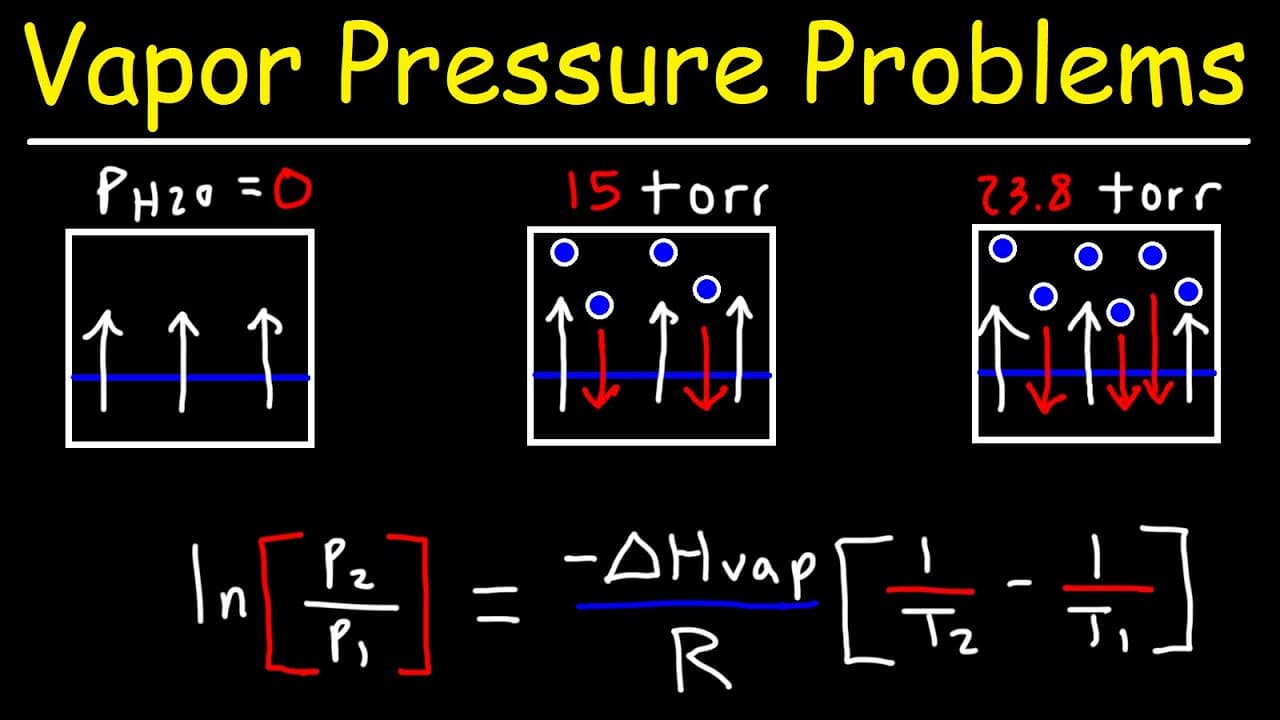
Vapor pressure is the partial pressure at which the rate of evaporation equals the rate of condensation, increasing with temperature. The normal boiling point of a liquid occurs when its vapor pressure equals atmospheric pressure, which is 100 degrees Celsius for water at sea level. Higher elevations result in lower boiling points because of reduced atmospheric pressure.
Transcript
in this video we're going to talk about vape pressure so what is vapor pressure well let's use an example to illustrate it let's say if we have a beaker that contains some water and it's closed up and initially there's no water vapor inside this area so there's no water molecules in here so therefore the partial pressure of water is currently zero ... Read More
Key Insights
- ☠️ Vape pressure is the equilibrium partial pressure at which evaporation and condensation rates balance.
- 🥺 Temperature affects the rate of evaporation, with higher temperatures leading to increased evaporation.
- 🚱 Vapor pressure of water increases with temperature, following a non-linear relationship.
- 🌊 The normal boiling point of water is 100 degrees Celsius at sea level, where vapor pressure equals atmospheric pressure.
- 😥 Boiling points decrease with increasing elevation due to decreased atmospheric pressure.
- ❓ The Clausius-Gloperon equation can be used to calculate vapor pressure at different temperatures and pressures.
- 😘 Higher elevations have lower atmospheric pressure, resulting in lower boiling points for substances.
Install to Summarize YouTube Videos and Get Transcripts
Explore YouTube Video Summarizer or Get YouTube Transcript Extractor
Questions & Answers
Q: What is vape pressure?
Vape pressure refers to the partial pressure at which evaporation equals condensation. It is the equilibrium pressure at which these rates balance out.
Q: How does temperature affect vapor pressure?
Temperature affects the rate of evaporation, and as temperature increases, the rate of evaporation also increases. This leads to an increase in vapor pressure.
Q: What is the normal boiling point of water?
The normal boiling point of water is 100 degrees Celsius at sea level. It is the temperature at which the vapor pressure of water equals atmospheric pressure.
Q: How does elevation affect boiling point?
As elevation increases, atmospheric pressure decreases. Therefore, the boiling point of a substance decreases, as it takes less energy to reach the vapor pressure at a lower pressure.
Summary & Key Takeaways
-
Vape pressure is the partial pressure at which the rate of evaporation equals the rate of condensation.
-
Temperature affects the rate of evaporation, with higher temperatures leading to increased evaporation.
-
Vapor pressure of water increases with temperature, and the normal boiling point is the temperature at which vapor pressure equals atmospheric pressure.
-
Boiling points decrease with increasing elevation due to decreased atmospheric pressure.
Read in Other Languages (beta)
Share This Summary 📚
Summarize YouTube Videos and Get Video Transcripts with 1-Click
Try YouTube Summary with ChatGPT & Claude or YouTube Transcript Generator
Explore More Summaries from The Organic Chemistry Tutor 📚



Summarize YouTube Videos and Get Video Transcripts with 1-Click
Try YouTube Summary with ChatGPT & Claude or YouTube Transcript Generator