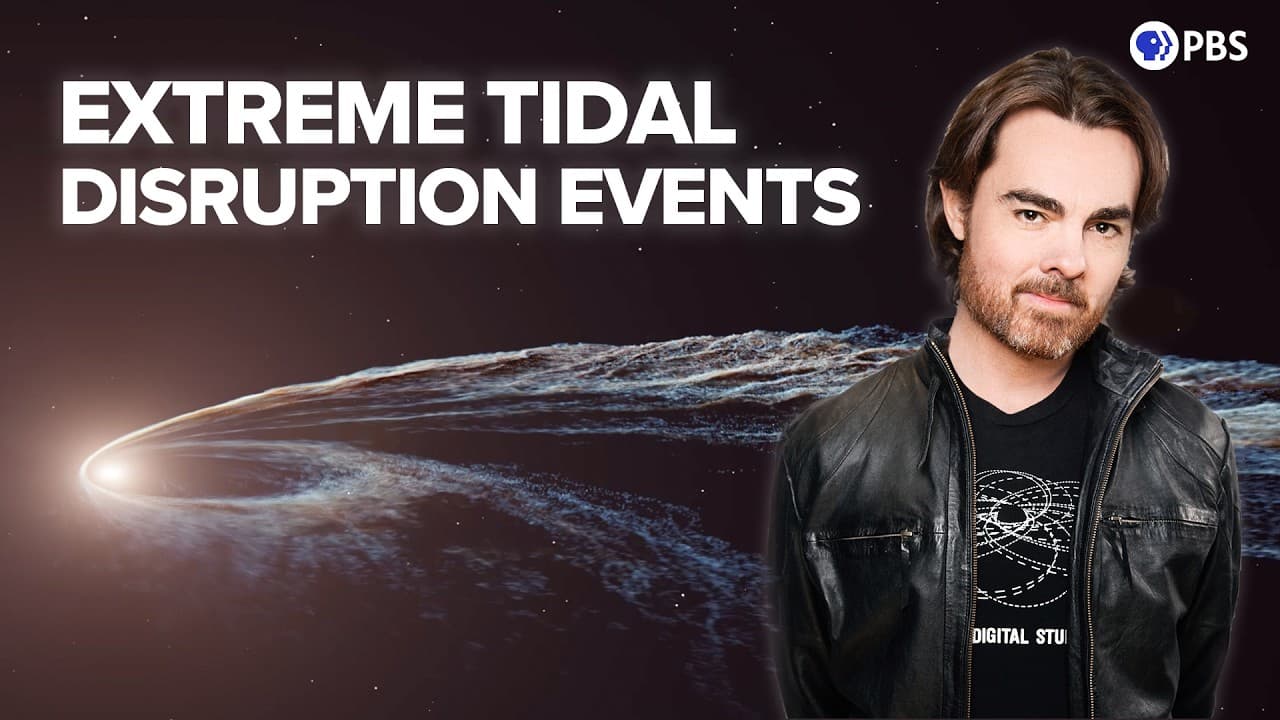
The NEW PHYSICS of Black Hole Star Capture | Extreme Tidal Disruption Events
TL;DR
Stars near black holes face tidal disruption, revealing black hole properties.
Transcript
If you track the motion of individual stars in the ultra-dense star cluster at the very center of the Milky Way you’ll see that they swing in sharp orbits around some vast but invisible mass—that’s the Sagittarius A* supermassive black hole. These are perilous orbits, and sometimes a star wanders just a little too close to that lurking monster,... Read More
Key Insights
- Tidal disruption events (TDEs) occur when stars get too close to supermassive black holes, leading to their destruction and revealing black hole characteristics.
- Simulations of TDEs help us understand the extreme gravitational forces and spaghettification process that stars undergo near black holes.
- General relativity, rather than Newtonian physics, is required to accurately simulate the complex gravitational interactions during a TDE.
- Extreme tidal disruption events (eTDEs) are more energetic and rare, occurring when stars pass very close to a black hole's event horizon.
- Simulations predict that eTDEs produce intense X-ray emissions and can be significantly brighter than common TDEs.
- The detection of TDEs and eTDEs relies on monitoring distant galaxies for bright flashes of light, often using X-ray surveys.
- Modern supercomputer simulations allow us to model the full lifecycle of a TDE, from star disruption to the formation of an accretion disk.
- The study of TDEs provides insights into the behavior of matter under extreme conditions and tests our understanding of general relativity.
Install to Summarize YouTube Videos and Get Transcripts
Explore YouTube Video Summarizer or Get YouTube Transcript Extractor
Questions & Answers
Q: What causes a tidal disruption event?
A tidal disruption event (TDE) occurs when a star gets too close to a supermassive black hole. The gravitational force on the side of the star closer to the black hole becomes stronger than on the far side, creating a differential force that stretches and compresses the star. This leads to the star being torn apart and its material being either ejected or accreted by the black hole.
Q: How do simulations help in understanding TDEs?
Simulations allow scientists to recreate the complex gravitational interactions and processes involved in tidal disruption events. By using supercomputer models based on general relativity, researchers can study how stars are disrupted and how matter behaves in the warped spacetime around black holes. These simulations help predict observable phenomena, such as light emissions, that can be used to identify TDEs in distant galaxies.
Q: What is the difference between a common TDE and an extreme TDE?
A common TDE occurs when a star crosses the tidal radius of a black hole without directly entering the event horizon, resulting in the star being stretched and forming an accretion disk. An extreme TDE, on the other hand, happens when a star's orbit takes it very close to the event horizon, leading to a more energetic and rare event. Extreme TDEs produce intense X-ray emissions and are significantly brighter than common TDEs.
Q: Why is general relativity important in simulating TDEs?
General relativity is essential for simulating TDEs because it accurately describes the warping of space and time by massive objects like black holes. Newtonian gravity is only an approximation and fails to capture the complex gravitational interactions near black holes. General relativity allows for precise modeling of the paths of stellar material and light in the warped spacetime, providing a better understanding of the dynamics during a TDE.
Q: What role does gravitational lensing play in TDEs?
Gravitational lensing occurs when the warped spacetime around a black hole bends the paths of light rays. During a tidal disruption event, this effect can twist and magnify the light emitted by the disrupted star, making it observable from Earth. Gravitational lensing helps scientists identify TDEs by enhancing the brightness of the light from the galactic center where the supermassive black hole resides.
Q: How can we detect TDEs from Earth?
TDEs can be detected from Earth by observing bright flashes of light from the centers of distant galaxies, where supermassive black holes are located. These flashes occur as the star's material is disrupted and accreted by the black hole. Visible light surveys and X-ray detectors, like eROSITA, are used to monitor the sky for these events, allowing scientists to identify and study TDEs.
Q: What are the challenges in simulating TDEs?
Simulating TDEs is challenging due to the need for accurate modeling of the complex gravitational interactions and fluid dynamics involved. Researchers must use general relativity to account for the warping of spacetime and employ relativistic hydrodynamics to simulate the motion of stellar material at high speeds. Additionally, the simulations must consider the effects of radiation and friction, making them computationally intensive and complex.
Q: What is the significance of studying TDEs?
Studying TDEs provides valuable insights into the behavior of matter under extreme gravitational forces and tests our understanding of general relativity. These events reveal properties of supermassive black holes and the dynamics of accretion processes. By observing TDEs, scientists can improve their models of black hole interactions and gain a deeper understanding of the fundamental physics governing the universe.
Summary & Key Takeaways
-
Tidal disruption events occur when stars approach supermassive black holes, leading to their destruction and revealing the properties of the black holes through the emitted light. These events are rare, with around 100 observed in distant galaxies, but have not been seen in the Milky Way.
-
Simulations using general relativity are necessary to understand the complex gravitational interactions during TDEs. These models help predict the behavior of stars as they are stretched and compressed by tidal forces, leading to phenomena like spaghettification and the formation of accretion disks.
-
Extreme tidal disruption events are more energetic and occur when stars pass very close to a black hole's event horizon. These events produce intense X-ray emissions and are predicted to be much brighter than common TDEs, providing a unique opportunity to study the physics of black holes.
Read in Other Languages (beta)
Share This Summary 📚
Summarize YouTube Videos and Get Video Transcripts with 1-Click
Try YouTube Summary with ChatGPT & Claude or YouTube Transcript Generator
Explore More Summaries from PBS Space Time 📚
Summarize YouTube Videos and Get Video Transcripts with 1-Click
Try YouTube Summary with ChatGPT & Claude or YouTube Transcript Generator