How Many Black Holes Are In The Solar System?
TL;DR
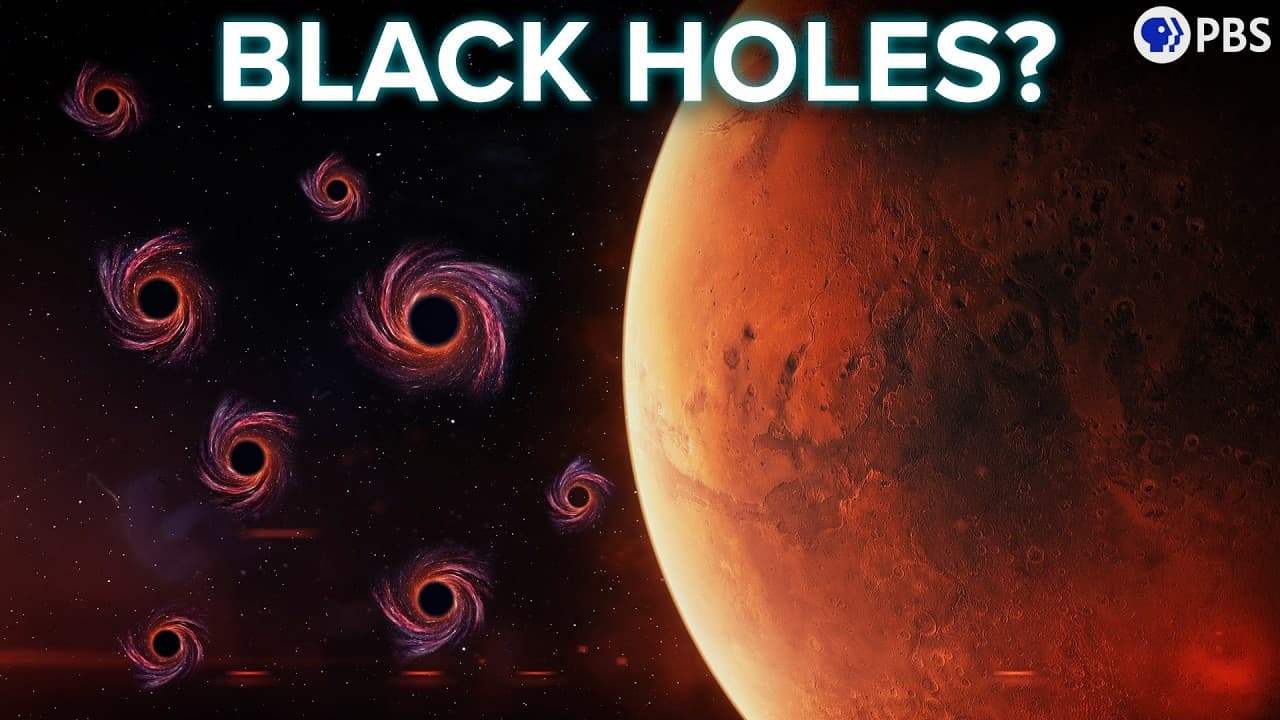
Dark matter could be detected using solar system as a black hole detector.
Transcript
Thank you to Anydesk for supporting PBS Hey Everyone. Before we get started, we wanted to let you know we have special, limited edition new merch in honor of the 50th anniversary of Space Shuttle patent. More info at the end of the episode. Dark matter has eluded us for many decades. Even our most advanced particle colliders and sophisticated un... Read More
Key Insights
- Dark matter remains elusive despite advanced detection efforts, but a simpler experiment using the solar system might provide answers.
- Primordial black holes (PBHs) are a potential candidate for dark matter, possibly formed right after the Big Bang.
- The solar system could act as a gigantic detector for PBHs by observing their gravitational effects on planetary orbits.
- The mass range for PBHs that could account for dark matter is between 10^17 to 10^23 grams, similar to asteroid masses.
- PBHs in the solar system would be difficult to detect visually, but their gravitational influence could be measured over time.
- Mars, with its predictable orbit and existing satellite data, is a prime candidate for detecting PBH-induced changes.
- Current data on Mars' position could reveal past PBH flybys, while future data might allow real-time tracking of PBHs.
- Differentiating between PBHs and interstellar asteroids relies on the frequency of detected gravitational anomalies.
Install to Summarize YouTube Videos and Get Transcripts
Explore YouTube Video Summarizer or Get YouTube Transcript Extractor
Questions & Answers
Q: What role does the solar system play in detecting dark matter?
The solar system can act as a large-scale detector for dark matter by observing the gravitational effects of primordial black holes (PBHs) on planetary orbits. By measuring tiny changes in the positions of planets like Mars, scientists hope to identify the presence of these elusive PBHs, which could account for dark matter.
Q: Why are primordial black holes considered candidates for dark matter?
Primordial black holes (PBHs) are considered candidates for dark matter because they could have formed right after the Big Bang, existing since the universe's early moments. Their mass range, similar to asteroids, makes them potential carriers of the mysterious dark matter, accounting for its gravitational effects without being directly observable.
Q: How can Mars help in detecting primordial black holes?
Mars is a key target for detecting primordial black holes due to its predictable orbit and the availability of precise satellite data. By monitoring Mars' position over time, scientists can detect tiny deviations caused by PBHs' gravitational influence, potentially revealing these elusive objects and their role in dark matter.
Q: What challenges exist in differentiating PBHs from interstellar asteroids?
Differentiating PBHs from interstellar asteroids involves analyzing the frequency and nature of gravitational anomalies in planetary orbits. PBHs, if they constitute dark matter, should be more abundant than asteroids. By identifying a higher-than-expected frequency of anomalies, scientists can infer the presence of PBHs rather than asteroids.
Q: What is the significance of the mass range 10^17 to 10^23 grams for PBHs?
The mass range of 10^17 to 10^23 grams is significant for primordial black holes (PBHs) because it aligns with the asteroid mass range, making these PBHs potential candidates for dark matter. This range remains unexplored and could account for the gravitational effects attributed to dark matter, offering a viable explanation for its elusive nature.
Q: How does the gravitational influence of PBHs differ from that of larger black holes?
The gravitational influence of primordial black holes (PBHs) is much subtler than that of larger black holes. While stellar black holes can drastically alter planetary orbits, PBHs in the asteroid-mass range cause only tiny, measurable shifts in planetary positions over time, making them challenging to detect but still significant for studying dark matter.
Q: What experiments are proposed to detect PBHs using the solar system?
Experiments to detect primordial black holes (PBHs) using the solar system involve analyzing existing data on Mars' orbit for past PBH flybys and monitoring future data for real-time detection. By simulating possible gravitational influences on Mars, scientists aim to identify anomalies consistent with PBH interactions, distinguishing them from other celestial bodies.
Q: What technological advancements aid in measuring planetary positions for PBH detection?
Technological advancements, such as precise atomic clocks and satellite triangulation, aid in measuring planetary positions with high accuracy. These tools allow scientists to detect minute deviations in Mars' orbit, potentially caused by primordial black holes (PBHs), thus offering a method for identifying these elusive dark matter candidates.
Summary & Key Takeaways
-
Dark matter's mystery persists, but the solar system may help detect it through primordial black holes (PBHs). These tiny black holes, formed after the Big Bang, could account for dark matter. Their gravitational effects on planets, especially Mars, might reveal their presence.
-
The solar system can serve as a massive detector for PBHs by observing their gravitational influence on planetary orbits. Mars is a key focus due to its predictable orbit and satellite data, which could help detect PBHs' subtle effects.
-
Detecting PBHs involves analyzing Mars' orbital data for anomalies. If dark matter consists of PBHs, they should be more frequent than interstellar asteroids, allowing differentiation through the frequency of gravitational anomalies.
Read in Other Languages (beta)
Share This Summary 📚
Summarize YouTube Videos and Get Video Transcripts with 1-Click
Try YouTube Summary with ChatGPT & Claude or YouTube Transcript Generator
Explore More Summaries from PBS Space Time 📚
Summarize YouTube Videos and Get Video Transcripts with 1-Click
Try YouTube Summary with ChatGPT & Claude or YouTube Transcript Generator