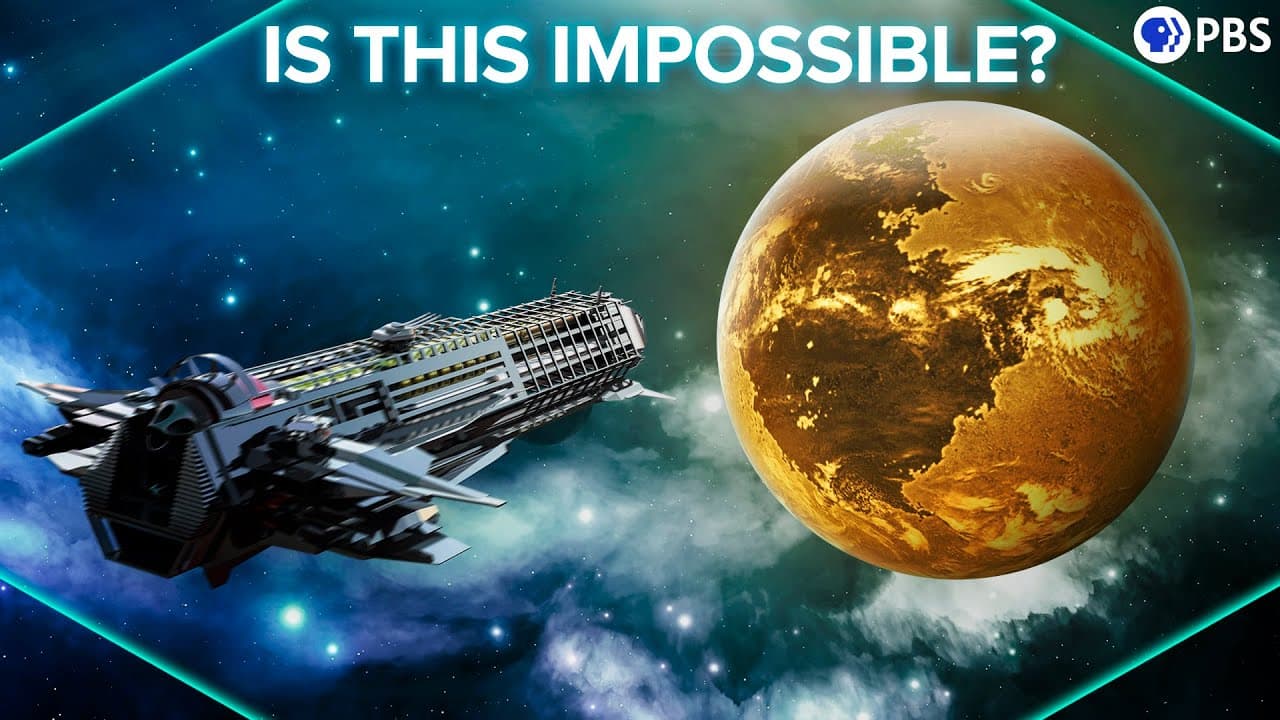
Is Interstellar Travel Impossible?
TL;DR
Interstellar travel is difficult but not impossible due to vast distances and deadly space hazards.
Transcript
Space is pretty deadly. But is it so deadly that we’re effectively imprisoned in our solar system forever? Many have claimed this is the case, but a few scientists have actually figured it out. Ever since Enrico Fermi asked his famous question “Where is everybody?” We’ve pondered the mystery of the Fermi Paradox. In a galaxy where billions of plane... Read More
Key Insights
- Interstellar travel faces two main challenges: the vast distances between stars and the deadly interstellar medium consisting of gas and dust.
- The Breakthrough Starshot program proposes using solar sails and lasers to accelerate tiny craft to 20% of light speed, highlighting the potential for future interstellar missions.
- The interstellar medium includes diffuse gas and dust grains, which at relativistic speeds, become hazardous projectiles to spacecraft.
- Moderate shielding is necessary to protect spacecraft from the interstellar medium, with options like titanium or water shields being viable solutions.
- Cosmic rays present a significant radiation hazard, requiring extensive shielding to protect crews on long interstellar journeys.
- Advanced propulsion systems, such as fusion drives or matter-antimatter engines, could potentially achieve the necessary speeds for human interstellar travel.
- The Fermi Paradox questions why we haven't encountered other civilizations, with one explanation being the extreme difficulty of interstellar travel.
- While interstellar travel poses significant challenges, it remains a possibility for the future, with no fundamental barriers preventing humanity from exploring beyond the solar system.
Install to Summarize YouTube Videos and Get Transcripts
Explore YouTube Video Summarizer or Get YouTube Transcript Extractor
Questions & Answers
Q: What are the main challenges of interstellar travel?
The main challenges of interstellar travel include the vast distances between stars, which require travel at relativistic speeds, and the hazardous interstellar medium filled with gas and dust that can damage spacecraft. Additionally, cosmic rays pose a significant radiation risk to crews on long journeys.
Q: How does the Breakthrough Starshot program propose to achieve interstellar travel?
The Breakthrough Starshot program proposes to use solar sails and a giant array of lasers to accelerate tiny spacecraft to 20% of the speed of light. These craft, little more than computer chips, would be sent to nearby stars, demonstrating the potential for future interstellar missions.
Q: What is the Fermi Paradox and how does it relate to interstellar travel?
The Fermi Paradox questions why we haven't encountered other civilizations despite the vast number of planets in the galaxy. One explanation is the extreme difficulty of interstellar travel, suggesting that civilizations may rise and fall without ever managing to populate the galaxy due to the challenges involved.
Q: What role does shielding play in interstellar travel?
Shielding is crucial for protecting spacecraft from the interstellar medium, which includes gas and dust that become hazardous projectiles at high speeds. Moderate shielding, such as titanium or water, can protect against these impacts and the radiation from cosmic rays, ensuring the safety of the crew.
Q: How do cosmic rays affect interstellar travel?
Cosmic rays are high-energy particles that pose a significant radiation hazard to interstellar travelers. They require extensive shielding to protect crews on long journeys, as they can significantly increase cancer risks. Shielding against cosmic rays is challenging because they can hit the ship from all directions.
Q: What advanced propulsion systems could enable interstellar travel?
Advanced propulsion systems that could enable interstellar travel include fusion drives, matter-antimatter engines, and large light sails. These technologies have the potential to accelerate spacecraft to a significant fraction of the speed of light, making human interstellar travel more feasible in the future.
Q: Why is interstellar travel considered difficult but not impossible?
Interstellar travel is considered difficult due to the vast distances, hazardous interstellar medium, and radiation risks. However, it is not impossible because potential solutions like advanced propulsion systems and shielding technologies exist. These challenges can be overcome with future technological advancements, allowing humanity to explore beyond the solar system.
Q: What does the video suggest about the future of interstellar travel?
The video suggests that while interstellar travel poses significant challenges, it remains a possibility for the future. There are no fundamental barriers preventing humanity from exploring beyond the solar system. With advancements in technology and propulsion systems, interstellar travel could become a reality, expanding our reach into distant tracts of interstellar space.
Summary & Key Takeaways
-
The video explores the challenges of interstellar travel, focusing on the vast distances and hazardous interstellar medium. It discusses potential solutions like solar sails and advanced propulsion systems, highlighting the Breakthrough Starshot program as a promising initiative for future missions.
-
Interstellar space is filled with gas and dust that can damage spacecraft traveling at high speeds. Moderate shielding is necessary to protect against these hazards, with options like titanium or water shields being viable solutions for manned missions.
-
Cosmic rays pose a significant radiation risk to interstellar travelers, requiring extensive shielding to ensure crew safety. Despite these challenges, interstellar travel remains a possibility, with no fundamental barriers preventing humanity from exploring beyond the solar system.
Read in Other Languages (beta)
Share This Summary 📚
Summarize YouTube Videos and Get Video Transcripts with 1-Click
Try YouTube Summary with ChatGPT & Claude or YouTube Transcript Generator
Explore More Summaries from PBS Space Time 📚
Summarize YouTube Videos and Get Video Transcripts with 1-Click
Try YouTube Summary with ChatGPT & Claude or YouTube Transcript Generator