What Is the Cosmic Microwave Background and Its Significance?
TL;DR
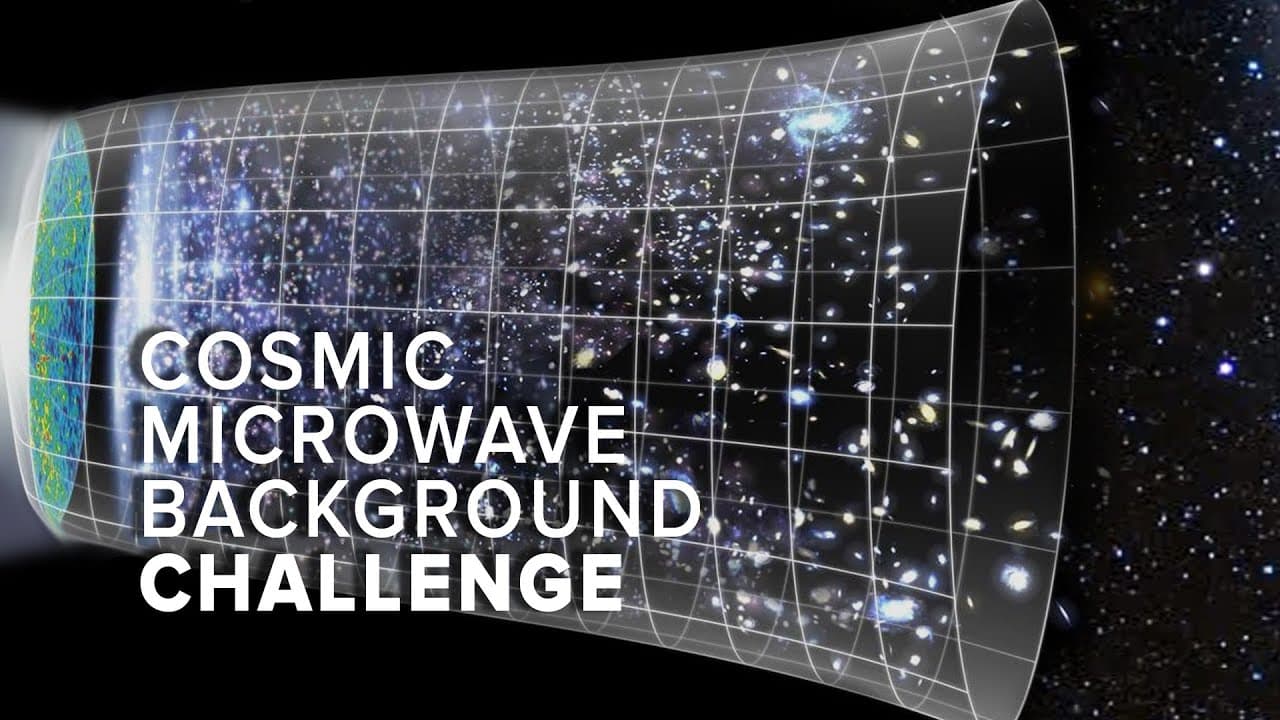
The cosmic microwave background (CMB) is crucial evidence for the Big Bang theory, showing that the universe was once much smaller, hotter, and denser. CMB photons were released when the universe was around 380,000 years old, allowing us to observe the universe as it was 13.7 billion years ago, now expanded to 93 billion light years across.
Transcript
This week, we have a challenge episode for you. We've been talking about the Big Bang theory a lot recently, and the most important piece of evidence for this theory is the cosmic microwave background radiation. It tells us that the universe was once most certainly much smaller, hotter, and denser than it is today. The photons of the cosmic backgro... Read More
Key Insights
- The cosmic microwave background (CMB) is crucial evidence for the Big Bang theory, showing the universe was once smaller, hotter, and denser.
- CMB photons were released when the universe was 380,000 years old, marking the transition from plasma to hydrogen gas.
- The observable universe has expanded from 43 million light years to 93 billion light years due to the universe's expansion.
- The CMB allows us to view the universe as it was 13.7 billion years ago, resembling a hot plasma ocean.
- A challenge is presented involving two questions about the distance CMB photons traveled, one conceptual and one mathematical.
- The universe became transparent during recombination when electrons were captured by protons, allowing photons to travel freely.
- Participants can submit answers to the CMB challenge via email for a chance to win a PBS Space Time t-shirt.
- An announcement for a seminar on gravitational waves discovery at Lehman College is included, inviting attendees to RSVP.
Install to Summarize YouTube Videos and Get Transcripts
Explore YouTube Video Summarizer or Get YouTube Transcript Extractor
Questions & Answers
Q: What is the significance of the cosmic microwave background (CMB) in the Big Bang theory?
The cosmic microwave background (CMB) is significant because it serves as one of the most compelling pieces of evidence for the Big Bang theory. It represents the thermal radiation left over from the early universe, providing a snapshot of the universe when it was just 380,000 years old. The CMB shows that the universe was once much smaller, hotter, and denser, supporting the idea of a rapid expansion from a singular point.
Q: How did the universe transition from opaque to transparent, allowing photons to travel freely?
The universe transitioned from opaque to transparent during an event known as recombination. This occurred when the universe cooled sufficiently for free electrons to be captured by protons, forming the first hydrogen atoms. Prior to this, the universe was filled with a hot plasma that scattered photons. Once hydrogen atoms formed, photons could travel freely without frequent scattering, making the universe transparent and allowing the cosmic microwave background radiation to reach us.
Q: What is the challenge presented in the episode, and how can participants engage?
The episode presents a challenge involving two questions about the cosmic microwave background (CMB). Participants can choose to answer either a conceptual question about the physical distance CMB photons traveled or a mathematical question requiring calculations related to photon travel before recombination. Participants are encouraged to submit their answers via email for a chance to win a PBS Space Time t-shirt. The challenge encourages engagement and deeper understanding of the CMB.
Q: What is the current size of the observable universe compared to its size when CMB light was emitted?
When the cosmic microwave background (CMB) light was emitted, the universe was much smaller, with blobs of plasma only 43 million light years away from what would become the Milky Way. Due to the universe's expansion, the observable universe has grown significantly and is now 93 billion light years across. This expansion illustrates the dynamic nature of the universe and the vast distances CMB photons have traveled to reach us.
Q: What upcoming event is announced in the episode, and how can viewers participate?
The episode announces an upcoming seminar on the discovery of gravitational waves, taking place at Lehman College in New York City. The seminar is scheduled for March 14th, and viewers interested in attending are invited to RSVP via email for more details. This event provides an opportunity for attendees to learn more about gravitational waves and engage with experts in the field, offering a deeper understanding than available on typical YouTube shows.
Q: Why is the cosmic microwave background (CMB) described as an 'ocean of orangey, red-hot plasma'?
The cosmic microwave background (CMB) is described as an 'ocean of orangey, red-hot plasma' because it represents the state of the universe approximately 380,000 years after the Big Bang. At that time, the universe was filled with a hot plasma composed primarily of protons, electrons, and helium nuclei. The CMB is the remnant radiation from this era, capturing the thermal energy and density fluctuations that would eventually lead to the formation of galaxies and other cosmic structures.
Q: How does the episode encourage viewer interaction and community engagement?
The episode encourages viewer interaction and community engagement by inviting participants to take part in the CMB challenge and submit their answers via email. Additionally, it promotes engagement through social media platforms like Twitter and Facebook, as well as Reddit and Patreon. By offering a chance to win a PBS Space Time t-shirt and providing opportunities for discussion and support, the episode fosters a sense of community among viewers interested in science and cosmology.
Q: What are the rules and guidelines for participating in the CMB challenge?
To participate in the CMB challenge, viewers must choose one of the two questions to answer—either the conceptual or the mathematical one. Answers should be emailed to the specified address with the subject line 'CMB Challenge.' Participants are advised not to discuss the problem or share answers online, as this will lead to disqualification. The challenge is time-sensitive, with submissions due within two weeks, and five random winners will receive a PBS Space Time t-shirt, encouraging timely and individual participation.
Summary & Key Takeaways
-
The episode introduces a challenge focused on the cosmic microwave background (CMB) as evidence of the Big Bang theory. It explains how CMB photons were released when the universe cooled enough to transition from plasma to hydrogen gas, allowing photons to travel through space.
-
Participants are invited to answer one of two questions about the distance CMB photons traveled, with the option to answer a conceptual or mathematical question. Submissions are accepted via email for a chance to win a PBS Space Time t-shirt.
-
An upcoming seminar on gravitational waves discovery at Lehman College is announced, inviting attendees to RSVP for more details. The episode encourages viewers to engage with PBS Space Time through social media and support platforms.
Read in Other Languages (beta)
Share This Summary 📚
Summarize YouTube Videos and Get Video Transcripts with 1-Click
Try YouTube Summary with ChatGPT & Claude or YouTube Transcript Generator
Explore More Summaries from PBS Space Time 📚
Summarize YouTube Videos and Get Video Transcripts with 1-Click
Try YouTube Summary with ChatGPT & Claude or YouTube Transcript Generator