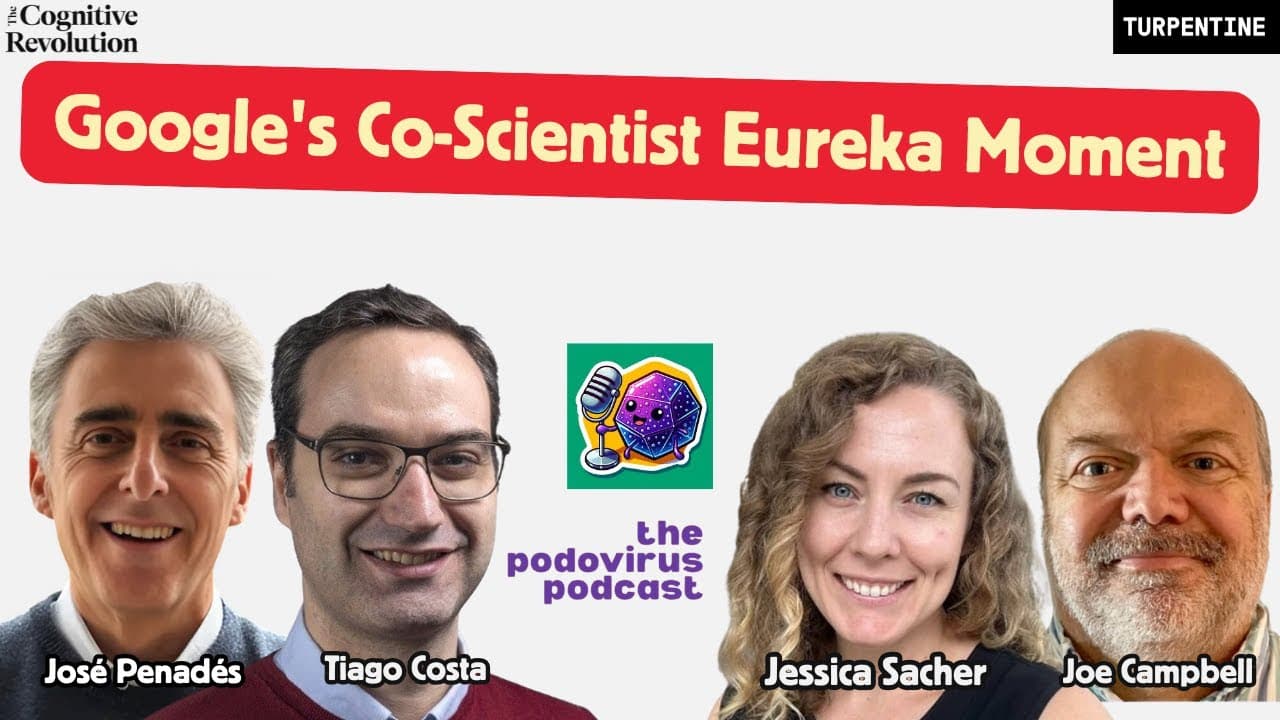
What did Google's AI Co-Scientist "Discover"? The Human Scientists' POV, from the Podovirus podcast
TL;DR
Google's AI Co-Scientist aids in discovering bacterial defense mechanisms.
Transcript
Hello and welcome back to the cognitive revolution. Today we're following up on our recent episode on Google's AI co-scientist with a special crossover episode from the pot of virus podcast in which hosts Dr. Jessica Satcher and Dr. Joe Campbell speak with Jose Panades and Thiago Costa, the scientists at Imperial College London, who recently made a... Read More
Key Insights
- Google's AI Co-Scientist helped uncover how capsid-forming PICIs spread across bacteria by connecting with various virus tails.
- PICIs are DNA sequences that hijack virus reproduction to spread themselves as a bacterial defense mechanism.
- The AI Co-Scientist provided a hypothesis that eluded human researchers for years, showcasing AI's potential in scientific discovery.
- AI can offer unbiased perspectives and key insights, accelerating scientific research and discovery processes.
- The episode highlights the potential of AI in frontier scientific research, moving beyond mere data analysis to hypothesis generation.
- Google's AI Co-Scientist analyzed literature to propose mechanisms of gene transfer, a task previously challenging for human scientists.
- The AI system's ability to connect dots without bias demonstrates its value in uncovering new scientific insights.
- The collaboration between human scientists and AI tools can lead to significant advancements in understanding complex biological systems.
Install to Summarize YouTube Videos and Get Transcripts
Explore YouTube Video Summarizer or Get YouTube Transcript Extractor
Questions & Answers
Q: What role did Google's AI Co-Scientist play in the research?
Google's AI Co-Scientist was instrumental in generating a hypothesis that explained how capsid-forming PICIs spread across different bacteria. By analyzing existing literature, the AI identified that these capsids evolved to connect with various virus tails in the environment, a discovery that had eluded human scientists for years.
Q: What are PICIs and their significance?
PICIs, or phage-inducible chromosomal islands, are DNA sequences that hijack virus reproduction to spread themselves as a form of bacterial defense. They play a crucial role in protecting bacteria from viral infections by replacing the virus's DNA with copies of themselves, thus preventing the virus from spreading further.
Q: How does the AI Co-Scientist differ from traditional research methods?
The AI Co-Scientist differs from traditional research methods by providing unbiased perspectives and generating hypotheses based on literature analysis. It can connect dots that human researchers might overlook due to biases or preconceived notions, thus accelerating the discovery process and offering new insights into complex scientific questions.
Q: What potential does AI hold for future scientific research?
AI holds significant potential for future scientific research by contributing to hypothesis generation, data analysis, and offering unbiased insights. As AI systems become more advanced, they can assist in directing experiments, collecting data, and even proposing new research directions, ultimately transforming the way scientific discovery is conducted.
Q: How did the collaboration between human scientists and AI tools impact the research?
The collaboration between human scientists and AI tools was pivotal in achieving the research breakthrough. While human scientists provided the experimental data and context, the AI Co-Scientist offered a fresh, unbiased perspective that led to the discovery of how capsid-forming PICIs spread. This synergy highlights the complementary strengths of humans and AI in scientific research.
Q: What challenges did human researchers face before the AI's involvement?
Before the AI's involvement, human researchers struggled to understand how capsid-forming PICIs spread across different bacteria. Despite years of research, the solution remained elusive due to biases and preconceived notions about virus behavior. The AI Co-Scientist's ability to analyze literature without such biases was crucial in overcoming these challenges.
Q: What insights did the AI Co-Scientist provide regarding gene transfer mechanisms?
The AI Co-Scientist provided insights into gene transfer mechanisms by suggesting that capsid-forming PICIs could connect with various virus tails in the environment. This hypothesis explained their widespread presence across different bacteria and highlighted a novel mechanism of gene transfer that was previously unconsidered by human researchers.
Q: How does this research exemplify the concept of science fiction becoming reality?
This research exemplifies science fiction becoming reality by demonstrating AI's capability to contribute to frontier scientific research, a concept often depicted in science fiction. The AI Co-Scientist's role in generating key insights and hypotheses showcases how advanced AI systems can transform scientific discovery, turning futuristic ideas into tangible outcomes in our lifetimes.
Summary & Key Takeaways
-
Google's AI Co-Scientist played a crucial role in discovering how capsid-forming PICIs spread across various bacteria by connecting with different virus tails. This breakthrough was achieved through the AI's analysis of existing literature, highlighting its potential in scientific research.
-
PICIs are unique DNA sequences that hijack virus reproduction to spread themselves as a bacterial defense mechanism. The AI Co-Scientist's ability to generate hypotheses that eluded human researchers for years demonstrates its value in accelerating scientific discovery.
-
The episode illustrates the collaboration between human scientists and AI tools, showcasing how AI can provide unbiased perspectives and key insights, ultimately leading to significant advancements in understanding complex biological systems.
Read in Other Languages (beta)
Share This Summary 📚
Summarize YouTube Videos and Get Video Transcripts with 1-Click
Try YouTube Summary with ChatGPT & Claude or YouTube Transcript Generator
Explore More Summaries from Cognitive Revolution "How AI Changes Everything" 📚

Summarize YouTube Videos and Get Video Transcripts with 1-Click
Try YouTube Summary with ChatGPT & Claude or YouTube Transcript Generator