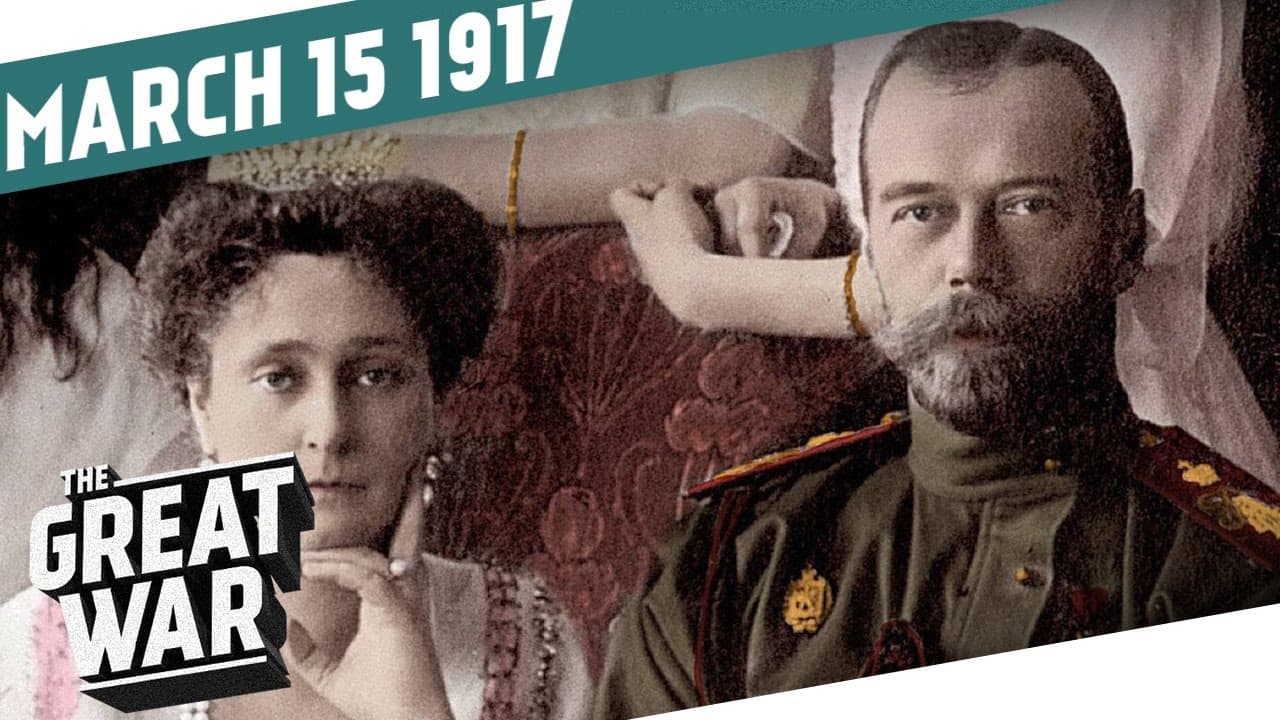
The Tsar Abdicates - Baghdad Falls I THE GREAT WAR Week 138
TL;DR
The Russian Tsar abdicates amidst revolution; British capture Baghdad.
Transcript
There’s only one word I can say to describe the main event of this week: Revolution!!! I’m Indy Neidell; welcome to the Great War. Last week the British and Indian forces pushed up the Tigris toward Baghdad, the Ottomans pulling back both there and in Persia, where they were being chased by the Russians. Russia had big problems at home, with food r... Read More
Key Insights
- The Russian Revolution began with widespread strikes and demonstrations against Tsar Nicholas II, eventually leading to his abdication.
- The revolution was not a singular, organized event but rather the result of simultaneous uprisings against a corrupt regime.
- The Petrograd Soviet emerged as a rival authority to the Duma, leading to a dual power situation in Russia.
- Tsar Nicholas II's abdication marked the end of the 300-year-old Romanov dynasty, as his brother refused the throne.
- The British capture of Baghdad was a significant morale boost after previous setbacks, marking a strategic victory in the Middle East.
- The fall of Baghdad signified the collapse of German ambitions in the Near East and shifted control to the British.
- In the Balkans, the Austro-Hungarian and Bulgarian forces launched counterattacks against the Toplica Rebellion, regaining control.
- The week saw significant geopolitical shifts, with China breaking relations with Germany and internal strife in Russia raising questions about its war efforts.
Install to Summarize YouTube Videos and Get Transcripts
Explore YouTube Video Summarizer or Get YouTube Transcript Extractor
Questions & Answers
Q: What triggered the Russian Revolution?
The Russian Revolution was triggered by widespread dissatisfaction with Tsar Nicholas II's rule, exacerbated by food shortages, strikes, and demonstrations in Petrograd. The situation reached a tipping point when military forces began siding with the revolutionaries, leading to the Tsar's abdication.
Q: How did the fall of Baghdad impact the Middle East?
The fall of Baghdad to British and Indian forces marked a significant strategic victory, effectively ending German ambitions in the Near East. It shifted control of a large area to the British, boosting morale after previous setbacks and forcing the Ottomans to refocus their military efforts.
Q: What was the significance of Tsar Nicholas II's abdication?
Tsar Nicholas II's abdication marked the end of the Romanov dynasty's 300-year rule. It signified a major political shift in Russia, leading to the establishment of a provisional government and a rival Petrograd Soviet, creating a dual power situation and raising questions about Russia's future in the war.
Q: What was the outcome of the Toplica Rebellion?
The Toplica Rebellion in the Balkans saw Serbian forces initially gaining ground, but the Austro-Hungarian and Bulgarian counterattacks quickly regained control. The Central Powers' forces, numbering around 30,000, managed to suppress the rebellion, regaining key towns and halting the rebels' advance.
Q: How did the Petrograd Soviet challenge the Duma?
The Petrograd Soviet emerged as a rival authority to the Duma, representing workers, soldiers, and peasants. It issued Order Number One, allowing political representation and expanding individual freedoms, challenging the Duma's leadership and creating a dual power situation in Russia.
Q: What role did Gertrude Bell play in the Middle East?
Gertrude Bell, a British Middle East expert, played a significant role in shaping British policy in the region. Her insights and expertise were instrumental in understanding the cultural and political landscape, and she was pivotal in the British efforts to establish control after the capture of Baghdad.
Q: What were the implications of China's break with Germany?
China's break with Germany was a significant geopolitical shift, influenced by Germany's aggressive actions, including the sinking of a ship carrying Chinese laborers. This move aligned China more closely with the Allies and marked a decisive stance against German aggression during World War I.
Q: How did the capture of Baghdad affect British military strategy?
The capture of Baghdad was a strategic victory for the British, but it also highlighted the challenges of overextending military resources. The campaign in Mesopotamia, while initially successful, became a lesson in mission creep, as securing the oil fields posed long-term strategic and logistical challenges.
Summary & Key Takeaways
-
The Russian Revolution erupted as strikes and protests in Petrograd led to Tsar Nicholas II's abdication. The Romanov dynasty ended after 300 years when his brother refused the throne, leading to a provisional government and a rival Petrograd Soviet vying for control.
-
In the Middle East, British and Indian forces successfully captured Baghdad, marking a strategic victory and ending German ambitions in the region. This victory, however, raised questions about the long-term strategic gains and led to internal disputes over governance.
-
The Austro-Hungarian and Bulgarian forces counterattacked the Toplica Rebellion in the Balkans, regaining control over key areas. Meanwhile, geopolitical shifts continued as China broke relations with Germany, and Russian internal strife raised uncertainties about its war efforts.
Read in Other Languages (beta)
Share This Summary 📚
Summarize YouTube Videos and Get Video Transcripts with 1-Click
Try YouTube Summary with ChatGPT & Claude or YouTube Transcript Generator
Explore More Summaries from The Great War 📚


Summarize YouTube Videos and Get Video Transcripts with 1-Click
Try YouTube Summary with ChatGPT & Claude or YouTube Transcript Generator