From the Empirical Formula to the Molecular Formula
TL;DR
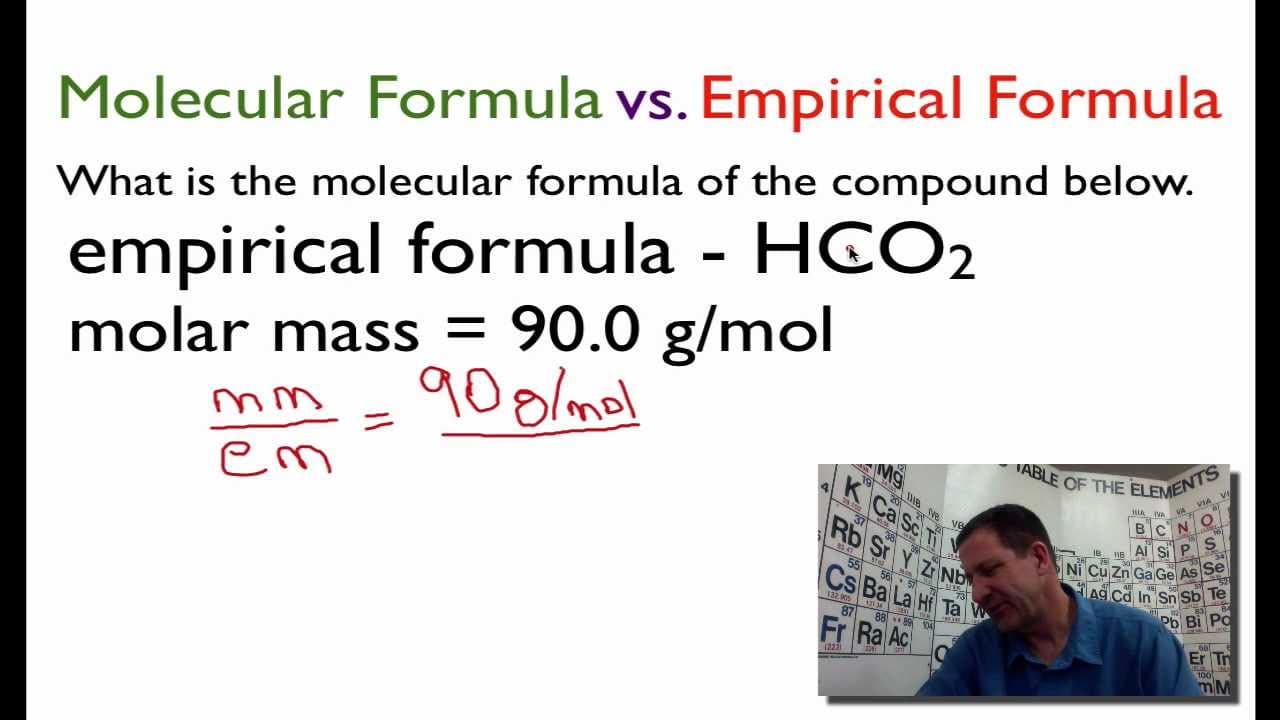
Learn how to convert empirical formulas to molecular formulas using molar mass comparisons.
Transcript
okay in today's video I'm going to show you how to go from the empirical formula to the molecular formula for a compound and just to review the quick the empirical formula shows you the lowest hold on a ratio of elements in a compound and the molecular formula shows you the actual homo ratio of elements in a compound I just think of the empirical f... Read More
Key Insights
- 🥳 Empirical formulas show the simplest ratio of elements in a compound.
- 🥳 Molecular formulas reveal the actual ratio of elements in a compound.
- 💆 Molar mass comparisons are necessary to convert empirical formulas to molecular formulas.
- 🥳 Multiplying the empirical formula by the ratio from molar mass comparisons gives the molecular formula.
- ❓ The process involves basic arithmetic calculations and understanding of chemical formulas.
- ❓ Example compounds like oxalic acid and ribose illustrate the conversion process effectively.
- 💼 In some cases, the molecular formula can be the same as the empirical formula.
Install to Summarize YouTube Videos and Get Transcripts
Explore YouTube Video Summarizer or Get YouTube Transcript Extractor
Questions & Answers
Q: How is the difference between empirical and molecular formulas explained?
The empirical formula represents the simplest ratio of elements, while the molecular formula shows the actual ratio and is derived from the empirical formula through molar mass comparisons.
Q: What role does molar mass play in converting formulas?
Molar mass comparisons are crucial as they help establish the ratio between empirical and molecular formulas by dividing the molar mass of the molecular formula by the empirical mass.
Q: How does the molar mass comparison lead to determining the molecular formula?
By dividing the molar mass of the molecular formula by the empirical mass, you can find the ratio, which indicates how many times the empirical formula needs to be multiplied to get the molecular formula.
Q: Can the molecular formula be the same as the empirical formula?
Yes, if the molar mass comparison yields a ratio of 1, it means that the empirical and molecular formulas are the same, as seen in the example of chloramine.
Summary & Key Takeaways
-
The video explains the process of converting empirical formulas to molecular formulas.
-
It involves comparing molar masses of both formulas to determine the ratio.
-
By multiplying the empirical formula based on the ratio, the molecular formula can be obtained.
Read in Other Languages (beta)
Share This Summary 📚
Summarize YouTube Videos and Get Video Transcripts with 1-Click
Try YouTube Summary with ChatGPT & Claude or YouTube Transcript Generator
Explore More Summaries from Step by Step Science 📚
Summarize YouTube Videos and Get Video Transcripts with 1-Click
Try YouTube Summary with ChatGPT & Claude or YouTube Transcript Generator