The hidden meaning of the verb Saber (to know) // Learn European Portuguese
TL;DR
Explores the multiple meanings of the verb 'saber' in Portuguese.
Transcript
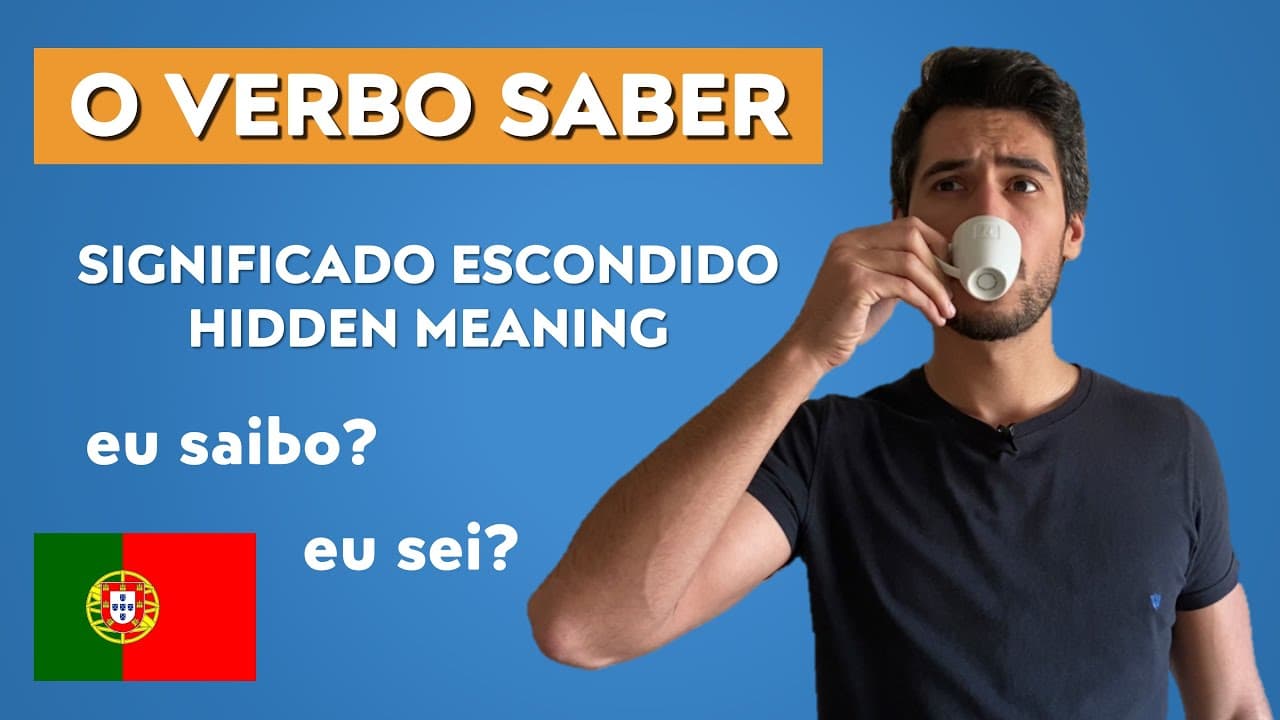
You know what? This coffee "está-me a saber pela vida"! Hello everyone and welcome back to Portuguese With Leo! For today's Portuguese lesson, I'm going to talk about a verb that, at first glance, seems quite obvious and direct, but that, like everything in Portuguese, has a little more to it: The verb "saber"! Before starting the video I'm goi... Read More
Key Insights
- The verb 'saber' is the eleventh most used verb in Portuguese, highlighting its importance in the language.
- 'Saber' primarily means to have knowledge of a fact, similar to the English verb 'to know'.
- The expression 'saber de cor' means to know something by heart, emphasizing memorization.
- When referring to knowing people, the verb 'conhecer' is used instead of 'saber'.
- 'Saber' can also mean to have the ability to do something, equivalent to 'know how to' in English.
- A unique use of 'saber' is to describe the taste of something, such as 'sabe bem' for good taste.
- 'Saber' also describes sensations or feelings, both physical and psychological, akin to 'how something feels'.
- Expressions like 'saber pela vida' indicate something feels exceptionally good, such as enjoying a coffee.
Install to Summarize YouTube Videos and Get Transcripts
Explore YouTube Video Summarizer or Get YouTube Transcript Extractor
Questions & Answers
Q: What is the primary meaning of the verb 'saber'?
The primary meaning of the verb 'saber' in Portuguese is to have knowledge of a fact or information. It is similar to the English verb 'to know'. This usage is common and often involves facts, data, or information that someone is aware of or has memorized.
Q: How is the expression 'saber de cor' used in Portuguese?
The expression 'saber de cor' in Portuguese means to know something by heart. It emphasizes the memorization of information, such as knowing one's phone number or multiplication tables without needing to refer to external sources. It is equivalent to the English expression 'to know by heart'.
Q: What distinguishes 'saber' from 'conhecer' in Portuguese?
In Portuguese, 'saber' is used for knowing facts or information, while 'conhecer' is used for knowing people. This distinction is important as it differentiates between the knowledge of factual information and the familiarity or acquaintance with individuals or places.
Q: How does 'saber' describe tastes in Portuguese?
In Portuguese, 'saber' is used to describe the taste of something, such as whether it tastes good or bad. For example, 'sabe bem' means it tastes good, and 'sabe mal' means it tastes bad. This use of 'saber' is unique and involves a slight conjugation change in the first person singular.
Q: What does the expression 'saber pela vida' convey?
The expression 'saber pela vida' conveys a sensation of something feeling exceptionally good or satisfying. It is used to describe experiences or tastes that are particularly enjoyable, such as having a delicious coffee or a refreshing day at the beach. It highlights the positive emotional impact of the experience.
Q: What is the significance of the verb 'saber' in Portuguese?
The verb 'saber' is significant in Portuguese as it is one of the most commonly used verbs, ranking eleventh in usage. Its versatility in conveying knowledge, abilities, tastes, and sensations makes it an essential component of the language, reflecting the complexity and richness of Portuguese expressions.
Q: How is 'saber' used to indicate ability in Portuguese?
In Portuguese, 'saber' is used to indicate the ability to do something, similar to 'know how to' in English. For example, saying 'Chef Sá Pessoa sabe cozinhar' means 'Chef Sá Pessoa knows how to cook'. This usage highlights competence or skill in performing specific tasks or actions.
Q: What conjugation change occurs with 'saber' when describing taste?
When 'saber' is used to describe taste, a conjugation change occurs in the first person singular. Instead of 'eu sei', it becomes 'eu saibo'. This change is specific to this context and does not affect other conjugations. It highlights the unique application of 'saber' in describing flavors and tastes.
Summary & Key Takeaways
-
The video lesson by Portuguese With Leo discusses the verb 'saber', a crucial verb in Portuguese, ranking as the eleventh most used. It covers its conjugation and various meanings, including knowing facts, abilities, tastes, and sensations, with examples for each usage.
-
The verb 'saber' has four main meanings: knowledge of facts, ability to do something, describing tastes, and conveying sensations. The lesson provides practical examples and expressions like 'saber de cor' and 'saber pela vida' to illustrate these meanings.
-
The lesson emphasizes the distinction between 'saber' and 'conhecer', the latter being used for knowing people. It also notes the unique conjugation change in the first person singular when 'saber' describes taste, highlighting the verb's versatility in Portuguese.
Read in Other Languages (beta)
Share This Summary 📚
Summarize YouTube Videos and Get Video Transcripts with 1-Click
Try YouTube Summary with ChatGPT & Claude or YouTube Transcript Generator
Explore More Summaries from Portuguese With Leo 📚






Summarize YouTube Videos and Get Video Transcripts with 1-Click
Try YouTube Summary with ChatGPT & Claude or YouTube Transcript Generator