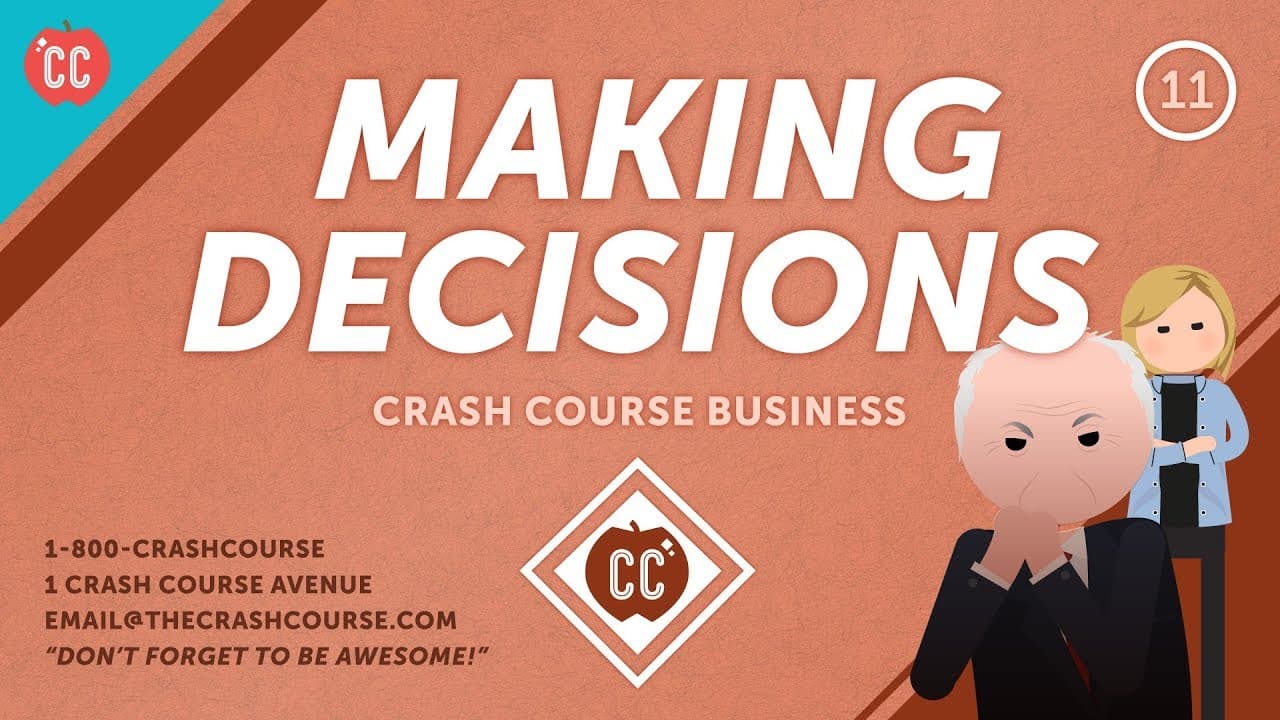
How to Make Tough Decisions: Crash Course Business - Soft Skills #11
TL;DR
Making informed decisions involves considering opportunity costs, avoiding psychological biases, and learning from past choices.
Transcript
Remember what it was like to be 8 and agonize over picking ice cream? Do I get the tweety bird with gumball eyes or the ninja turtle with gumball eyes?! It was probably the most important decision of your day. But now, we’re adults. We make small choices like what to eat for lunch, but we also have to set goals, pick a career, and decide how to inv... Read More
Key Insights
- 🏋️ Decision-making involves considering opportunity costs and weighing the benefits and drawbacks of each option.
- ⚓ Psychological biases like anchoring and the sunk cost fallacy can impact decision-making and skew perspectives.
- 💄 Seeking advice, considering different perspectives, and learning from failures are crucial elements of making informed decisions.
- ❓ It's essential to avoid motivated blindness and unethical behavior in decision-making to ensure ethical considerations are prioritized.
- 🥺 The sunk cost fallacy can lead to escalating commitment to a failing choice, emphasizing the need to reassess and pivot when necessary.
- 🍝 Learning from past choices involves understanding the outcomes, analyzing why they occurred, and applying those insights to future decisions.
- 🖐️ Trial and error play a significant role in decision-making, highlighting the importance of continuous learning and adaptation.
Install to Summarize YouTube Videos and Get Transcripts
Explore YouTube Video Summarizer or Get YouTube Transcript Extractor
Questions & Answers
Q: How does opportunity cost affect decision-making?
Opportunity costs make us consider what we're giving up when choosing one option over another. It involves weighing the benefits of one choice against the sacrifices of another, helping prioritize decisions.
Q: Why is seeking advice important in decision-making?
Seeking advice provides fresh perspectives, helps avoid confirmation bias, and can offer insights that we may not have considered. It's essential in making well-rounded decisions and gaining clarity.
Q: How do psychological biases like anchoring impact decision-making?
Anchoring can lead us to make decisions based on initial information rather than objective factors, influencing our judgment. Being aware of biases like anchoring helps in making more rational and informed choices.
Q: Why is it important to learn from past choices in decision-making?
Learning from past decisions helps us understand what worked and what didn't, enabling us to make better choices in the future. It allows for growth, improvement, and avoiding repeating mistakes.
Summary & Key Takeaways
-
Decision-making involves weighing options, considering opportunity costs, and avoiding psychological biases.
-
Anchoring and the sunk cost fallacy can influence decision-making, skewing perspectives.
-
Seeking advice, considering different perspectives, and learning from failures are crucial in making informed decisions.
Read in Other Languages (beta)
Share This Summary 📚
Summarize YouTube Videos and Get Video Transcripts with 1-Click
Try YouTube Summary with ChatGPT & Claude or YouTube Transcript Generator
Explore More Summaries from CrashCourse 📚


Summarize YouTube Videos and Get Video Transcripts with 1-Click
Try YouTube Summary with ChatGPT & Claude or YouTube Transcript Generator